



Reality’s Last Stand is a reader-supported publication. Please consider becoming a paying subscriber or making a one-time or recurring donation to show your support.

About the Authors
Benjamin Ryan is an independent journalist, specializing in science and health care coverage. He is a contributor for The New York Times, The Guardian, NBC News, The Free Press, and The New York Sun. He has also written for the Washington Post, The Atlantic and The Nation, among many others. Follow him on X: @benryanwriter. Visit his website: benryan.net. Subscribe to his Substack: Hazard Ratio
Dr. Colin Wright is an evolutionary biologist, a Manhattan Institute fellow, and the CEO and editor-in-chief of Reality’s Last Stand. His work focuses on the science and public policy of sex and gender. His writing has appeared in The Wall Street Journal, the New York Post, Newsweek, City Journal, The Washington Examiner, and other leading news outlets and scientific journals.
This article was originally published on Benjamin Ryan’s Substack: Hazard Ratio
During the 24 days between news breaking of Jason Arday’s alleged academic misconduct and serial lying and his death on Aug. 14, a blast radius extended across Cambridge University. In an apparent effort to respond to the mounting public outcry over Dr. Arday’s alleged plagiarism and academic fraud while containing the damage to the august institution’s reputation, Cambridge on Aug. 5 announced an investigation into Dr. Arday’s appointment.
In a statement on the expanding crisis for the university then issued Aug. 12, Cambridge Vice-Chancellor Deborah Prentice said she shared the “concerns” about Dr. Arday’s appointment. But she insisted that his case was an “aberration.”
Or was it—at least where the quality of his scholarship was concerned?
The PhD thesis of a student in Cambridge’s Faculty of Education—in which Dr. Arday held a professorial chair, in the sociology of education, until he resigned hours after the investigation announcement—has been put under what British and Canadian academics have told us is a remarkably long embargo, shielding it from public view until 2031.
Crucially, among the panelists who reviewed the thesis was Dr. Arday himself.
The thesis, which we have obtained and which we review below, raises important questions about whether the Faculty of Education, including Dr. Arday’s own contributions, let down the basic standards of higher education.
The lengthy embargo raises further questions about what Cambridge, which is among the most elite universities in the world, and the paper’s author might have to hide where her scholarship is concerned.
Written by Damilola Folayan, the thesis is entitled Of, but not in: A poetic exploration of how Black women students respond to the coloniality of Oxbridge—referring to the portmanteau of Oxford and Cambridge. It garnered her a coveted Cambridge PhD in 2025. Following what’s known as an autoethnographic style, it is in essence an epic poetry-slam interpretation of the plight of Dr. Folayan and three other black women at Oxbridge and their experiences navigating, with considerable ambivalence, these historically, and still overwhelmingly, white elite institutions.


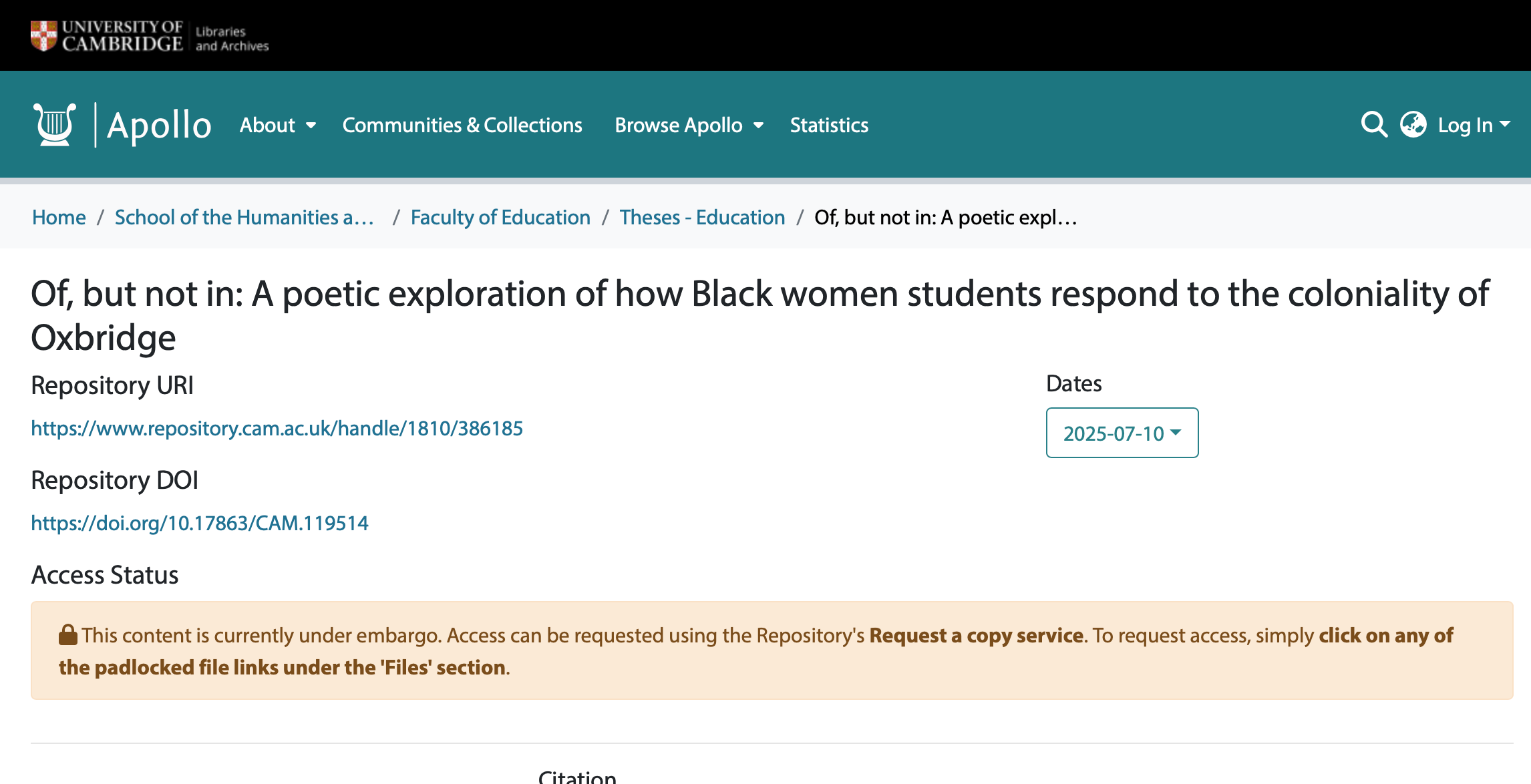
The sprawling thesis unabashedly thumbs its nose at the rigors and demands of academia even as it demands in return an elite PhD and all the rights and privileges pertaining thereto.
The landing page for Dr. Folayan’s thesis was taken down on Aug. 14, just before news of Dr. Arday’s death broke. This followed our first submission via email of questions, earlier that day, to Cambridge and Dr. Folayan about her thesis. The landing page was put back online at some point in the subsequent weeks.
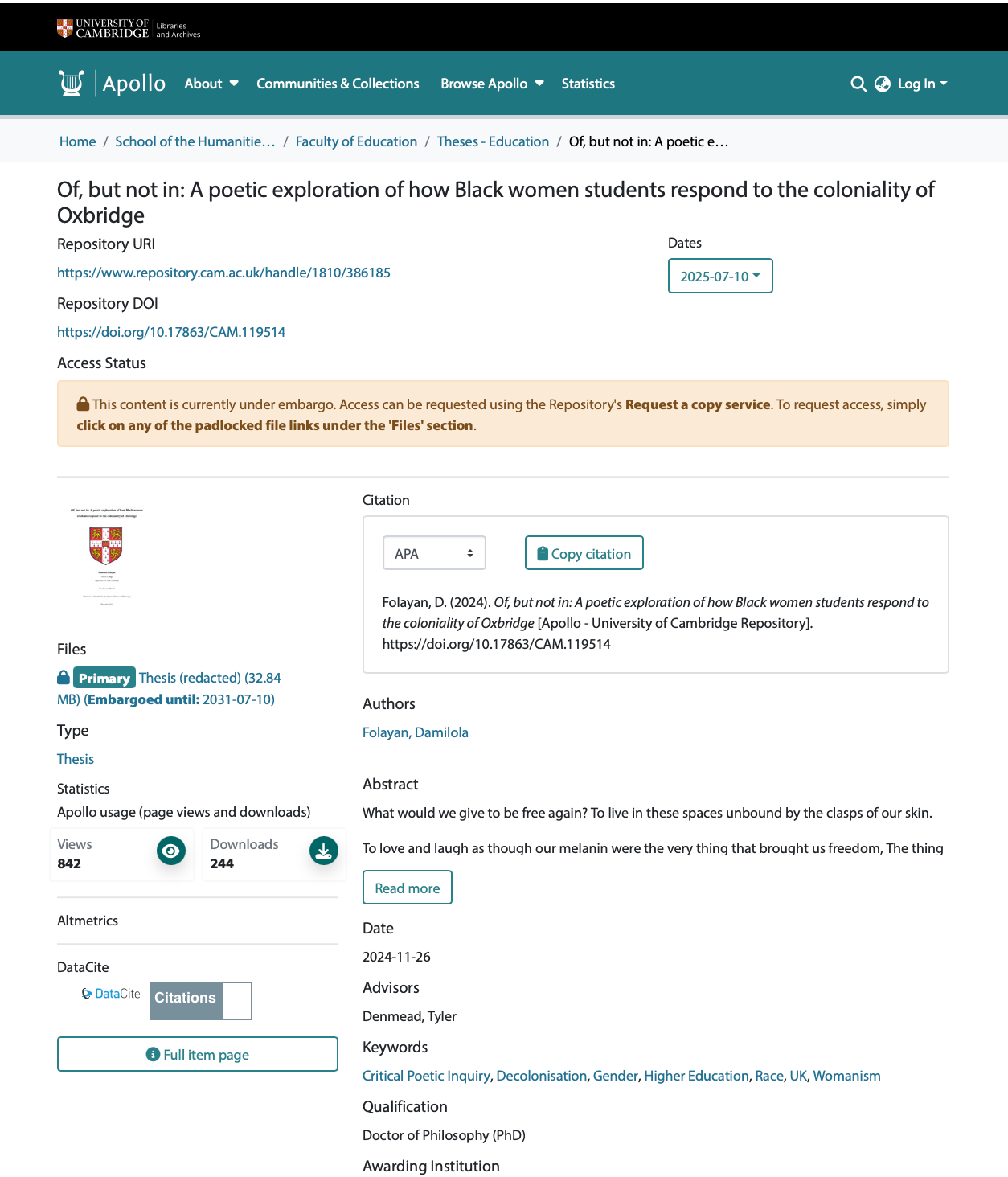
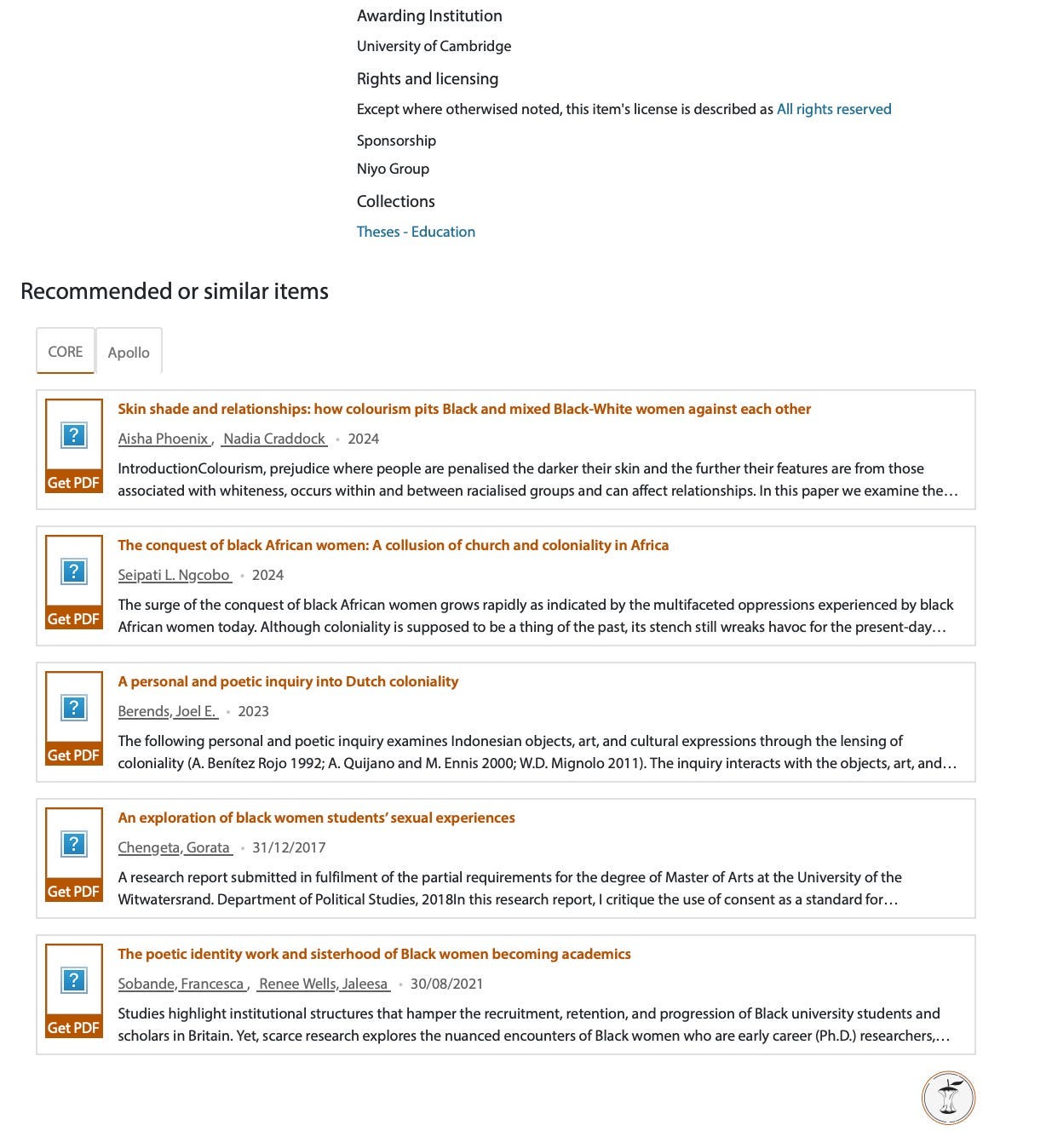
Dr. Folayan, who did not return requests for comment, submitted her thesis on Nov. 26, 2024, and it was published July 10, 2025. A source who monitored the thesis over this period informed us that the university placed the thesis under an initial one-year embargo. The particular type of embargo the thesis received, called embargoed access, permits the author to release copies upon request at their own discretion.

Various academics familiar with the British system told us it is not uncommon for a university to keep a PhD thesis initially under wraps like this, while, for example, its author seeks to publish it in book form.
But what happened next was more exceptional—and even an apparent violation of university policy—sources tell us.
At some point after July 27—the date when our source was able to freely download Dr. Folayan’s thesis, given it was not under embargo at that time—and before Aug. 9, the university placed a new, five-year embargo on the thesis. This shielded the document until July 10, 2031.
Various academics informed us that in rare cases, PhD theses may be put under lengthy embargos if they contain, for example, information that could violate an individual’s safety. But Dr. Folayan did not receive the type of stricter embargo that would be placed in those circumstances.
The embargo on Dr. Folayan’s thesis appears to violate Cambridge’s own rules for limits on such embargoes, which state: “The maximum embargo permitted is 6 years from the date of first deposit”—not from the date that the thesis was published, as is now the case for Dr. Folayan’s thesis. Given her deposit date, the university rules would appear to place the outer limit at Nov. 26, 2030, which is 226 days before the current expiration date on the embargo.

The records suggest that Dr. Folayan herself requested the embargo extension, given her thesis sits under “embargoed access.” Under this protocol, the thesis author completes an embargo extension form, which a university supervisor then signs (or if the supervisor disagrees, the degree committee weighs in). Or it could be that the university administration broke protocol and applied the embargo itself through this route.
Regardless, the length of the embargo raised eyebrows among our sources in British academia.
“I have never heard of a PhD being embargoed in the social sciences,” Alice Sullivan, a professor of sociology at University College London, told us in an email exchange that took place before Dr. Arday’s death. “Most students are keen to share their work.” She said that if a PhD thesis is shielded for many years, “it is unclear how it could count as a contribution to knowledge.”
A Cambridge spokesperson on Aug. 14 stated, on the contrary: “It is common practice for PhD students to request an embargo on their theses. There are a number of reasons why such a request might be made and in each case a standard protocol is followed.” The spokesperson did not respond to follow-up questions about whether Dr. Folayan’s especially lengthy embargo violated university policy.
The Arday plagiarism scandal broke in the Substack of Nathan Cofnas, an American academic who is a postdoctoral researcher at Ghent University in Belgium, on July 21—11 days after Dr. Folayan’s embargo lifted. Dr. Cofnas told one of us that he first alerted Cambridge to his investigation on July 16. Retraction Watch followed Dr. Cofnas’ article on July 27 with even more explosive reporting about Dr. Arday’s alleged academic misconduct and his apparently aggressive—and temporarily successful—efforts to leverage the legal system to intimidate those who questioned his scholarship and honesty and keep the damning story under wraps.
This means that the new, especially long embargo was placed on a PhD thesis—a piece of scholarship for which Dr. Arday sat on the review panel—after Dr. Arday’s alleged academic misconduct became a major public scandal.
The intense public focus on such offenses and the purported poor quality of Dr. Arday’s academic publications threatened to tarnish Cambridge’s historically sterling reputation. In particular, the Faculty of Education, in which Dr. Arday became the university’s youngest black professor in 2023, found itself under withering scrutiny.
Dr. Sullivan, who, according to her bio, studies “social and educational inequalities in the life course”—similar to the domains of Drs. Arday and Folayan—said that there were academics “doing good work” in Cambridge’s Faculty of Education at large. “I feel for them, because they will now be tainted by association with the Arday scandal,” she said—albeit before Dr. Arday’s death instantly changed the tenor of the public debate over his life and work.
But Dr. Sullivan offered a scathing and unsparing appraisal of Cambridge’s Faculty of Education, saying that “the department as a whole is surprisingly weak, particularly given the advantages of the prestige and perks of Cambridge, which should make it possible for them to hire the very best.”
Hilary Cremin, who heads the Faculty of Education and who in a 2023 BBC interview said that Dr. Arday was “the best in the world” in the research he did, was under particularly scorching scrutiny in the weeks before Dr. Arday’s death. Critics accused Dr. Cremin of pandering to Dr. Arday and overlooking what they asserted was his weak publication record in favor of leveraging his race to paper over Cambridge’s notable lack of diversity where black scholars are concerned.
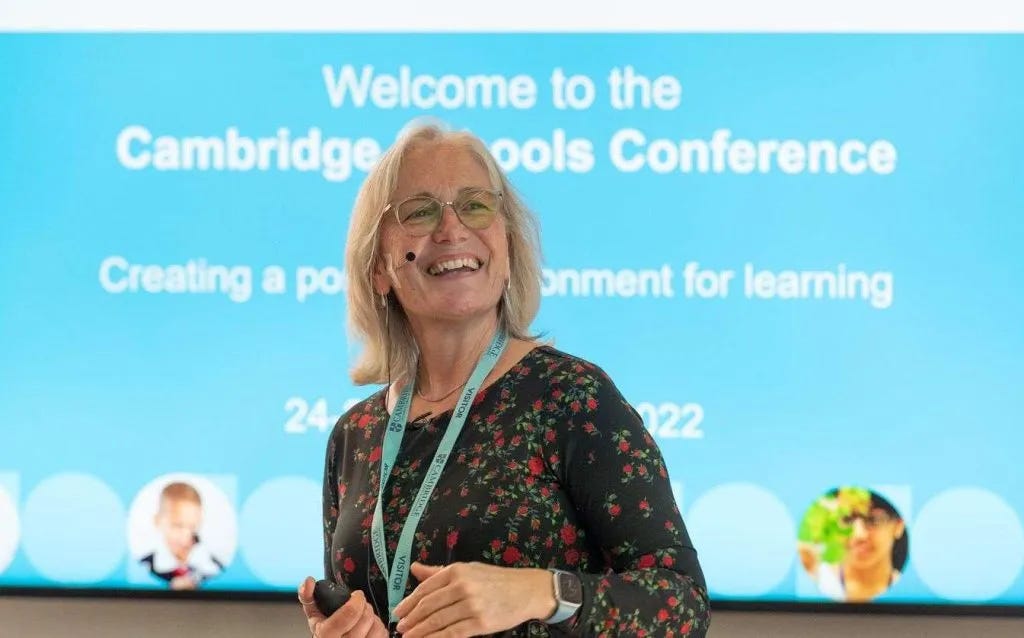
Dr. Sullivan said that Dr. Cremin “is not someone of the calibre you would expect to head a department at Cambridge.” She suggested that Dr. Cremin was a linchpin in appointing someone with an academic background as thin as Dr. Arday’s, saying, “One of the most important roles of a head of department is to sit on all senior appointment panels and ensure that weak hires are avoided. This is one reason that having an intellectually credible head is essential to a strong department.”
“I am concerned that students at Cambridge have been badly let down,” Dr. Sullivan said. “They deserve better.”
Dr. Folayan’s thesis: a poetic act of defiance
What is a PhD thesis supposed to accomplish? The answer can vary widely by discipline, but the basic expectation is that it is meant to represent a genuine contribution to or advancement of human knowledge. That knowledge doesn’t need to be timeless, like discovering the mass of a carbon atom. It can be narrowly focused. And research methods vary between disciplines. Formal experiments and statistical hypothesis testing are not appropriate or even possible in many fields. Social scientists, including anthropologists, sociologists and other qualitative researchers, often study highly subjective questions that can’t be answered with the tools and precision of the hard sciences.
Dr. Folayan’s thesis asks how black women students experience and respond to what she calls the “coloniality of Oxbridge,” which she describes as the persistence of colonial power, norms and racial hierarchy at Oxford and Cambridge. To answer that question, she relies on conversations she held with three black women who had attended or were attending Oxbridge, infuses their stories with her own experiences through so-called autoethnography, and ultimately spends 70,413 words analyzing the resulting material using so-called Critical Poetic Inquiry.
In other words, she sought a doctorate from one of the world’s greatest halls of higher learning by interviewing three people. Her contribution to human knowledge characterizes two social practices—leaving Oxbridge for London and gathering for potlucks—as forms of “marronage,” a term used to describe the practice of escaping enslavement.
This arguably undisciplined mode of inquiry is not unique to Dr. Folayan. It has spread widely across academia and is arguably one of the central dead weights that have brought down trust in higher education. Dr. Folayan’s thesis takes this already flawed method to an extreme by stirring poetry and political activism into the mix.
Dr. Arday’s own 2015 thesis, for which he was accused of plagiarizing another author, follows a similar approach. It is a lengthy exploration of the travails of just four student teachers in the physical-education discipline. (Specifically, Dr. Arday’s doctorate was in the teaching of P.E., not P.E. itself. Following an investigation Liverpool John Moores University, which awarded him his PhD, cleared him of the plagiarism charge in March. But Dr. Arday was also credibly accused of plagiarism and fraud in other papers he wrote while at other universities, according to The Times.) He otherwise employed autoethnography, which is a fancy word for writing about oneself, in his published work.
Methods should matter and require justification in every field. If a researcher makes claims about reality, there must be some disciplined means of determining whether those claims are true or plausible. Evidence and logic must, at least to some degree, guide one’s interpretation. Alternative explanations have to be considered. It must be clear how a researcher moved from their observations to their conclusions. And, at least in principle, they must stress test their argument by articulating the kind of evidence that would or could have caused them to arrive at a different conclusion. Without such constraints on interpretation, research can no longer be considered an investigation and instead becomes a mere subjective exercise—in expressing what the author already believes or desires to be true.
In short, absent rhetorical and epistemological standards, the academic project falls apart.
But that seems to be exactly what Dr. Folayan would rather. Which is quite convenient, since dispensing with any and all structure clears a much smoother path toward earning a PhD than a course that is bogged down by rigor and strict standards. The complete lack of constraint is what makes Dr. Folayan’s PhD thesis so astonishing. Her subject is remarkably narrow and would typically be considered extremely low-powered for any research project, let alone a PhD. And her thesis does not actually investigate the experiences of her participants in a way that meets even the lowest bar for academic rigor. Instead, the methods are structured in a way that permits her to interpret evidence through a predetermined ideological and political framework that, conveniently enough, pre-emptively shields it from challenges of falsification.
This thesis cannot be considered research in any meaningful, scholarly sense.
The Critical Poetic Inquiry, or CPI, method she uses is, in her words, “distinct from other forms of qualitative inquiry in that it prioritises justice.” What actually constitutes “justice” for the sake of research she leaves undefined. However, “justice” is a subjective moral and political pursuit. It is not a method for determining what is true, which is the ostensibly higher purpose of a PhD thesis. The slam-poetic nature of Dr. Folayan’s thesis causes her to describe her project with terms such as: “a lament, a war cry, a chant and a belly laugh” and “a joyful, painful rupture, a disruption, a deliberate transgression, a riff, and a drum beat… a prayer for all we have lost and for all that we can be.”
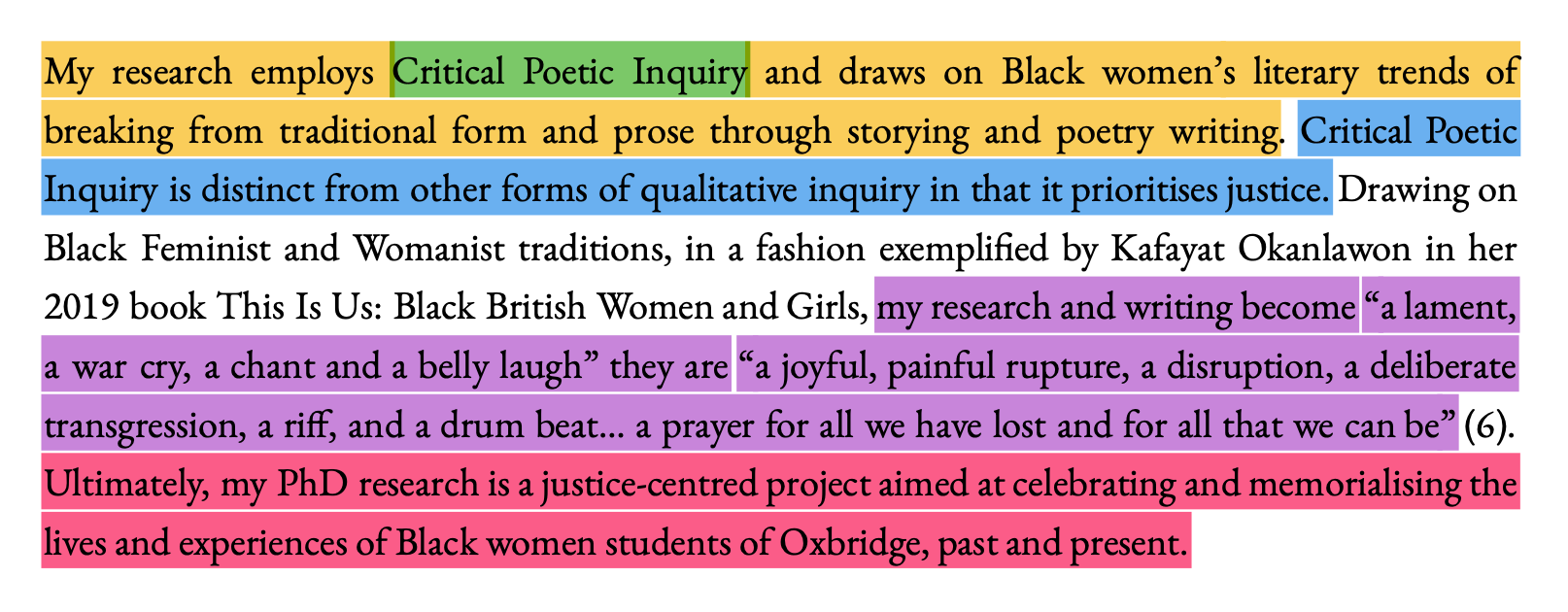
She describes her thesis as “a justice-centred project aimed at celebrating and memorialising the lives and experiences of Black women students of Oxbridge, past and present.” She also calls the project “an ode to the ebony women who maroon their way through the HEIs [Higher Education Institutions] they are traditionally shut out of or told to contort themselves to enter into.” Elsewhere it becomes a “love letter,” “poetry,” a “process of healing,” and an aspiring “performance.”
Dr. Folayan has served up a tribute to women such as herself, channeled through an amalgam of poetry and activism. She also inserts herself into the dataset through autoethnography, which in her case means mining her own journals and personal experiences at Cambridge as research material.
The three women she interviewed either volunteered via a social media open call or were acquaintances hand-selected by Folayan herself. Dr. Folayan also infused the interviews with personal bias by sharing her own experiences with the subjects in order to “affirm [the participants’] experiences” through their commonality.
Her methods provide an alternative to, she writes, the “taking up space” model in black feminism. Her alternative route is concerned with how black women at Oxbridge “create alternative spaces to help them remain part of the institutions.”
“Through this work,” Dr. Folayan writes, “I centre the experiences of Black women students who have chosen to be of, but not in the Universities of Oxford and Cambridge.” Elsewhere: “Through this research, I seek to synthesise a recent turn in the development of Black British Womanhood Studies marked by a refusal to play our counters in quiet and cry our tears in private.” She says she writes “because of the beautiful ebony butterflies who escape the oppressive terrains of UK HEIs and invent alternative modes of engaging with and existing in Oxbridge.” She also tells the reader: “This research is a love letter to the ebony beauties who have and are yet to navigate Oxbridge.”
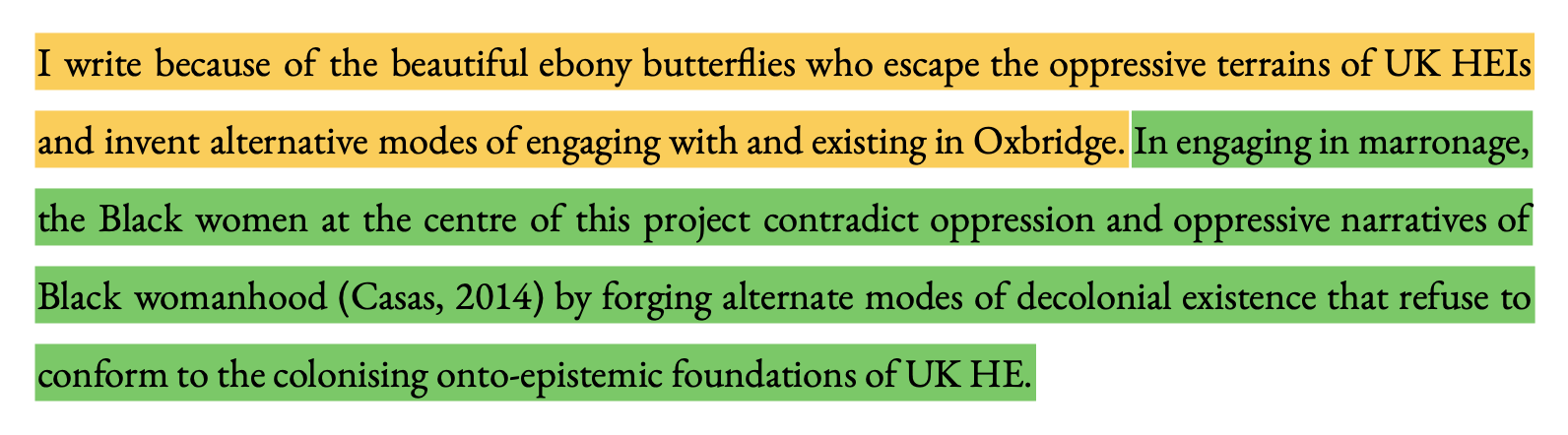
She then offers this:
“In engaging in marronage, the Black women at the centre of this project contradict oppression and oppressive narratives of Black womanhood by forging alternate modes of decolonial existence that refuse to conform to the colonising onto-epistemic foundations of UK HE.”
What observation could even potentially determine whether this interpretation was accurate? What would distinguish “forging alternate modes of decolonial existence” from ordinary friendship, socializing, travel or seeking out people with shared cultural backgrounds? Dr. Folayan does not offer any answers or guidance. When you strip out all the academic jargon of “marronage,” “decolonial existence,” and “onto-epistemic foundations,” she’s simply saying: I feel out of place here.
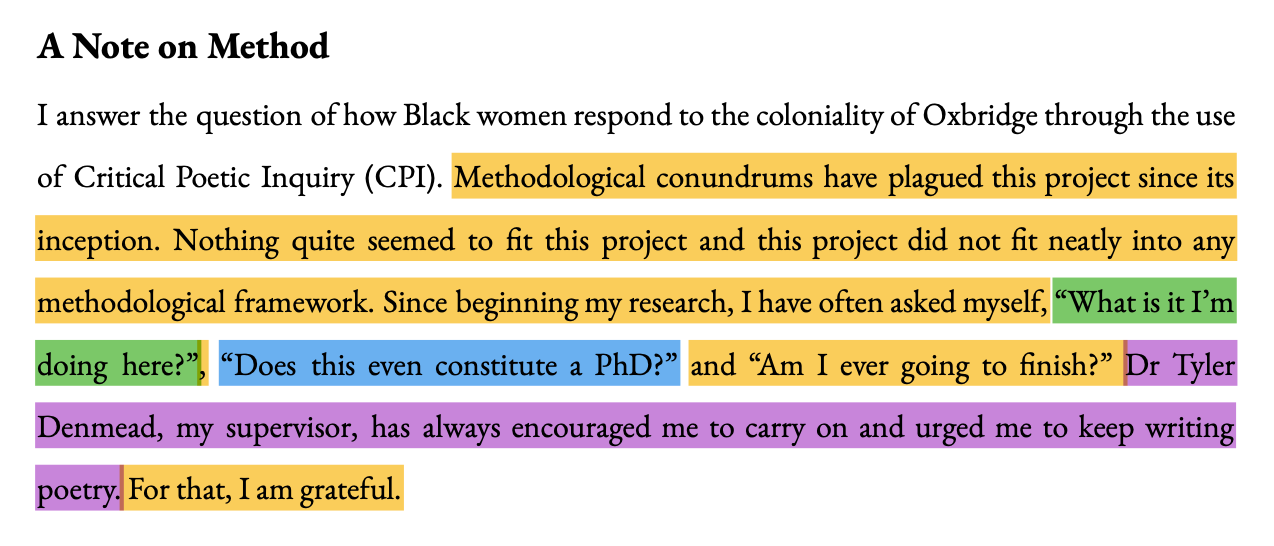
Remarkably, Dr. Folayan even appears to sense the methodological shortcomings of her own work—and in so doing almost dares the reader to engage in exactly the sort of criticism we’re administering here. “Methodological conundrums have plagued this project since its inception,” she writes, in a moment of meta-analysis, of the genesis of her thesis. “Nothing quite seemed to fit this project and this project did not fit neatly into any methodological framework.” She reports having asked herself, “What is it I’m doing here?” and “Does this even constitute a PhD?”
Her supervisor, Tyler Denmead will, as of October 2026, earn the distinguished title of professor of education at Cambridge. Dr. Denmead, who is white, is the coauthor of the 2025 book Rethinking Critical Race Theory: Education Against Elimination in a Time of Genocide. He recently coauthored scholarly articles with titles that open with the words “White educability,” “White profitability,” and “Reckoning with white empathy.” His next book is at least tentatively entitled The White Rage Curriculum.
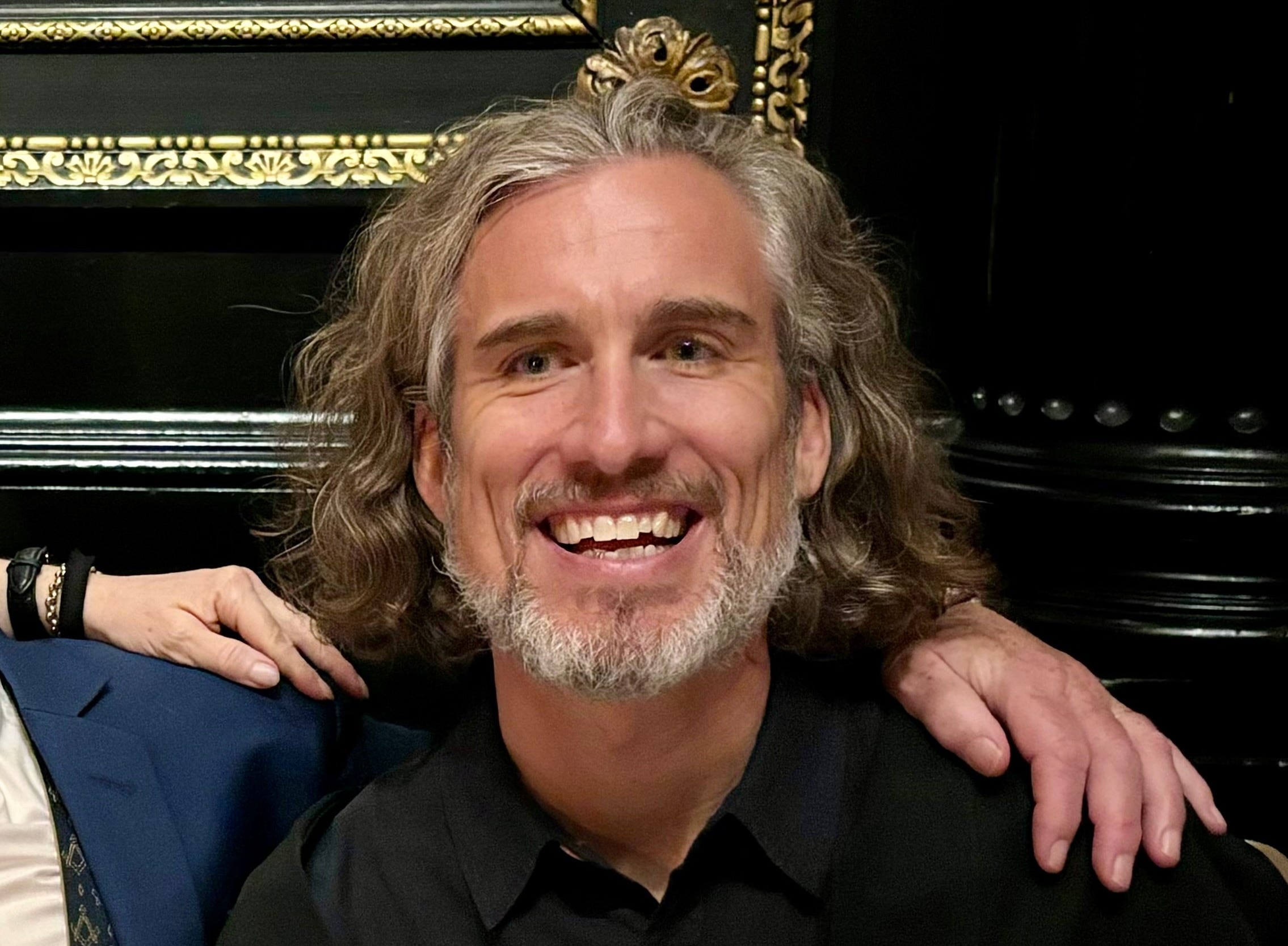
Dr. Denmead, who did not respond to requests for comment, apparently did not help Dr. Folayan develop a clearer and more rigorous research design. Instead, Dr. Folayan writes that he “urged me to keep writing poetry.”
The big picture: Dr. Folayan’s ascent through the ranks
According to her LinkedIn page (which was taken down at some point after Aug. 14), Dr. Folayan is a lecturer in equity, diversity and inclusion at Arden University and “a poet-researcher whose work sits at the intersection of social transformation and the sociology of education.” She asserts that she researches “race, gender, and institutional inequalities, with a particular interest in motherhood in higher education and fostering transformative change.”
In addition to receiving her PhD in education from Cambridge, in February 2025, she has worked at the universities of Sheffield, Leeds and Cambridge. She asserts on LinkedIn that she has worked on “projects including Generation Delta, Decolonising the Social Sciences and the Black Professors Project.” While earning her PhD, she also worked in HR and sustainability at Niyo Group, a Birmingham-based tech and training venture that describes itself as “a global technology company that empowers, educates and enables the most under-represented communities.”
Niyo sponsored her PhD, at least in part, and is thanked in the acknowledgements, as is Dr. Arday.
Dr. Folayan is also a poet, having received poetry commissions from the University of Sheffield, from which she received a masters of science in international social change and policy in 2019, and the Royal Academy of Arts, per LinkedIn. She earned her bachelor of science in sociology and education studies from Oxford Brookes University in 2018.
Her ultimate goal is to become a professor and “impact evaluation consultant.”
“Inspired poetry”
Curiously, Dr. Folayan’s “Inspired Poetry” approach does not routinely attempt to reproduce verbatim the words her participants uttered in her interviews. Instead, she funnels those words through a creative process that communicates the women’s “thoughts, patterns and feelings” and captures what she subjectively felt constituted their “essence.” She draws on other scholars’ research and her interview transcripts and then crafts poems around the elements she “felt were important.”
The poems born out of this process then become a new research text that can supposedly reveal even greater intellectual insights.
At no point during this exercise is there an independent check capable of determining whether anything true or useful had actually been discovered—or if it’s pure projection on her part.
But Dr. Folayan did indeed face an independent check: her thesis viva, as the PhD oral examinations are called in the U.K. The review panel included Dr. Arday. We don’t know what went on beyond those closed doors except that they granted her a PhD and validated this thesis as her final product.
And then the thesis was sealed in a vault guarded by the author herself—minus a little over two weeks earlier this summer when the embargo lapsed—for what is now set to be six years all told. Is this the sort of transparency Vice-Chancellor Prentice spoke of when she sought to reassure the Cambridge community about the investigation into Dr. Arday? Will Dr. Arday’s approval of this thesis be a part of that investigation? Or will the embargo thwart such an inquiry?
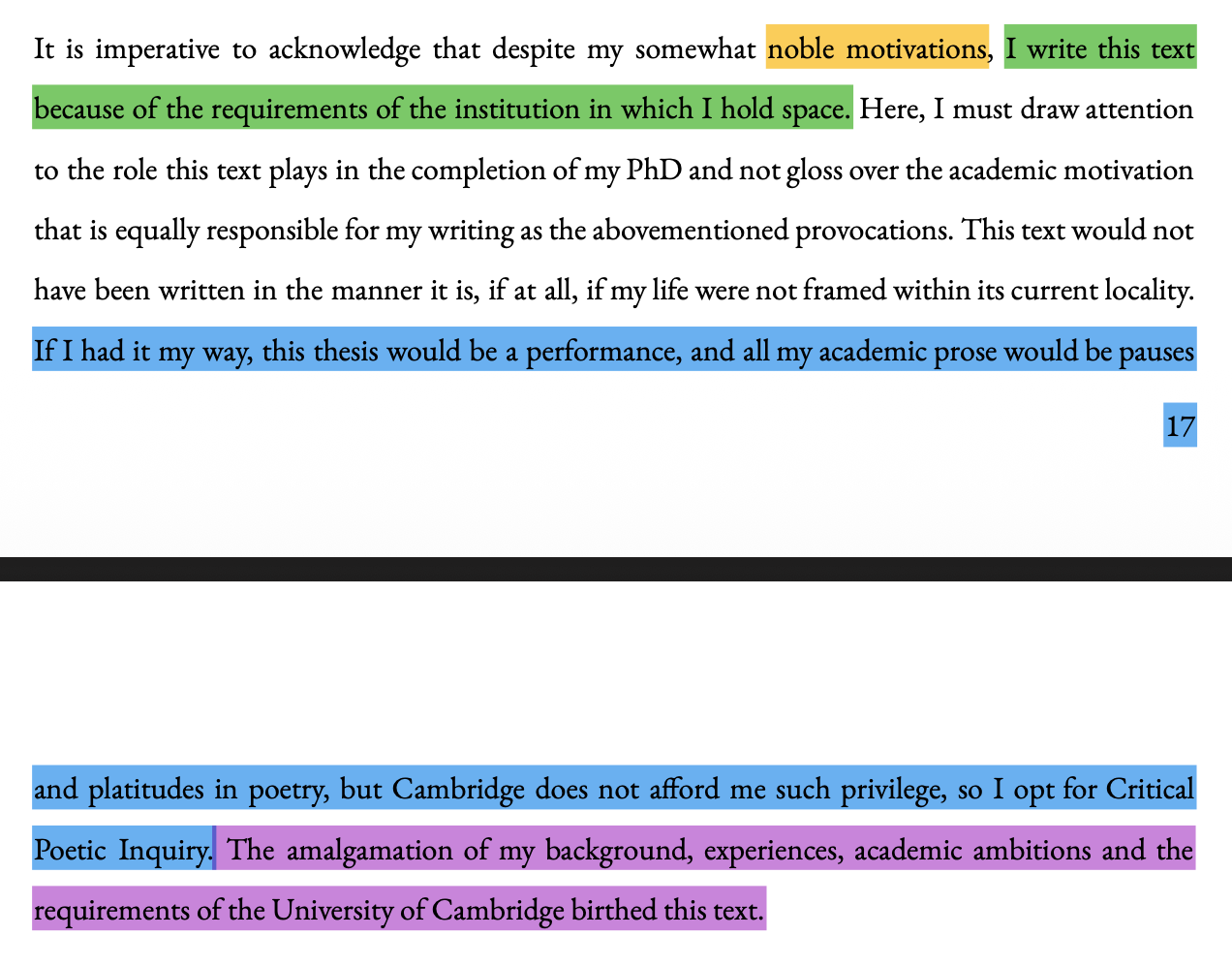
In her thesis, Dr. Folayan also notes her “somewhat noble motivations,” while revealing, remarkably for someone seeking a doctorate, that writing a thesis was not her preferred medium. She says she underwent the academic task “because of the requirements of the institution in which I hold space.” She states, “If I had it my way, this thesis would be a performance, and all my academic prose would be pauses and platitudes in poetry, but Cambridge does not afford me such privilege, so I opt for Critical Poetic Inquiry.”
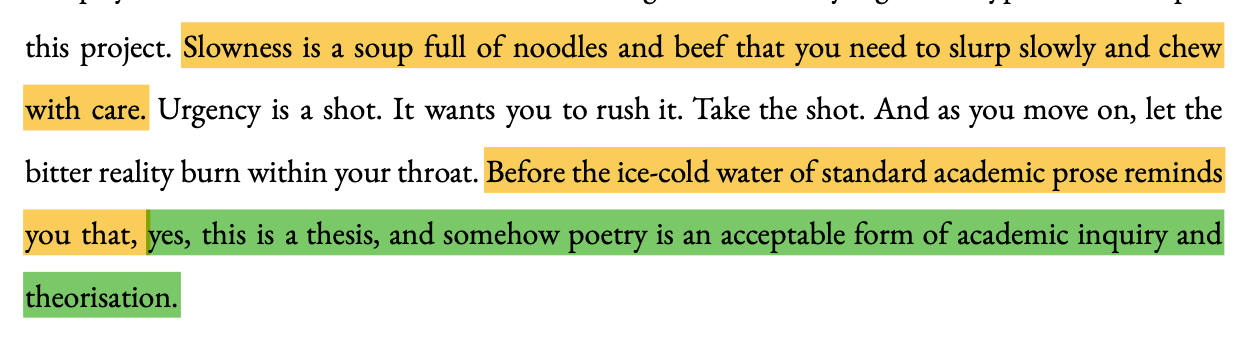
Dr. Folayan herself seems incredulous that she’s getting away with writing activist poetry for her education PhD thesis, saying that “yes, this is a thesis, and somehow poetry is an acceptable form of academic inquiry and theorisation.”
She even explains that she was initially drawn to Critical Qualitative Inquiry (of which, according to her, Critical Poetic Inquiry is a subset) because it was a form of “activist research” that was, in part, “concerned with perceived academic rigour.” In other words, she did not prioritize actual academic rigor, just the perception of it in order to achieve her activist goals.
Dr. Folayan is brazenly candid about her rejection of such rigor. She opens with a so-called positionality statement—academic throat clearings that have become de rigueur in social-justice-oriented academia in which the author lists their various racial, gender, socioeconomic and sexual identities—quoting other scholars that her project “does not align with notions of ‘neutral’ research or ‘objective’ researchers.”
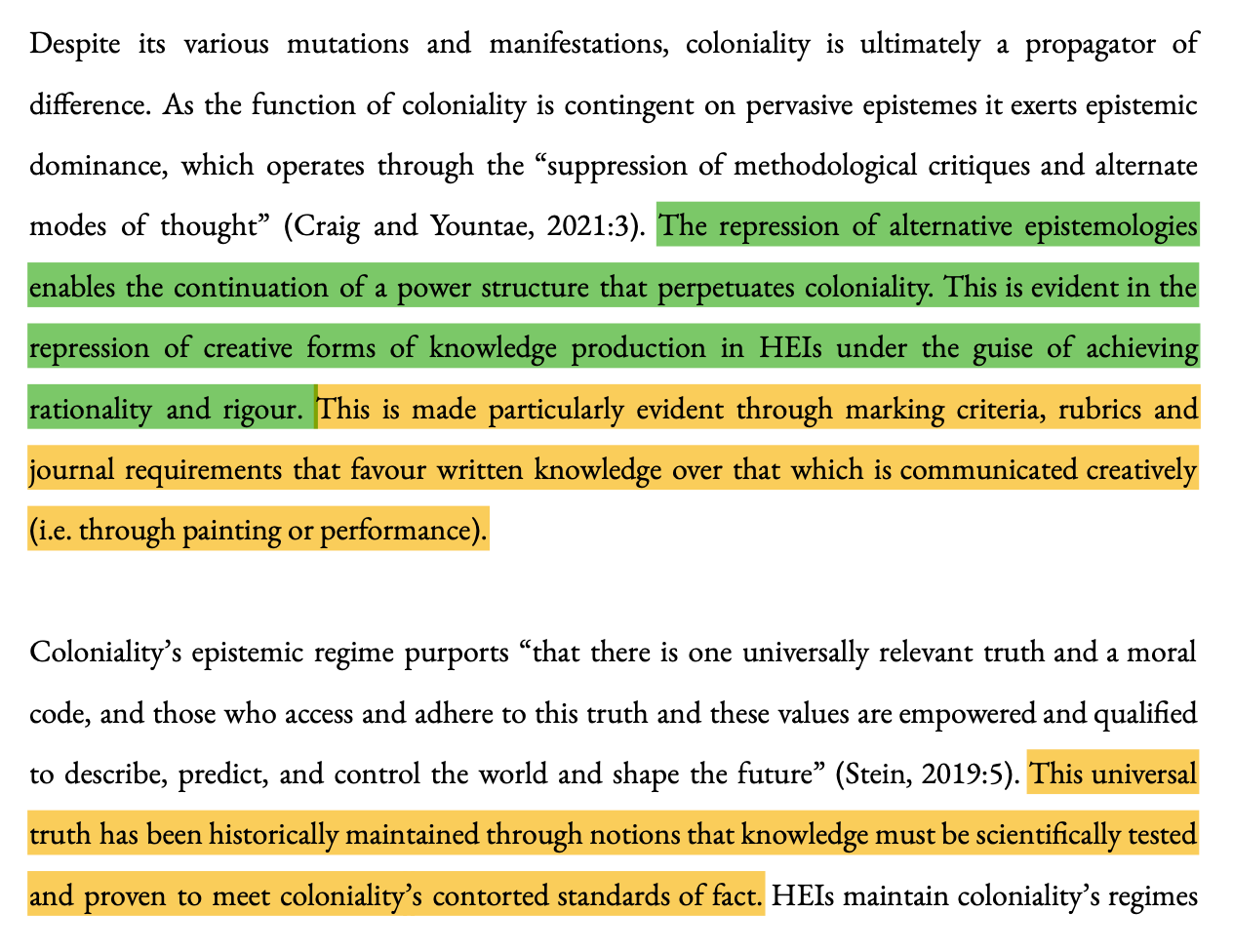
She rejects what she calls the “fantasy of objectivity,” and makes evident she believes the utter lack of objectivity resulting from her positionality actually makes her work more, not less, credible. This is because she rejects what she refers to as “Coloniality’s Epistemic Regime,” which is the “colonial power dynamics [that] permeate societies to repress epistemologies that exist outside of coloniality’s frame of reason and rationality.” This repression manifests as “marking criteria, rubrics and journal requirements that favour written knowledge over that which is communicated creatively (i.e. through painting or performance)” and also as “notions that knowledge must be scientifically tested and proven to meet coloniality’s contorted standards of fact.”
While it’s important and valid to acknowledge researcher bias in qualitative research, acknowledging such bias is not the same thing as controlling for it to help establish whether one’s interpretation is true.
Undergirding the thesis’s ideological framework is Dr. Folayan’s proudly defiant rejection of conventional scholarly standards and constraints. She shields her work from criticism by aligning herself with scholars who refuse “to privilege contemporary epistemic modes [of knowing] over Indigenous sciences and epistemes” and favors methodologies that are not “dictated by coloniality’s standards of knowledge production.” She claims the “ambiguity around this project’s status as an acceptable academic work” is a result of it being situated in a colonialist institution. She says her project is “conscious of the confines created by institutional expectations and academic assumptions yet refuses to adopt them.”
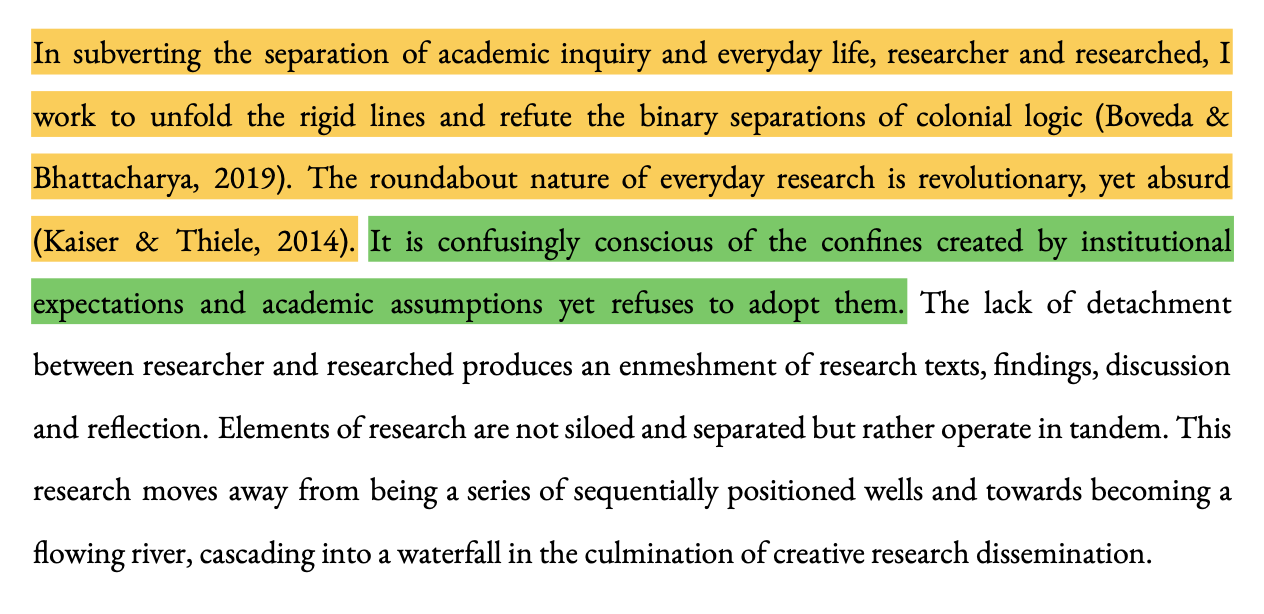
Perhaps her clearest effort to reject academic standards while having her academic cake and eating it too, so to speak, comes in her assertion: “Project and product thus remain unsegregated, and my method has not been determined by rigid academic definitions as being an acceptable form of research. My mode of research has been characterised by a refusal to give into the knowledge standards of coloniality which, as noted by Sriprakash et al. (2022), function to uphold White-dominance and hierarchical social orders.”
This thesis produces a paradox: Cambridge is awarding its highest academic credential to a project whose author openly presents accepted academic standards as oppressive constraints to be undermined and resisted. To paraphrase her thesis title, Dr. Folayan wants to be of Cambridge—receive her doctorate—but never adhere to this elite academic institution’s epistemic standards, even as she complains that she feels out of place in this very institution.
Dr. Folayan’s purported “contribution to knowledge” is the discovery of two previously unexplored forms of “marronage”: traveling to London to find community and holding potlucks. London becomes a “historic foothill of escape,” while potlucks are theorized to be an extension of “the maroon tradition of seeking protection in the landscapes of territories ruled by European powers.”
There is good reason to believe that black women at Oxbridge can feel isolated. Blacks comprise only an estimated 3 percent to 4 percent of the undergraduate students accepted at Cambridge and just under 1 percent of the academic staff (actual black professors are even rarer)—a disparity that Cambridge apparently sought to rectify by hiring Dr. Arday, his subpar qualifications notwithstanding. And it’s entirely likely that spending time with friends in London or eating familiar foods with likeminded individuals would make such women feel more at home. Those certainly seem like resonant emotional experiences, potentially worthy of documentation in some forum. But Dr. Folayan devotes tens of thousands of words in a PhD thesis saying that she feels out of place at Cambridge and likes leaving campus to find her place elsewhere and enjoy comfort food.
Simply attaching the vocabulary of slavery to the most ordinary of human interactions does not constitute an argument, analysis, or a new empirical discovery.
As an institution, Cambridge appears to have been incapable of distinguishing between scholarship and a literary act of self indulgence. And astonishingly, the university has sanctioned an exceptionally long embargo that has permitted the contents of this thesis to remain out of view into the next decade.
If there is to be a true reckoning at Cambridge to understand what internal rot Dr. Arday’s interrupted tenure signified, breaking the embargo and taking a hard look at this thesis might be a good place to start.
But that might prove inconvenient to the vice-chancellor’s preordained conclusion that the Arday affair is a mere isolated incident.
This article was originally published on Benjamin Ryan’s Substack. Subscribe below.

If you enjoyed this free article, please consider upgrading to a paid subscription or making a recurring or one-time donation below to show your support. Reality’s Last Stand is a reader-supported publication, and your help is greatly appreciated.
If you enjoyed this article, you may also like…


Thanks, everyone, for reading our reporting about this egregious Cambridge PhD thesis that Jason Arday approved. You can check out the many other Substacks I've written about Jason Arday here: https://benryan.substack.com
It is unmerited respect for this gobbledygook to even bother trying to discredit it. The whole department should be shut down.