



Reality’s Last Stand is a reader-supported publication. Please consider becoming a paying subscriber or making a one-time or recurring donation to show your support.

About the Author
Steven Gussman is a scientist and video game developer on the east coast of the United States. He is the author of The Philosophy Of Science. He can be found on X at @Schwinn3.
I have lived with obsessive-compulsive disorder since childhood; it became especially intense just before puberty. In OCD, a person is gripped by obsessions—say, the fear that the next bite of food is poisoned—and the anxiety is temporarily relieved by a compulsion or ritual, such as throwing the food away and starting over. The relief is real, but it comes at a cost: In the long run, giving in to compulsions tends to strengthen the obsession and deepen the anxiety. It is no surprise, then, that one of the most effective treatments is cognitive behavioral therapy (CBT), particularly exposure therapy in which the patient repeatedly resists the compulsion, endures the panic, and eventually learns that the feared outcome never arrives. The age old advice to “face your fears” turns out to be clinically sound.
OCD is hardly the only condition that can be alleviated through this kind of confrontation with reality. CBT is also used to treat depression. Neurologist V.S. Ramachandran famously treated phantom limb syndrome—a condition in which amputees still feel sensations in a missing limb—using mirrors that allowed a patients to “see” the limb on their healthy side reflected where the missing limb would be. In different ways, these therapies all push the mind back into contact with the world as it is, rather than as it is feared or imagined to be.
But why does exposure work so often, and so well? And why should exposure therapy treat mental disorders for which the terms clinical psychologists use to describe a subject’s symptoms are often occult, with two common descriptive phrases being, “magical thinking” and “ritualistic thinking”?
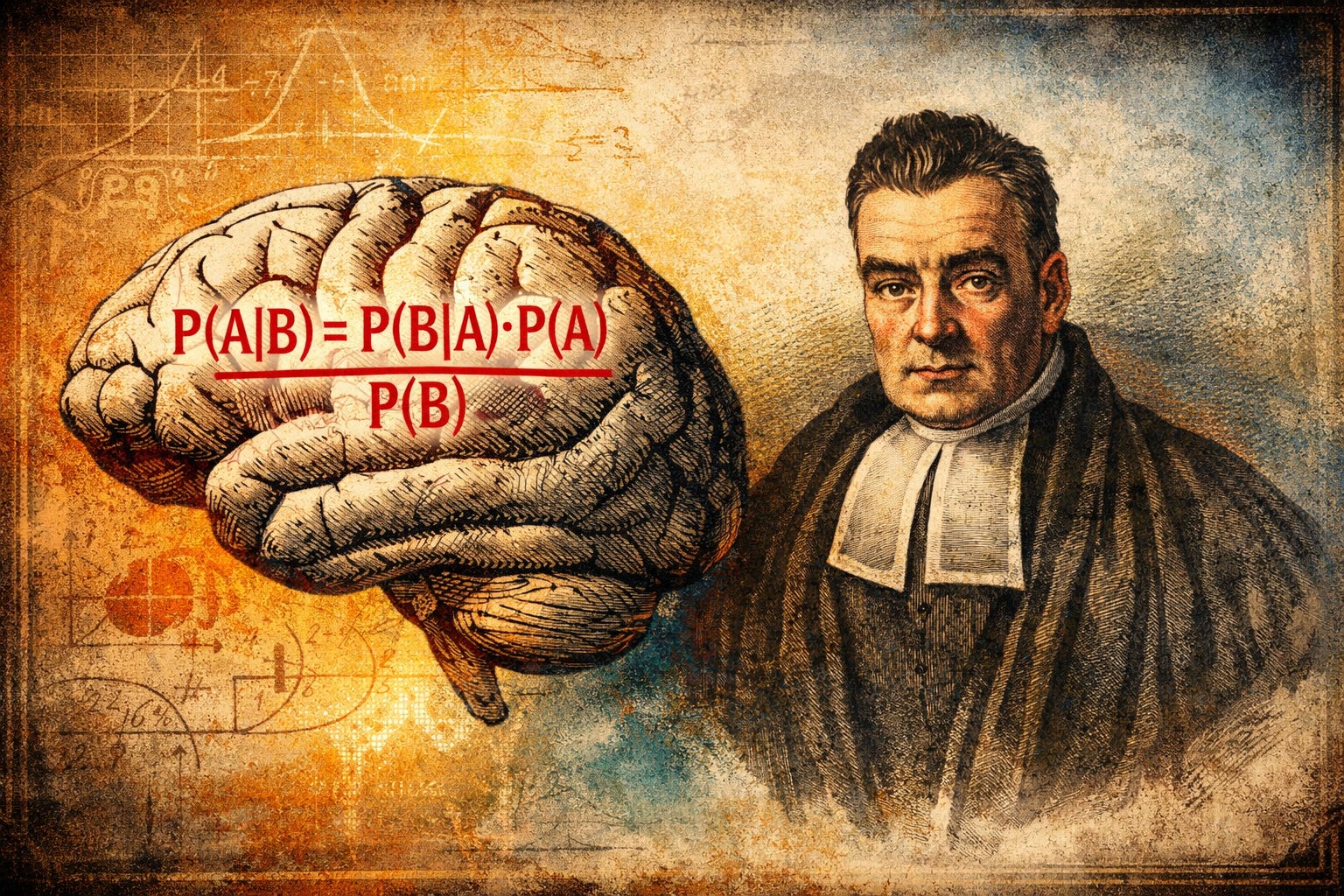
One possible answer comes from epistemology, the branch of philosophy concerned with how we form and justify beliefs. At both conscious and unconscious levels, the mind is constantly making judgments about what is likely to be true and what is likely to happen next. Bayes’ theorem is the algebraically correct way to update probabilities in light of new evidence and prior knowledge. A familiar example is taught to medical students: A doctor interpreting a positive test result has to consider not just the test’s sensitivity and specificity, but also the prevalence of the disease in the population. Those inputs together determine how likely it is that the patient actually has the disease. The math is exact, but the information plugged into it never is. But Bayes still gives the best possible way to revise beliefs under uncertainty.
When a person’s reasoning strays too far from Bayes’ Theorem—for example, when someone with OCD grossly overestimates the risk of not triple-checking that the oven is off—he may be engaging in what clinicians describe as “magical” or “ritualistic” thinking. And if repeated exposure to the feared situation (for example, going to bed without checking the oven) without the feared consequence (waking up to a house fire) reduces the obsession, then it is reasonable to infer that, somewhere in the patient’s mind, a Bayesian prior is being updated. The feared outcome comes to feel less probable because repeated experience shows it is. For exposure therapy to work as well, as quickly, and as broadly as it often does, the brain must be estimating risk in a Bayesian way.
If that’s right, then exposure therapy works in part because the brain is already built to learn from repeated evidence. Indeed, evolutionary psychology suggests that natural selection would favor something like a Bayesian risk estimator. Ancestors who made better use of past experience and sensory information would, on average, leave more—and fitter—offspring. A further prediction of this view is that these estimators would not be perfectly calibrated for accuracy in every case. They would be biased in ways that improve fitness, depending on the costs and benefits of the behavior in question. A male, for example, might be expected to take greater risks to attract a mate than to obtain a small amount of food. Most of us can think of anecdotal examples: feeling braver in front of someone we are trying to impress, or taking more social risks early in courtship than later, once the relationship is secure. Across the animal kingdom, parents also often behave fearlessly when defending their young; in many species, the difference in violence between a female without offspring and a mother whose young are threatened, is striking.
Of course, it is easy to conflate ultimate explanations (why a trait evolved) with proximate ones (the everyday mechanisms by which it is expressed). No one thinks hunter-gatherers—much less birds—are consciously calculating coefficients of relatedness when they behave nepotistically. Likewise, the claim here is not that the human brain contains a homunculus consciously doing algebra. The better way to put it is that the mind may have evolved subconscious “as-if” estimators that operate in ways that approximate Bayesian updating. Whatever the brain’s actual computational machinery may be, it may have evolved to reach conclusions similar to those predicted by Bayes’ theorem, because accuracy in prediction generally improves fitness.
If that is right, then disorders such as OCD and perhaps some forms of depression can be modeled, in part, as disorders of one or more Bayesian-like estimators in the mind, and in particular as cases of miscalibrated priors. In practical terms, that means unrealistically negative beliefs about everyday risks or about one’s prospects for happiness. People who are fully detached from reality may require antipsychotic medication and other interventions. But those who maintain a stronger grip on reality, despite this kind of miscalibration, often appear to be good candidates for CBT. It is even possible—though this remains speculative—that some more severe conditions, including forms of psychosis such as schizophrenia, might be more effectively contained if caught earlier and treated in part through carefully designed exposure-based approaches.
Provocatively (though far from conclusively), some researchers have proposed a link between the cat-borne parasite Toxoplasma Gondii (“toxo”) and schizophrenia. Toxo is known to alter behavior in its hosts—rodents and potentially humans as well—pushing them toward greater risk-taking. This is called an extended phenotype: a trait expressed in one organism that is ultimately driven by the genes of another. Because toxo’s life cycle depends on cats, an infected mouse is made to be more likely to expose itself to predation, making it easier prey. In exchange, the cat provides the parasite with the host environment it needs, and when the parasite is later shed into the environment, it can infect new mice—continuing the cycle. The details here matter less than the broader point: extreme risk-taking is the opposite of extreme anxiety or avoidance, and both can be modeled as miscalibrated Bayesian priors about danger. The adaptive middle would be closer to reality: a more accurate estimate of the moderate risks most behaviors actually pose to one’s fitness.
As cognitive psychologist Steven Pinker has argued, other evidence also points to a natural tendency toward Bayesian-style reasoning in humans—at least when factual accuracy aligns with practical success (i.e., evolutionary fitness). Biologist Louis Liebenberg, for example, has found that hunter-gatherers use remarkably sophisticated inference in animal tracking that accords with Bayesian principles.
That effective exposure therapy is built on the same logic as Bayes’ Theorem suggests that the human mind evolved to obey it. Exposure therapy brings a mind trapped in fear or fantasy into repeated contact with reality until the mind updates towards more realistic beliefs. The subconscious appears to learn by testing its predictions against the world. And when it does, the point isn’t to become fearless—it’s to become properly calibrated.
If you enjoyed this free article, please consider upgrading to a paid subscription or making a recurring or one-time donation below to show your support. Reality’s Last Stand is a reader-supported publication, and your help is greatly appreciated.
If you enjoyed this article, you may also like…


The equation in the cover illustration is wrong. The line indicating division is shown under the left and right sides of the equation. It should be ONLY under the right side. The outcome P(A|B) is not divided by P(B) again.
"Exposure therapy brings a mind trapped in fear or fantasy into repeated contact with reality until the mind updates towards more realistic beliefs."
But today we have the reverse. It is fear and fantasy exposure powered by careerist politicians that are really just monetization influencers exploiting social media algorithms. It should not be a surprise outcome of increased diagnosis in mental health issues.