



Reality’s Last Stand is a reader-supported publication. Please consider becoming a paying subscriber or making a one-time or recurring donation to show your support.

About the Author
Jowan Mahmod, PhD, is a multidisciplinary researcher focused on how digital technologies, identity, and shifting social norms are transforming contemporary societies. Dr. Mahmod’s work challenges dominant narratives by examining the psychological and sociological forces behind polarization, perception, and collective behavior. She is currently writing a second book that shows why polarization makes more sense once the deeper dysfunctions driving it are understood. You can follow her work at wehavebeenfooled.substack.com.
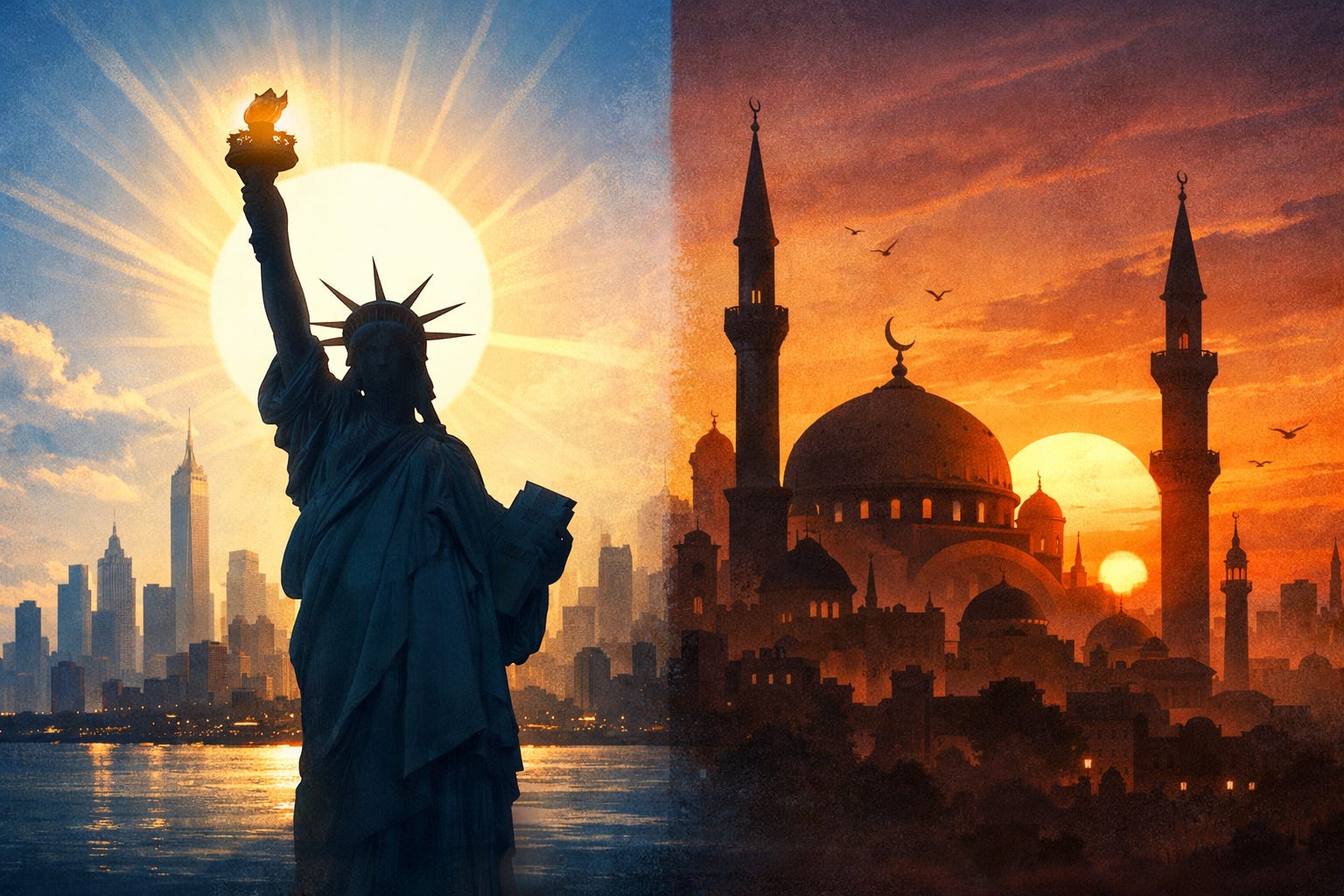
The question of whether Islam is compatible with Western values has become particularly loaded, as the discussion is assumed to revolve around binaries such as “good versus bad” or “progressive versus backward.” Framed that way, it turns into a moral question. It trivializes—and often obscures—a conclusion that is fairly straightforward from a historical and rational perspective, even if we set aside Islam’s more extreme manifestations.
Value systems don’t emerge from nothing. They are shaped by the social, political, and economic conditions in which they develop, and by the incentives and constraints they were forced to navigate. A comparison with medieval Europe makes the point without triggering the same defensiveness. No one argues that the sacred and moral order of thirteenth-century Europe—a world of religious absolutism and patriarchy, where women were legally and socially subordinate to men and heretics were persecuted—could function within today’s secular democracies.
What works under one set of conditions often does not hold under another. Seen this way, asking whether an Islamic value system sits comfortably within modern liberal democracies should be no more inflammatory than asking whether medieval European values are compatible with contemporary Western society.
Values are not just private beliefs about right and wrong. They are highly consequential because they shape motives, attitudes, and goals. They form an ordered set of priorities that characterizes and orients people—what they pursue, what they tolerate, what they fear losing, and what they are willing to sacrifice, both individually and collectively. When a society’s value system shifts, those priorities shift with it—and so does the society.
The irony is that Western societies are, at this very moment, in the middle of their own value shift—one in which postmodern sensibilities increasingly compete with the ideals of modernity. That clash makes something easy to see: when incompatible value systems insist on shaping public life, conflict and polarization are the predictable result. The friction shows up not only in policy, but in the regulation of language and speech. Yet this basic logic is often treated as impolite—or simply ignored—when the conversation turns to Islam. The omission is even more striking given that many of the postmodern generation’s normative expectations rest on a worldview that is fundamentally at odds with the Islamic one.

