




Reality’s Last Stand is a reader-supported publication. Please consider becoming a paying subscriber or making a one-time or recurring donation to show your support.

About the Author
Dr. Colin Wright is an evolutionary biology PhD, Manhattan Institute Fellow, and CEO/Editor-in-Chief of Reality’s Last Stand. His writing has appeared in The Wall Street Journal, The Times, the New York Post, Newsweek, City Journal, Quillette, The Washington Examiner, and other major news outlets and scientific journals.
Nick Fuentes has spent years trying to present himself as the youthful face of a new, insurgent “America First” movement—an unfiltered truth-teller breaking through the old conservative establishment. But a new report from the Network Contagion Research Institute (NCRI) suggests that his growing visibility isn’t the result of a groundswell of organic enthusiasm. It was manufactured.
According to NCRI, Fuentes’s apparent rise was driven by coordinated manipulation of online platforms, artificial engagement meant to boost his posts, and an information ecosystem in which major media outlets can be misled into thinking a fringe figure is suddenly influential.
Fuentes, a 27-year-old livestreamer, is known for his provocation. He has praised Adolf Hitler as “awesome,” called interracial marriage “degenerate,” claimed marital rape is impossible, and said he hopes to marry a sixteen-year-old “when the milk is fresh.” He has described women as “fundamentally lower” in intelligence, insisted Jim Crow segregation benefited black Americans, and called for “the state” to crush the free market.
Despite presenting himself as an “America First” patriot, Fuentes routinely praises America’s adversaries. He has cheered Vladimir Putin’s invasion of Ukraine, defended Iran during a live crisis with the United States, said he would “fight on the side of China against America,” and even admired China’s repression of Muslim minorities as a model for dealing with crime in American cities. Iranian state television has approvingly aired his commentary, and Russian outlets have treated him as a legitimate American voice.
Yet in 2025, Fuentes suddenly seemed omnipresent. Tucker Carlson recorded a two-hour interview with him. His face started popping up in The New York Times, The Atlantic, Politico, and The Guardian. And instead of the usual grainy screenshots and awkward stills, he was now being photographed in moody, dramatic lighting, styled and polished to look almost glamorous.
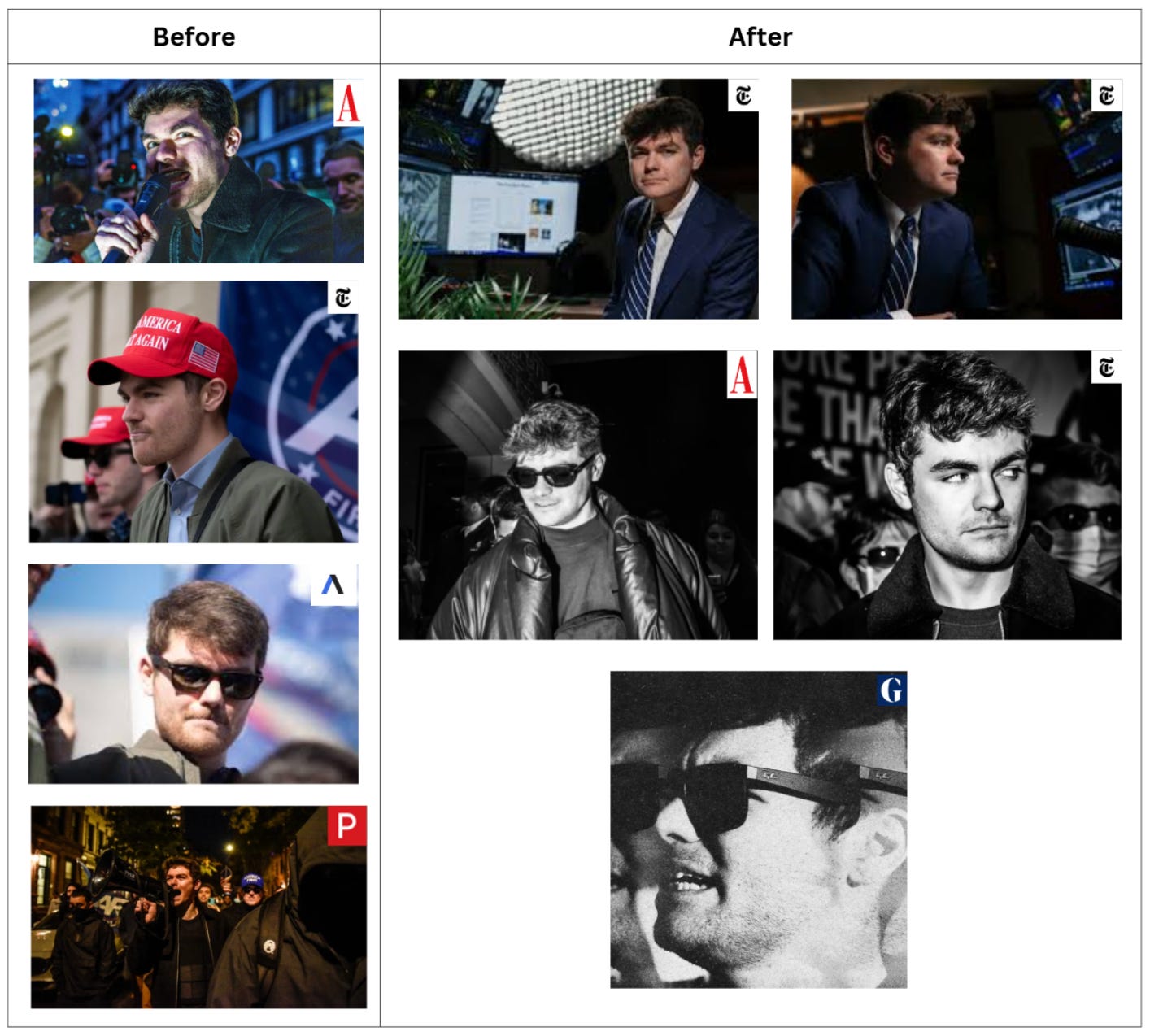
To outside observers, all this sudden attention made it seem like Fuentes had genuinely become a major force on the right. But the NCRI report shows that this was mostly an illusion created through a complex mix of coordinated retweeting, anonymous booster accounts, foreign engagement, and a media environment that misreads a burst of online activity as evidence of genuine grassroots influence.
The report’s most shocking finding is just how wildly Fuentes’s engagement numbers differ from those of other political influencers. NCRI compared the first 30 minutes of engagement on 20 of his recent posts with those from four major online figures—Elon Musk, Hasan Piker, Steven “Destiny” Bonnell, and Ian Carroll. Incredibly, Fuentes outperformed all of them in early retweets, including Musk, whose follower count is over 200 times higher.
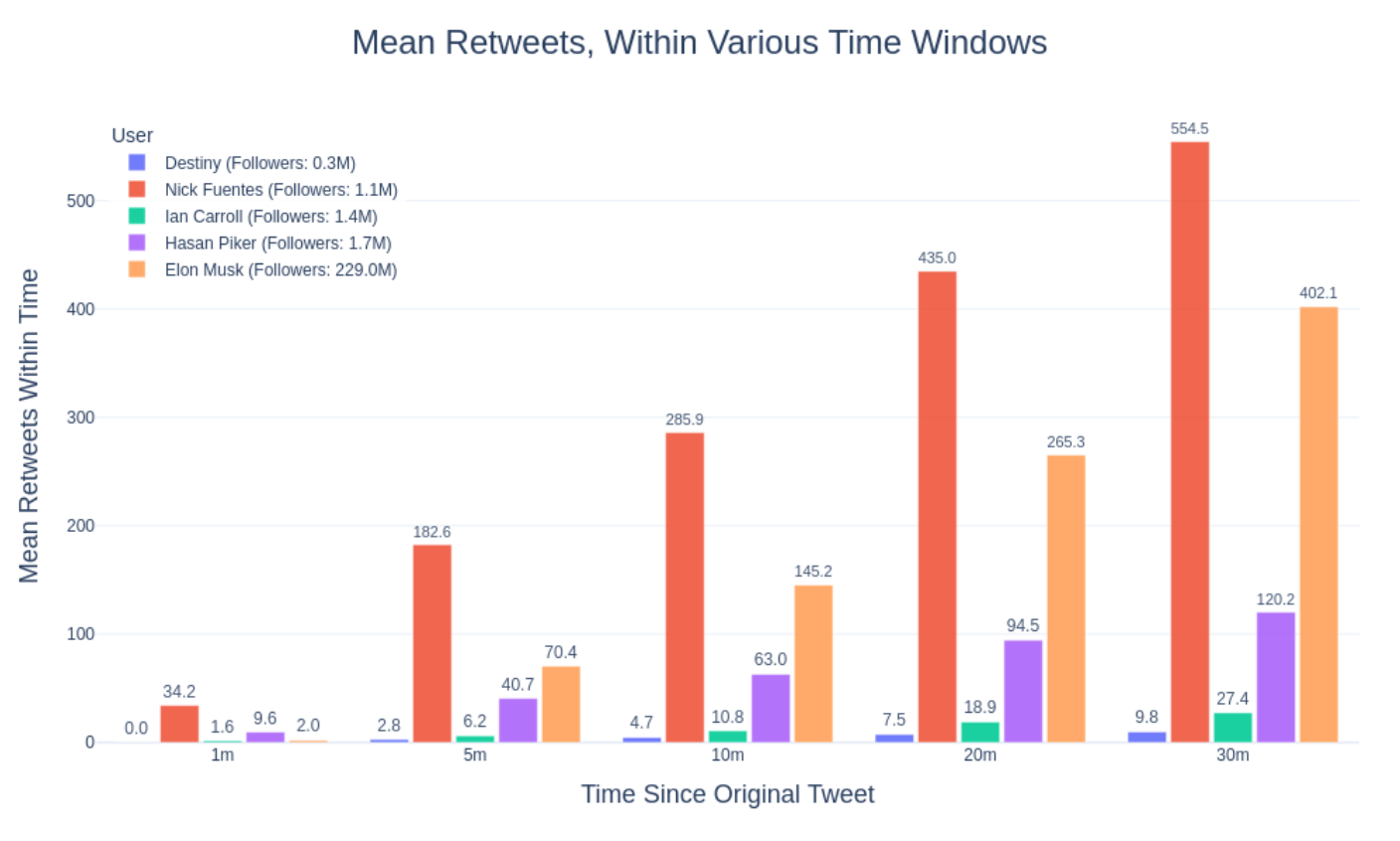
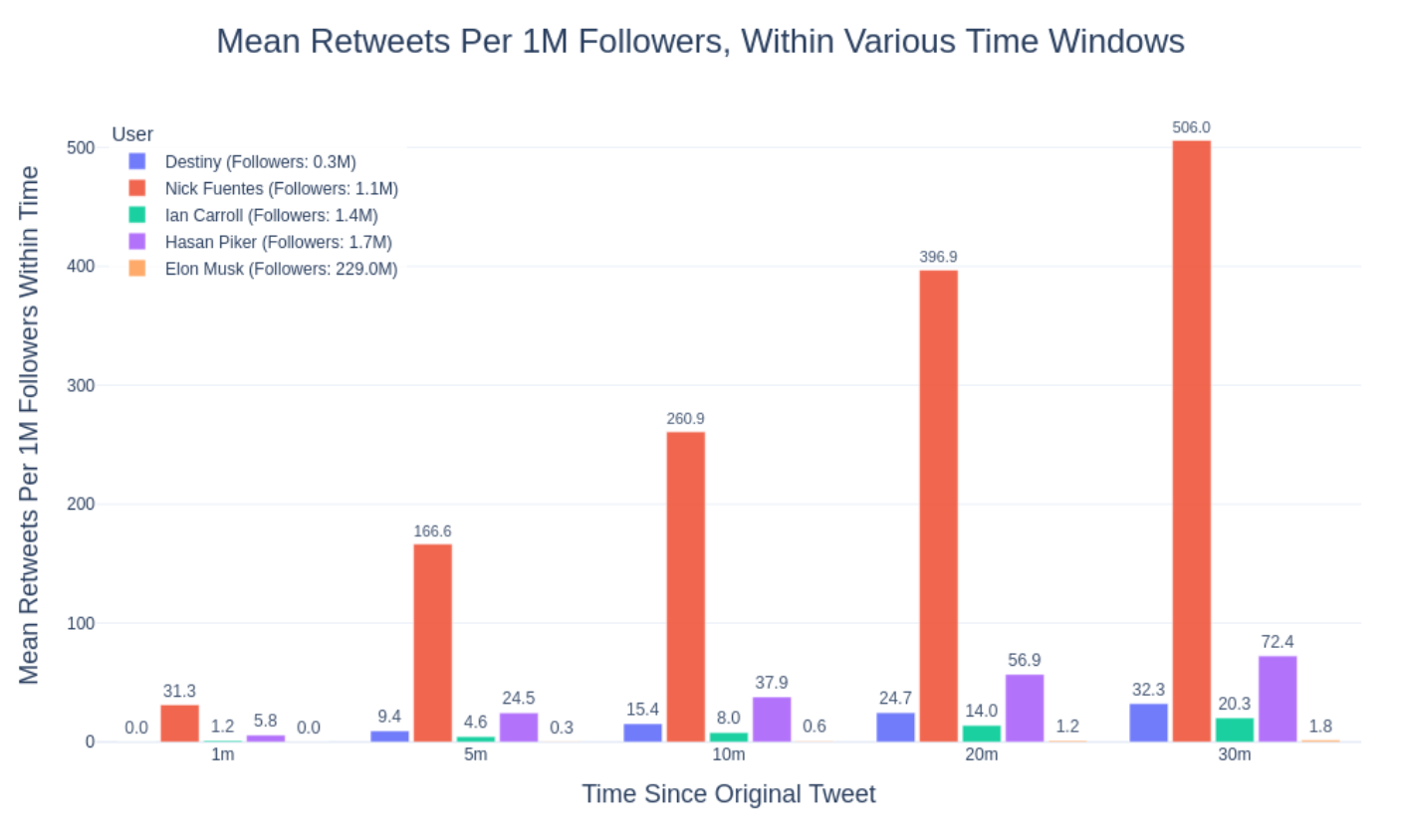
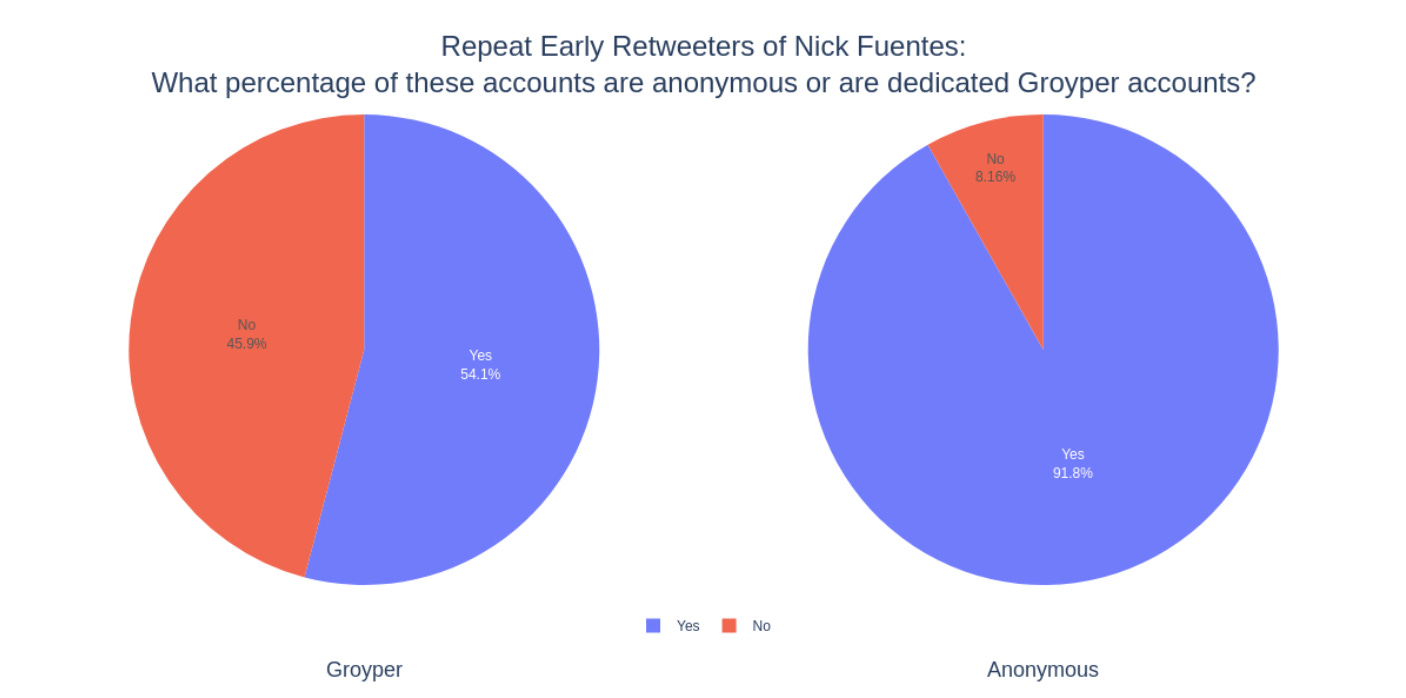
None of this makes sense if the engagement is organic. According to NCRI’s report, this is explained by the fact that 61 percent of Fuentes’s early retweets come from accounts that repeatedly retweeted several of his posts within the same 30-minute window. This is not what you’d expect if these were random users scrolling their feeds. Rather, these accounts appear to be waiting for Fuentes to post so they could amplify his content almost instantly.
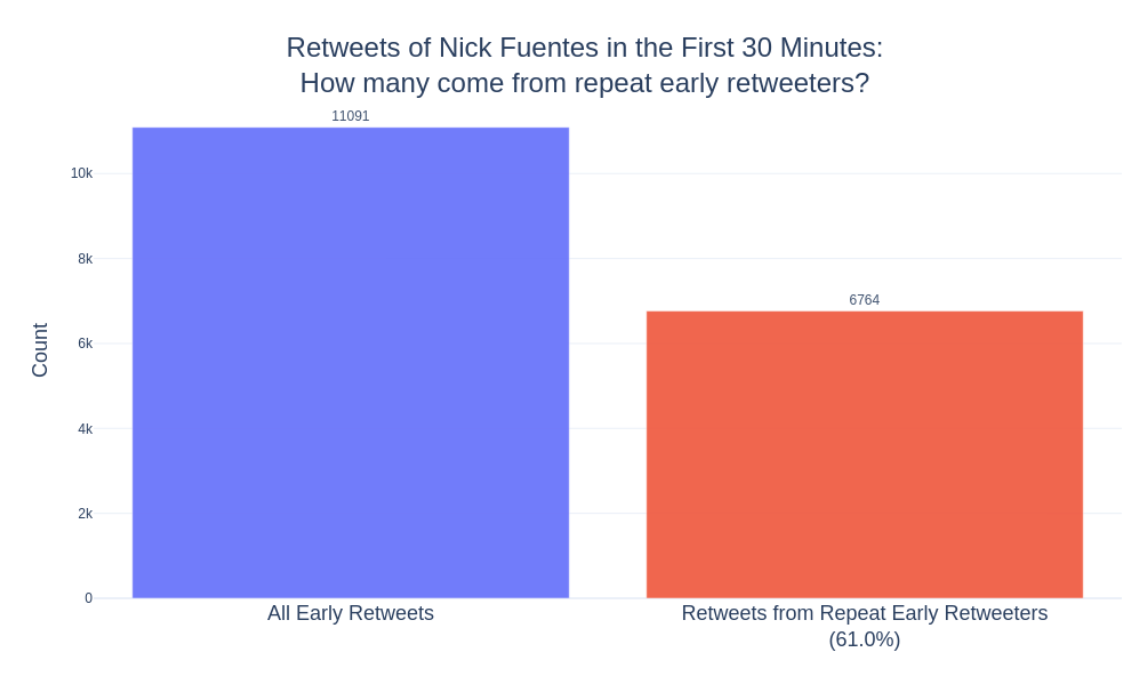
When NCRI dug into who these accounts actually were, 92 percent were completely anonymous. No real names, no real photos, no location, no identifiable personal information. Many openly identified as “Groypers,” members of Fuentes’s online fan base, and their feeds consisted almost entirely of retweets or replies to him. Some even labeled themselves as Fuentes “signal boosters.” These accounts appear to be part of a coordinated network built to push his content as widely and quickly as possible.
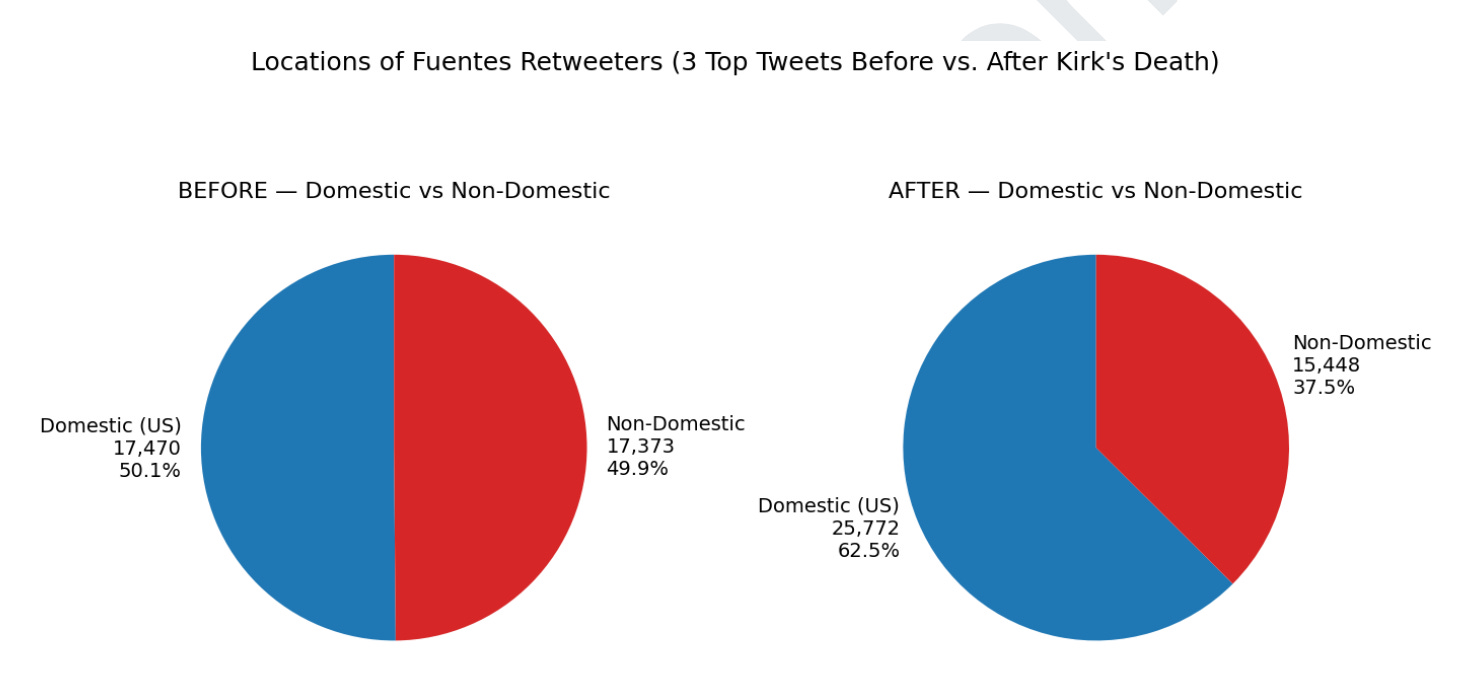
NCRI uncovered another major red flag. When they examined Fuentes’s most viral posts—three from before the assassination of Charlie Kirk and three after—it found that nearly half of all retweets came from foreign accounts, heavily concentrated in India, Pakistan, Nigeria, Malaysia, and Indonesia. These regions are known hubs for low-cost engagement farms.
Crucially, Fuentes is not merely a passive beneficiary of this manipulation—he actively coordinates it. NCRI shows that he routinely gives his viewers direct instructions during live broadcasts to retweet his content, often just seconds after posting a link. This is meant to trigger the early spike in engagement that algorithms reward, a tactic that may violate X’s own rules against coordinated inauthentic activity.
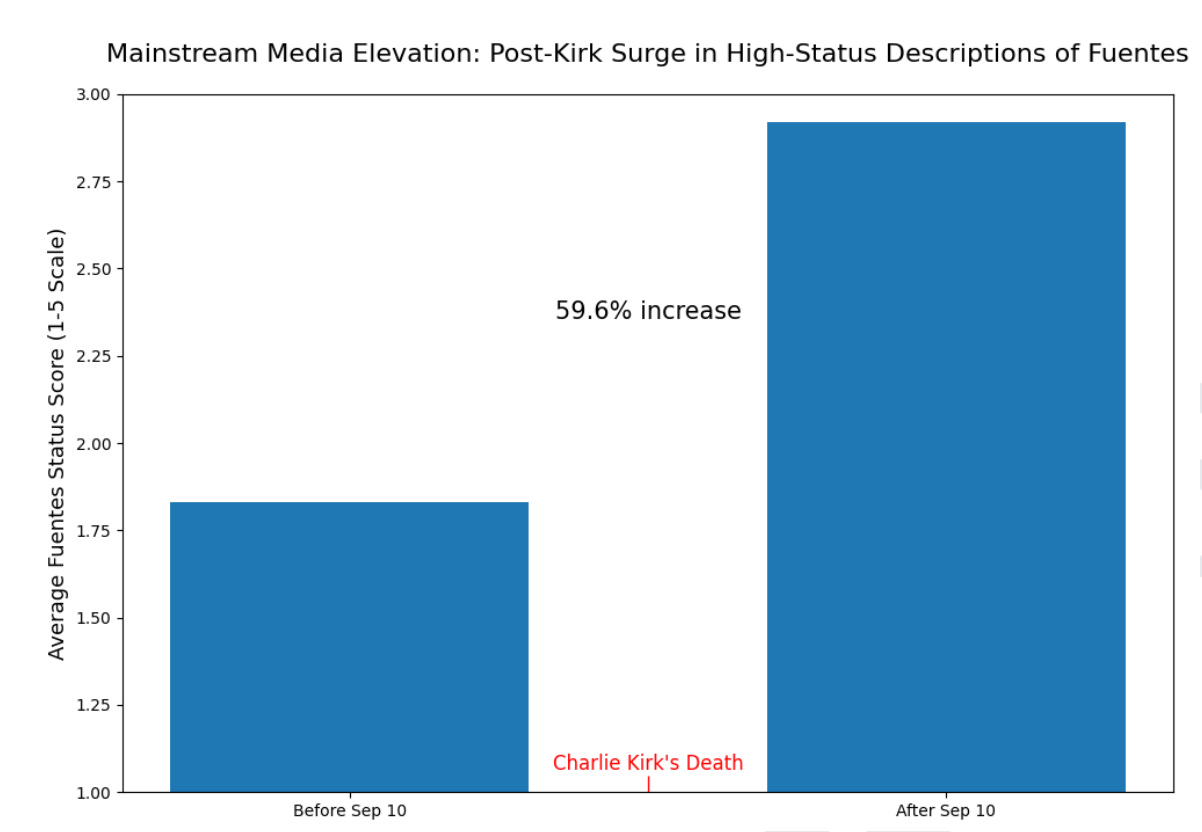
And the effects of this manufactured engagement didn’t stay online. They spilled into mainstream news coverage. Between June and November 2025, 15 major outlets published 149 stories mentioning Fuentes. After Kirk’s assassination—a moment that disrupted the conservative youth movement Fuentes had long criticized—coverage not only increased but changed tone. NCRI’s language analysis found a nearly 60 percent jump in “high-status” framing after Kirk’s death. In other words, reporters began describing Fuentes as more important, more central, and more politically influential.
The media believed it was responding to a real political shift. It wasn’t. It was responding to a manipulated signal created by anonymous amplification networks and foreign engagement farms. Even TPUSA’s own social-media replies showed growing Groyper infiltration as Fuentes tried to capitalize on the vacuum left by Kirk’s death.
What the NCRI report ultimately reveals is how vulnerable our media and technology ecosystem has become. Platforms reward speed and volume, both of which can be cheaply manufactured. Newsrooms monitor online trends for signs of cultural shifts, but the signals they rely on are easily faked. Once someone appears to be “on the rise,” media coverage reinforces that impression, creating a feedback loop in which manipulated attention turns into real attention.
Without this coordinated manipulation, Fuentes would likely have remained what he has long been: an extremist entertainer with a niche following. Instead, a network of anonymous accounts and foreign engagement farms helped push him into the center of national conversation. The most troubling part is how easily it happened, and how quickly major institutions treated the artificial signal as authentic.
The problem, as NCRI makes clear, isn’t just Nick Fuentes. It is an information ecosystem that can no longer reliably distinguish real influence from manufactured noise. And if one fringe figure can climb into national view this easily, the more pressing question is how many others are preparing to do the same.
If you enjoyed this free article, please consider upgrading to a paid subscription or making a recurring or one-time donation below to show your support. Reality’s Last Stand is a reader-supported publication, and your help is greatly appreciated.
If you enjoyed this article, you may also like…


In my observation Nick Fuentes was obscure until Tucker Carlson interviewed him.
I must live under a rock.
I don't know or give a crap for this guy.