



Affiliate disclosure: This post contains affiliate links.
Reality’s Last Stand is a reader-supported publication. Please consider becoming a paying subscriber or making a one-time or recurring donation to show your support.

Editor’s Note
This article is the first installment in a planned point-counterpoint exchange between philosopher Holly Lawford-Smith and Stella O’Malley, founder of Genspect, over Genspect’s REPATH (re-psychopathologization) initiative.
Holly will kick things off with her critique of REPATH, followed by a response from Stella defending the initiative and addressing Holly’s arguments. For now, these are the only two articles scheduled, but if both authors wish to continue the discussion for another round, I would be more than happy to accommodate them.
Before reading Holly’s critique, please take a moment to vote in our initial REPATH poll if you haven’t already. Once Stella’s response has been published, we’ll run the same poll again to see whether readers have become more or less supportive of the initiative after hearing both sides. I’m very interested to see the results!
This is exactly the kind of content I love being able to publish at Reality’s Last Stand. Not every issue is black and white, and finding the best way forward often requires considering different perspectives, engaging seriously with good-faith disagreements, and ultimately deciding for yourself who has made the stronger argument.
And if you finish reading both essays and still aren’t sure where you stand, that’s perfectly fine, too. “I don’t know” is always a perfectly defensible position to hold!
I hope you enjoy the exchange, and I look forward to hearing what you think.
Colin Wright
CEO & Editor-in-Chief
Reality’s Last Stand
About the Author
Holly Lawford-Smith is an Associate Professor in Political Philosophy at the University of Melbourne. Her latest book, Feminism Beyond Left and Right, came out with Polity in May. She writes semi-regularly for Quillette and Fairer Disputations. Visit her YouTube page and follow her on X.
Despite the (by now well-known) lack of evidence that puberty blockers and cross-sex hormones do more good than harm for trans-identified youth, many countries and states around the world continue to offer these interventions. Six of Australia’s eight states and territories are among them (Queensland and the Northern Territory are the honorable exceptions). The Coalition for Advancing Scientific Care (CASC) is an Australian organization formed to advocate against “gender-affirming care” on the grounds that there is insufficient evidence to justify it. At CASC’s 2026 conference, held in October in Adelaide, Stella O’Malley and I took up the question: “What does better care for gender-distressed youth look like?”
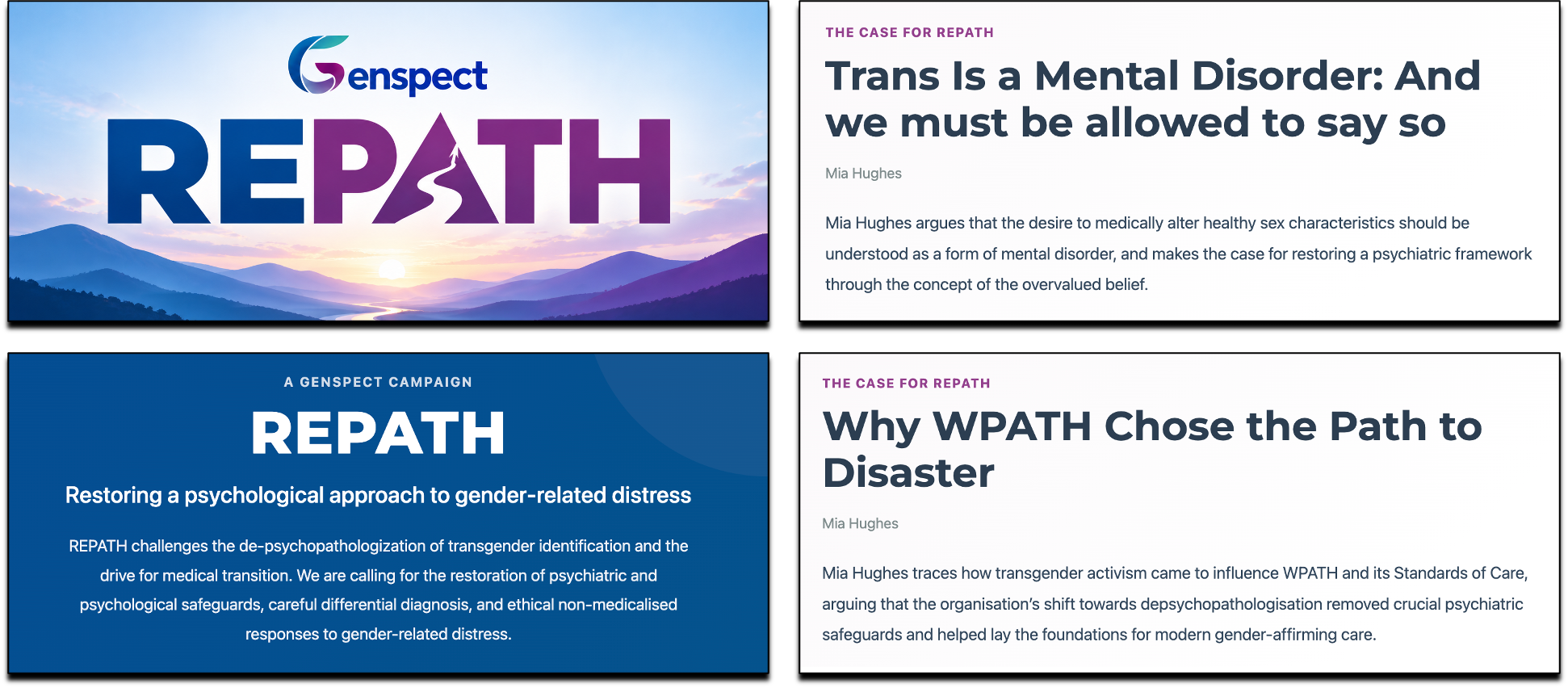
O’Malley, together with her colleague Mia Hughes, recently launched Genspect’s REPATH campaign, which defends one answer to this question: better care for gender-distressed youth requires “re-psychopathologizing” trans identification. The campaign includes a video series, an essay series, and a collection of relevant historical and scholarly materials. Hughes’s latest essay (at the time of writing), posted to the Genspect website on September 15, is titled “Trans is a Mental Disorder: and we must be allowed to say so.”
The basic idea behind “re-psychopathologizing” is that once we understand the history and key developments in approaches to trans identification, it becomes clear that de-psychopathologizing trans identification was a crucial misstep. This newfound clarity presents an obvious remedy: re-psychopathologizing.
From this point on, I will drop the “—psycho—” part of these cumbersome terms and simply refer to de-pathologizing and re-pathologizing, because the important question is whether we should treat trans identification as pathological, and the answer does not depend on understanding trans identification in psychiatric or psychological terms.
From their discussions in the campaign’s video series, it is evident that O’Malley and Hughes have faced pushback along the lines that calling trans identification a mental disorder stigmatizes trans-identified people. O’Malley’s response is that we should not stigmatize mental disorders, given that they are not anyone’s fault and can befall anyone. This response is perhaps not entirely adequate, because if we do currently stigmatize mental disorders, then arguing that something not currently considered a mental disorder should be considered one risks inviting stigma for it.
But that is not the disagreement I am here to pursue.
My disagreement is more fundamental: I believe that better care for gender-distressed youth does not require re-pathologizing trans identification, for the simple reason that trans identification is not pathological. If it is not pathological, then de-pathologizing it cannot have been a misstep, and re-pathologizing it cannot be the right remedy. Of course, there have been missteps in the history of approaches to trans identification, but I would argue that they occurred elsewhere and require different solutions.
