




Affiliate Disclosure: This article contains affiliate links. We may earn a commission from purchases made through these links. As an Amazon Associate, RLS earns from qualifying purchases.
Reality’s Last Stand is a reader-supported publication. Please consider becoming a paying subscriber or making a one-time or recurring donation to show your support.

About the Author
William Costello is a doctoral researcher in evolutionary psychology at the University of Texas at Austin. His work focuses on all aspects of human mating psychology. His research has appeared in American Psychologist, Evolution and Human Behavior, and several other academic journals. He has also appeared on several prominent podcasts, including multiple appearances on Modern Wisdom, discussing evolutionary psychology, relationships, sex differences, and contemporary social issues.
Novig is a new “sports prediction market”. That’s just a sophisticated-sounding way to gamble on sport. Sydney Sweeney owns equity in the business, so saying she has skin in the game is putting it mildly. As its face (and body), she is cashing in on the oldest maxim in marketing: sex sells!
In a controversial advert, American footballs and a strategically placed tennis racket fight a losing battle to cover her curves. The slogan is “No wars. No death. No politics. Just sports.”

One might expect conservatives to be the ones objecting to a naked actress promoting gambling. But instead, an army of progressive scolds has arrived waving banners of concern about women’s sport. This is despite Sweeney arguably epitomizing the archetype they claim to adore. She is an empowered and independent businesswoman, exercising her sexual autonomy, leaning in, and girlbossing. Her body, her choice, after all? Meanwhile, conservatives cheerleading the advert seem to find the opportunity to own the libs more seductive than fidelity to their own principles.
Female athletes are divided too. WNBA player Sophie Cunningham rejected the suggestion that the advert was an attack on women’s sport, saying, “Go do your thing, sis.” Others, such as Ariarne Titmus, called it “a kick in the face” to women who have dedicated their lives to sport.
One Irish radio presenter even suggested that Sweeney had “set women’s sport back forty years in forty seconds.”
What a remarkably low opinion of women’s sport!
Earlier this month, I cheered on Katie Taylor as her farewell fight drew more than 82,000 fans to Croke Park in Dublin. An Olympic gold medalist and undisputed world champion at both lightweight and super-lightweight, she arguably single-handedly put women’s boxing on the world stage through her courage and extraordinary skill.
Quite frankly, I found the presenter’s comments demeaning. The achievements of Katie Taylor and countless other extraordinary sportswomen are not so fragile that Sydney Sweeney’s breasts can undo them, formidable and all as they are.
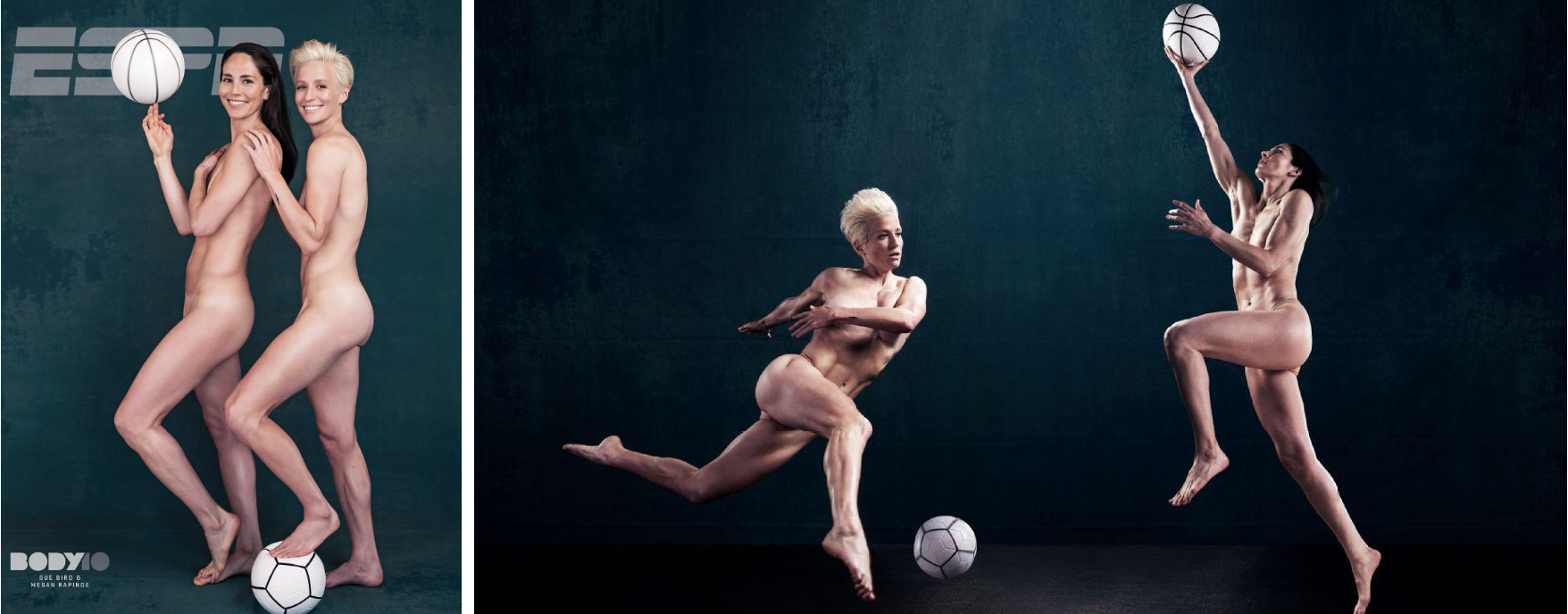
Sweeney herself responded by sharing nude photographs of athletes, including Megan Rapinoe in ESPN’s Body Issue. Female nudity evidently represents either empowerment or moral panic, depending on who is naked and whose approval she seeks.
Throughout this essay, I’ll use theories and evidence from evolutionary psychology to explain this selective outrage through three connected processes: (1) intrasexual competition, (2) female coalitional psychology, and (3) sexual economics theory.
After mansplaining female intrasexual psychology, I’ll explain why Chads (exceptionally attractive men) don’t seem to vex other men in quite the same way. I’ll finish by highlighting the very real gambling harms to young men that this controversy largely overlooks.
The Privilege and Perils of Female Beauty
In a previous essay for Reality’s Last Stand, evolutionary psychologist Aaron Lukaszewski used Sweeney to illustrate the science of female beauty. Evolutionary psychologists challenge the idea that beauty is simply in the eye of the beholder, locating it instead in the adaptations of the beholder. The eye doing the beholding belongs to a brain shaped by selection, and cross-cultural research finds substantial agreement about beauty. In women, recurring ingredients include feminine facial features and a relatively narrow waist compared with the hips. The evolutionary logic is that many of these preferences guided ancestral men toward cues of youth and reproductive potential.
Pretty privilege is real. Research on attractiveness bias outlines a form of favoritism that people often fail to recognize.
But beauty also comes with costs. Primarily, it makes you a target of more intense intrasexual competition from rivals.
Human mate preferences set the ground rules for intrasexual competition. Well-replicated cross-cultural research consistently finds that men prioritize youth and physical attractiveness as cues of reproductive value, while women place greater weight on financial prospects.
From these preferences flows a whole suite of behaviors, including strategies we use to make ourselves desirable and tactics we use to derogate rivals. Calling another woman “promiscuous,” for example, can serve to question her fidelity and undermine her perceived value as a long-term partner. This targets men’s preference for sexual fidelity, which evolutionary theory connects partly to paternity uncertainty and the ancestral risk of investing in another man’s offspring.
Mate preferences also explain which rivals make us insecure. Meta-analytic evidence shows that women exhibit greater jealousy in response to physically attractive rivals, while cross-cultural research finds that men are more distressed when rivals surpass them in financial prospects and physical strength.
But there are plenty of beautiful young women. Why does Sweeney, specifically, seem to get under other women’s skin?
Sydney Sweeney Is a Guy’s Gal
“Pick me” and “not a girl’s girl” are favored insults women use to police one another’s allegiances. The accusation is that such women seek male approval at other women’s expense. To understand why these insults carry such force, we need to consider how women’s styles of intrasexual competition evolved throughout ancestral history.
Central to the evolutionary logic is Anne Campbell’s “staying alive” hypothesis. Across cultures, women provide most childcare, and a mother’s death has far greater consequences for her children’s survival than a father’s. Children’s enormous dependence on their mothers created strong selection pressures for women to avoid serious injury and death.
Women’s stronger immune responses and lower pain thresholds fit this broader account of physiological adaptations for survival, alongside greater fear of danger and lower risk-taking.
But survival also depended on people you could count on for childcare, food, and protection, especially where marriage meant leaving your own kin. Women needed reliable allies. The difficulty is that those allies could also be competitors.
Women often manage this by disguising competitiveness and playing down inequalities. You can try to get ahead, but making a great show of it risks alienating people you still depend on. Indirect competition allows you to damage a rival while limiting retaliation and retaining plausible deniability.
Evidence suggests women are more supportive than men of egalitarian outcomes and equity over merit-based hierarchies. Beauty is a particularly visible inequality, and its rewards are hardly distributed fairly.
The girl code requires successful women to make themselves less threatening. Women value humble, loyal allies. Self-deprecation and intimate disclosures of vulnerability reassure other women that your advantages have not gone to your head.
A “guy’s gal” invites a different suspicion.
One X post suggested Sweeney “seems like the kind of girl who would steal your boyfriend behind your back.” There is research on precisely this perception. Women who preferred male friends were judged by other women as less trustworthy and more sexually unrestricted. A preference for male friends was also associated with more unrestricted sexual behavior. The suspicion therefore had some empirical basis. Cross-sex friendships often involve attraction, and mate poachers can use friendship as an infiltration tactic. From an error-management perspective, suspicion of guys’ gals can make sense. Overlooking a genuine threat to your relationship can cost more than being unnecessarily wary.
One of Sweeney’s sins is that she entertains men without first assuring women that their approval disgusts her. Contrast this with Sabrina Carpenter, the archetypal “girl’s girl” to whom Sweeney is so often juxtaposed. Her sexual presentation comes with a clear assurance of female allegiance. Her hit song “Manchild” ridicules male incompetence. Nobody is left wondering whose side she is on.
My reading of celebrity culture is that public declarations of empathy offer similar reassurance. Supporting vulnerable people, such as civilians in Palestine, signals a good female ally. I prioritize our collective interests. My success is safe for you. Young women are far more likely than men to hold “woke” attitudes, and in a culture of “silence is violence,” solidarity must be performed aloud. For progressives who insist that sport should carry symbolic political gestures like taking the knee to protest racism, “No politics. Just sports” won’t suffice.
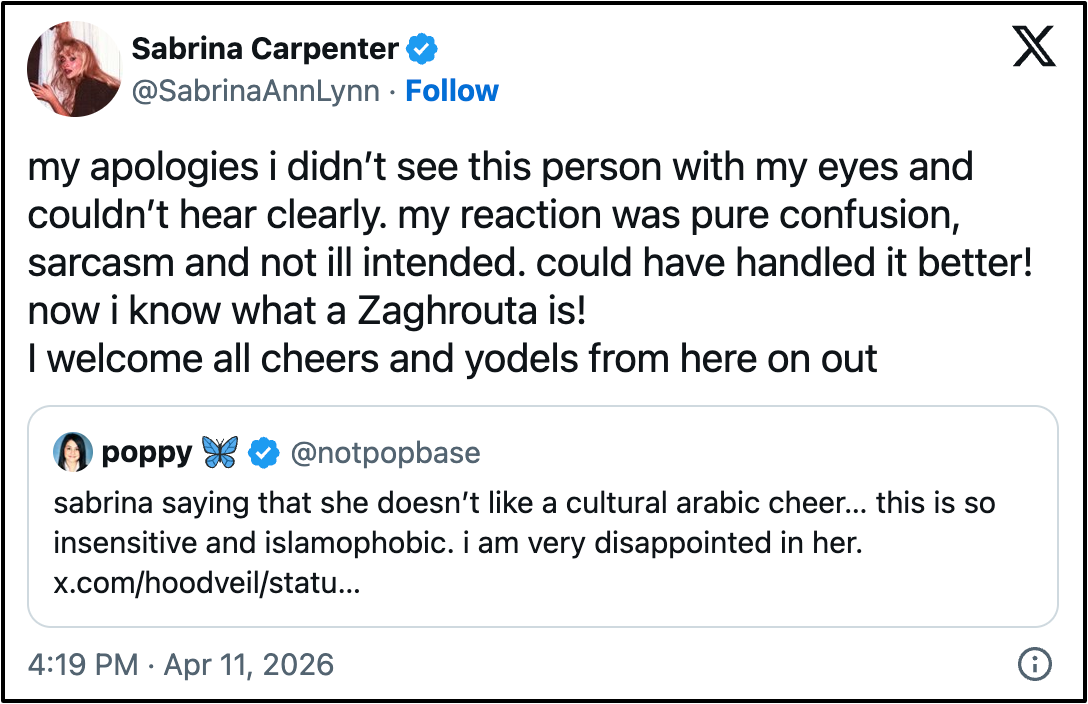
Sweeney’s American Eagle “great jeans” campaign had already generated racism and eugenics accusations. Unlike Carpenter, who publicly apologized for calling a fan’s Arabic celebratory cry “weird”, Sweeney initially declined the expected struggle session.
Trump’s defense helped cement her political coding. Once someone is condemned to the “wrong team,” I’m afraid her cleavage is never looked at quite the same way again.
One irony is that accusing Sweeney of delegitimizing women’s sport seems particularly strange when she produced and starred in Christy, portraying boxing pioneer Christy Martin’s achievements and survival of horrific domestic abuse. Her roles in The Handmaid’s Tale and Immaculate offer further feminist credentials. Yet these seem to count for little once she is deemed “for the boys” and conservative-coded.
TL;DR: Sweeney violates the expectation that women compete quietly while putting female solidarity first. Her brazen embrace of the male gaze is perceived as disloyalty to women. Court that attention so openly, and you forfeit the sisterhood’s support and invite collective condemnation.
Intrasexual Competition Is Not Just Jealousy or Envy
I feel for women whose valid criticisms of other women get dismissed as “just jealousy.” If denying a competitive motive is taken as proof of self-deception, she is caught in a Kafka trap. Her denial becomes evidence against her.
Part of the confusion comes from treating competition as synonymous with jealousy or envy. These are distinct emotions, although they are often mistakenly used interchangeably. Jealousy concerns the threatened loss of a relationship (e.g., She might take my partner). Envy concerns another person’s advantage (e.g., I wish I looked like her). Intrasexual competition can involve either, both, or neither.
It can also involve derogating traits you want discouraged so that other qualities—likely your own—are rewarded instead. A woman might criticize Sweeney’s sexual display because she wants men to value intellect or athletic achievement more. Feeling neither jealousy nor envy, she may honestly conclude that she feels she is not competing.
The eminent evolutionary biologist Robert Trivers argues that deceiving ourselves can help us deceive others. Experimental research finds that people motivated to persuade others can convince themselves through selective information gathering, then become more persuasive. I suspect this is especially important in female intrasexual competition, where plausible deniability is so valuable. Sincerely believing you are defending women’s sport may make you more convincing while undermining a rival.
Ultimately, all criticism should be judged on its merits. A criticism can be competitively motivated and still be entirely valid.
Sexual Economics Theory
Another related concept is sexual economics theory, which models bargaining over sex, commitment, and resources, with women more often occupying the seller’s position and men the buyer’s. The “price” can be attention, investment, or commitment.
The logic resembles a cartel maintaining a price floor. Women demanding substantial investment have an interest in discouraging others from accepting less. Sexual shaming can police that undercutting.
Research shows that women react negatively to an attractive woman dressed provocatively but barely notice her when she is dressed conservatively. Other research finds that women were more willing than men to punish sexually accessible women, even at a cost to themselves.
If Sweeney’s sexual display wins attention and money, others may feel pressure to compete on those terms.
Men have an analogue in “simp-shaming”: ridiculing men who shower women with money, attention, or deference. The complaint is that they raise the price everyone else must pay.
The Breasts
I suppose we should address the two biggest reasons why so many men adore her while so many women resent her.
Breast preferences do not obey a simple “bigger is better” rule. Neither do women’s penis preferences (whether that’s good news or bad news for you, dear reader, I couldn’t possibly say).
Cross-cultural research finds variable preferences for breast size but a consistent preference for firmness. This fits the nubility hypothesis, which proposes that breast morphology signals remaining reproductive potential.
Women show greater willingness to derogate women with larger breasts and attribute greater sexual promiscuity to larger-breasted women. Those perceptions could reinforce the mate-poaching suspicions attached to Sweeney mentioned earlier.
Sydney Sweeney is, of course, unlikely to meet most critics’ boyfriends, let alone steal them. But our competitive psychology evolved in environments where repeatedly seeing an attractive rival usually meant she was part of your social world. Evolutionary mismatch may help explain why knowing they will never meet her does not necessarily stop women from viscerally reacting to her as a competitor.
Why Don’t Men Hate Chad?
Women also desire attractive partners. Why, then, does Chad receive admiration while Sweeney receives condemnation?
Part of my explanation is that an impressive man can be both a mating rival and a valuable ally. Hunting, defending resources, and surviving violent conflict rewarded having strong, capable men beside you. The qualities that attracted women could also benefit male friends.
A meta-analysis found that men valued friends’ fitness and status more, while women valued intimacy and disclosure. Men also prioritize friends who provide access to potential mates.
Some of Chad’s advantages may also feel attainable. You may not be able to acquire his height (unfortunately for me), but you can build muscle, develop skills, and earn status. Benign envy can motivate improvement when the desired advantage seems within your control.
For women, youthful beauty presents a different problem. Nobody can earn another twenty-third birthday. Comparison may feel less like an invitation to improve than a reminder of a ticking clock or a deadline.
Envy, therefore, has a different emotional texture for women. Sydney Sweeney literally embodies an advantage that effort cannot reliably reproduce. In other words, a woman can grow a shapely ass in the gym, but she cannot bench-press her way to big naturals.
Heteropessimism and the Obligation to Disparage Men
Another mark against Sweeney, it seems, is insufficient heteropessimism (i.e., public embarrassment or hopelessness about the heterosexual experience). In its familiar female form, attraction to men becomes an unfortunate condition requiring regular public denunciation. You can still want a boyfriend, provided you convey sufficient disappointment in the species.
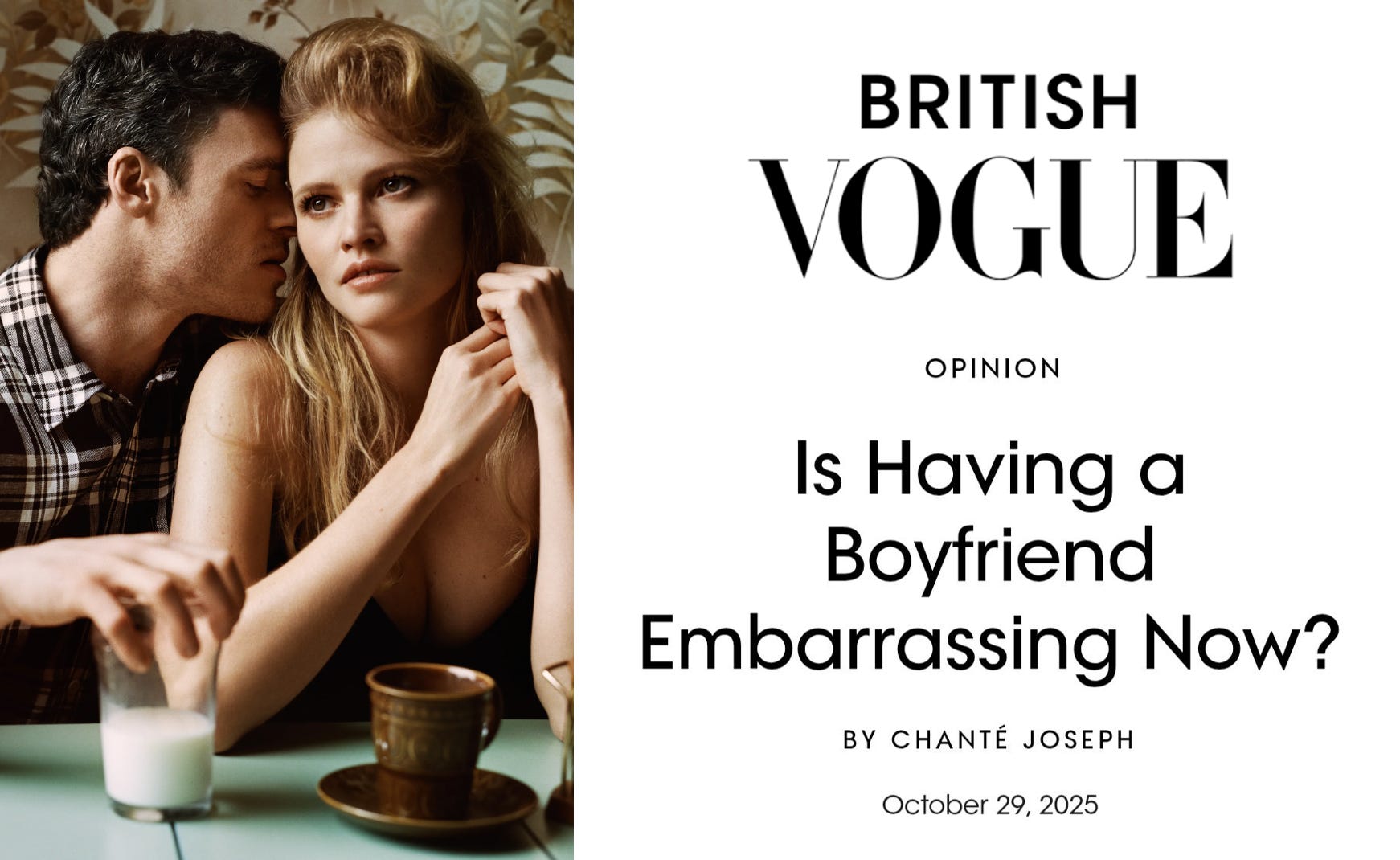
British Vogue’s “Is Having a Boyfriend Embarrassing Now?” describes women downplaying relationships online, losing followers after posting partners, and worrying that sharing their happiness looks boastful. The author explicitly connects public complaints about men with demonstrating solidarity with other women. One quoted comment, “Why does having a boyfriend feel Republican?”, also captures the overlap between political and gender wars.
Heteropessimism may therefore let women enjoy romantic success without appearing too pleased with themselves or too eager for male approval. Publicly disparaging men can reassure rivals and provide cover against “pick me” accusations.
Sweeney offers little such reassurance. She also seems unwilling to play the victim of the male gaze. Moral typecasting research finds that people readily cast women as victims. Sweeney instead presents herself as a beneficiary of male desire, not its victim. She understands her appeal and intends to profit from it. She perhaps realizes that she need not persuade women to want to be her when she can instead sell something to men who want her.
In the New Statesman, Faye Curran applies Turkish feminist Deniz Kandiyoti’s “patriarchal bargain” to Sweeney, whom she describes as “an actress of fluctuating talent who knows a bargain when she sees one.” She writes, “women can negotiate with patriarchal structures, rather than simply submit to or resist them…extract what advantages they can: protection, status, money. You do not have to believe in the system to make it work for you. Sweeney has figured this out, and is flapping her $100 bills directly in our scrunched-up, reddening faces.” Did I already mention sexual economics theory?
Ironically, criticizing Sweeney as having “only her looks” overlooks her two Emmy nominations and her $40 million fortune. Recognizing your assets and how to profit from them hardly suggests an absence of brains.
All of this is to say that, for any argument treating sexual objectification as inherently injurious, a woman visibly enjoying male sexual attention makes for an awkward witness. Sweeney’s reveling in it may irk women who feel unable to enjoy or profit from the same attention.
Gamma Bias and the Double Standards of Sexual Objectification
The suspicion of men running through heteropessimism has a counterpart in how we judge expressions of sexual desire. Women ogling men can be celebrated as playful and liberated, while men ogling women are accused of degrading them. This fits the proposed gamma bias framework, which describes selectively emphasizing or downplaying gender in ways that favor women.
Consider the viral footage of women filming Carlos Alcaraz removing his top at the US Open. An Independent columnist explicitly defended the double standard, arguing that women ogling male players was acceptable while the reverse would be sexist.
Chris Williamson and I discussed another example when Gwyneth Paltrow joined Alex Cooper on Call Her Daddy to gleefully compare Brad Pitt and Ben Affleck’s performances in bed. Now imagine Chris or Joe Rogan asking Brad whether Jennifer Aniston or Angelina Jolie was better in bed. I suspect there would be uproar.
However, evolutionary theory offers principled reasons why sexualization can feel different for women. While additional sexual partners could increase ancestral men’s reproductive success without the obligatory costs of pregnancy and nursing, sex carries much greater risks and costs for women. Men are generally more open to casual sex and even relax their standards for short-term partners. Men often welcome sexual attention even from women they have little interest in pursuing. For a woman, an unwanted admirer who could physically overpower her presents a different calculation. Women face higher rates of sexual violence and greater associated costs.
This helps explain why men generally welcomed the idea of being featured without consent on the “Hot Dudes Reading” page, while young women report that being catcalled is closer to awful than awesome.
Misplaced Outrage and Imperfect Victims
Sydney Sweeney is selling gambling to young men. That deserves more scrutiny than her cleavage.
The wider industry offers ample reason for concern. A New York Times investigation reports that DraftKings uses AI to target betting incentives at gamblers most likely to lose, while resisting similar technology designed to protect customers at risk of addiction.

The American Institute for Boys and Men’s report cites a survey finding that 48 percent of men aged 18–49 had an online sportsbook account, compared with 22 percent of adults overall. Among male online bettors, 23 percent had lost enough on a bet to struggle with financial obligations.
The damage follows them home. Family research documents relationship conflict and emotional distress. A review covering 107 studies found that people with gambling problems had roughly 2.8 times the odds of reporting a lifetime suicide attempt compared with people without gambling problems.
During our podcast episode, Chris Williamson recalled gambling’s corrosive effects while growing up in northeast England. He said he repeatedly refuses gambling sponsorships because of the harm they cause young men. For someone whose work has been described as “toxic masculinity,” his refusal to profit from young men’s vulnerabilities deserves credit.
The evolutionary psychology of the “young male syndrome” helps explain the appeal of gambling to young men, connecting risk-taking with competition for status and reproductive success. For a young man who feels behind in the status hierarchy, a gamble promises a spectacular leap compared with education, skill-building, and career progression, which take years.
The presence of an attractive woman may do more than catch his eye. Experiments have found that exposure to potential female mates increased men’s valuation of wealth and status. Some studies also report greater financial risk-taking following erotic cues, while two more experiments found increased willingness to choose risky investments specifically among men with no previous romantic relationship.
Put an exceptionally attractive woman beside an opportunity to win money, and you may intensify a man’s desire for wealth while offering a frictionless but risky way to pursue it.
Why might young men’s vulnerability be overlooked in favor of a moral panic about women’s sport? Recall moral typecasting, our tendency to more readily recognize women as victims and men as perpetrators. A review of the evidence documents a broader pattern of greater protectiveness towards women. Identical harms are often judged more serious when women suffer them. In one “moral chivalry” experiment, participants sacrificed more money to protect women from painful electric shocks than men.
A young man who gambles away his wages makes an imperfect victim. He placed the bet. He should have known better. We recognize his agency in his own downfall far more readily than we recognize the parasitic businesses feeding on his desperation. While the culture debates a supposed symbolic injury to women’s sport, the young man lying awake wondering how he will pay the rent barely enters the argument.
But compassion should not require a perfect victim. Young men can make bad decisions and still deserve protection from businesses exploiting their vulnerabilities.
Ultimately, Sydney Sweeney’s exquisite breasts are unlikely to cost a single woman a sporting medal. The product she is promoting could cost someone his savings, his relationship, or worse, his life. That should be the real story.
For further reading, Joyce Benenson’s Warriors and Worriers and Maryanne Fisher’s edited The Oxford Handbook of Women and Competition. This essay draws on many researchers work linked throughout. Too many to name.
RLS Readers: Save 50% on SEGM’s 2026 Conference
The Society for Evidence-Based Gender Medicine (SEGM) is bringing leading researchers, clinicians, patients, parents, and legal experts to Washington, DC, November 5–7, for its 2026 conference, “Rethinking Youth Gender Medicine: Charting a Path Forward.”
Over three days, speakers will examine what the evidence on youth gender medicine actually shows, where important uncertainties remain, and what ethical and responsible care should look like going forward.
SEGM has generously extended a special 50% discount to Reality’s Last Stand readers on both in-person and livestream tickets! Use promo code RLS-SAVE50% when registering.
This special rate may not last forever, so register soon if you plan to attend.

If you enjoyed this free article, please consider upgrading to a paid subscription or making a recurring or one-time donation below to show your support. Reality’s Last Stand is a reader-supported publication, and your help is greatly appreciated.
If you enjoyed this article, you may also like…


I am not jealous of Sidney Sweeney. I grew up surrounded by images of this in the 80s and early 90s and experienced the resulting objectification from men. I understood even before puberty what those messages said about how men perceive women - as objects. Pretty privilege is not a thing, but if it is, men experience it too. I did not experience intra-competition from women, they actually complimented me on my looks. Men did too - while also sexually harassing me and posing a direct threat to my safety. When I see these sexualized poses, I harken back to an era I thought we overcame. But liberal women are "self objectifying " while Sidney Sweeney uses her body on a manner both exploitative of women and men, so looks like we are all going backwards. It doesn't matter if she is making money. She is sending a message that objectifying women is okay. Becuase it isn't sex that sales it is FEMALE BODIES that sale.
Which brings me to ESPN. Those photo shoots include women AND men and show ALL of them in neutral or powerful poses. It is not the same and people need to stop pretending context doesn't matter.
But I agree leftist women who don't call out leftist women for self-obejctification are hypocrites. Cardi B and Sabrina Carpenter are also doing great harm to women. By starting her song with "There are whores here" Cardi is actually doing more harm than Sweeney.
I also think all these righter wingers talking about family values are hypocrites for defending her using her body to take advantage of men through gambling. It is just all together a gross affair.