



Reality’s Last Stand is a reader-supported publication. Please consider becoming a paying subscriber or making a one-time or recurring donation to show your support.

About the Author
James L. Nuzzo, PhD, is an exercise scientist and men’s health researcher. Dr. Nuzzo has published over 80 research articles in peer-reviewed journals. He writes regularly about exercise, men’s health, and academia at The Nuzzo Letter on Substack. Dr. Nuzzo is also active on X @JamesLNuzzo.
Diversity, equity, and inclusion (DEI) is not merely a set of workplace trainings or campus slogans. DEI is a political movement rooted in critical theory, intersectionality, and “social justice”—ideas that often begin from premises at odds with reality. The result is a worldview that does not merely fail to promote human flourishing, but actively obstructs it.
That obstruction comes at a cost.
A framework for understanding those costs can help explain the damage DEI has done, expedite its removal from institutions, and warn future generations against repeating the mistake. DEI imposes three broad kinds of costs: the cost of commission, the cost of omission,[1] and the cost of correction.
The Cost of Commission
The cost of commission is probably what most people think of first when they think about the price of DEI. It is the cost of doing DEI.
Some of that cost is financial. Between 2016 and 2024, the University of Michigan spent $250 million on DEI staffing and programs, with many DEI staffers earning between $152,000 and $416,000 per year. Federal agencies have spent billions more on DEI-related projects, including the Departments of Education, Defense, and Health and Human Services. And because DEI causes bureaucracy to bloat, it reduces institutional efficiency that creates indirect costs that are harder to measure but no less real.
DEI also creates unnecessary noise in systems. In academia, this has been achieved by lowering the bar for what counts as rigorous scholarship. Thousands of DEI-based papers are submitted to journals each year, further clogging an already overburdened and flawed peer-review system. Professors’ inboxes fill with requests to review weak papers dressed up in fashionable jargon. When those papers are eventually published, they pollute databases with junk research that other scholars must waste time navigating around.
But the costs of commission do not end there.
DEI policies and practices also harm human health and well-being. They include the physical and psychological harms caused by “gender-affirming care.” They include the injuries, lost medals, and lost opportunities suffered by women and girls forced to compete against male athletes. They include the damage done by public health authorities telling people that their health is almost entirely determined by “structural” forces, and feminist psychiatry telling boys and men that their struggles are the product of privilege and toxic masculinity.
DEI judicial activism is another costly act of commission. When judges influenced by critical legal theory treat criminals less harshly because those criminals occupy favored identity categories, the public becomes less safe. Take, for example, the case of a New York City woman who, after being assaulted by a black man, refused to cooperate with prosecutors because she did not want to see another black man go to jail. Weeks later, that same man killed an elderly man in the subway.
Human life, quite literally, can be one of the costs of DEI.
The Cost of Omission
The costs of commission are bad enough. But for every act of commission, there is usually an omission.
Omission means leaving something out, or failing to do something that should have been done. In the case of DEI, the cost of omission is the cost of all the things institutions did not do because they were busy doing DEI instead. It represents the counterfactual: the research not conducted, the students not taught, the time not spent on the actual mission of the institution.
Counterfactuals are hard to quantify because they concern things that never happened. Nevertheless, we can still speculate rationally about the kinds of losses DEI has imposed.
In academic research, the cost of omission includes the knowledge that was never produced because a government agency funded a DEI project instead of a more academically serious one. It includes the papers that were never published—or were delayed in publication—because their conclusions offended the ideological commitments of journal editors. And, in the most extreme cases, it includes the entire careers and research programs derailed because scholars were punished or cancelled for challenging DEI orthodoxy.
In teaching, the cost of omission is the insightful lecture students never heard because a professor was hired for ideological or demographic reasons rather than academic merit. It is the serious course material that was minimized, distorted, or crowded out to make room for DEI programming. It is the hours students spent completing ideological coursework instead of studying history, biology, economics, literature, mathematics, or any number of subjects that might have actually expanded their minds. One analysis estimated that undergraduates in the United States spend a combined 40 million hours fulfilling DEI course requirements.
Finally, there is the time lost by faculty and staff. In 2024, more than 4.1 million people worked as faculty or staff at American colleges and universities. If each spent just 30 minutes a year on DEI-related requirements, that would amount to more than 2 million hours annually diverted from other work. Even if the burden were only 10 minutes per person per year, the total would still be roughly 685,000 hours.
Those hours could have been spent grading papers, answering student emails, improving lectures, reading scholarship, writing papers, collecting data, analyzing results, or simply giving one’s mind a needed rest. Instead, they were fed into the DEI machine.
The Cost of Correction
The cost of correction is the time, money, and labor required to fix the problems DEI creates.
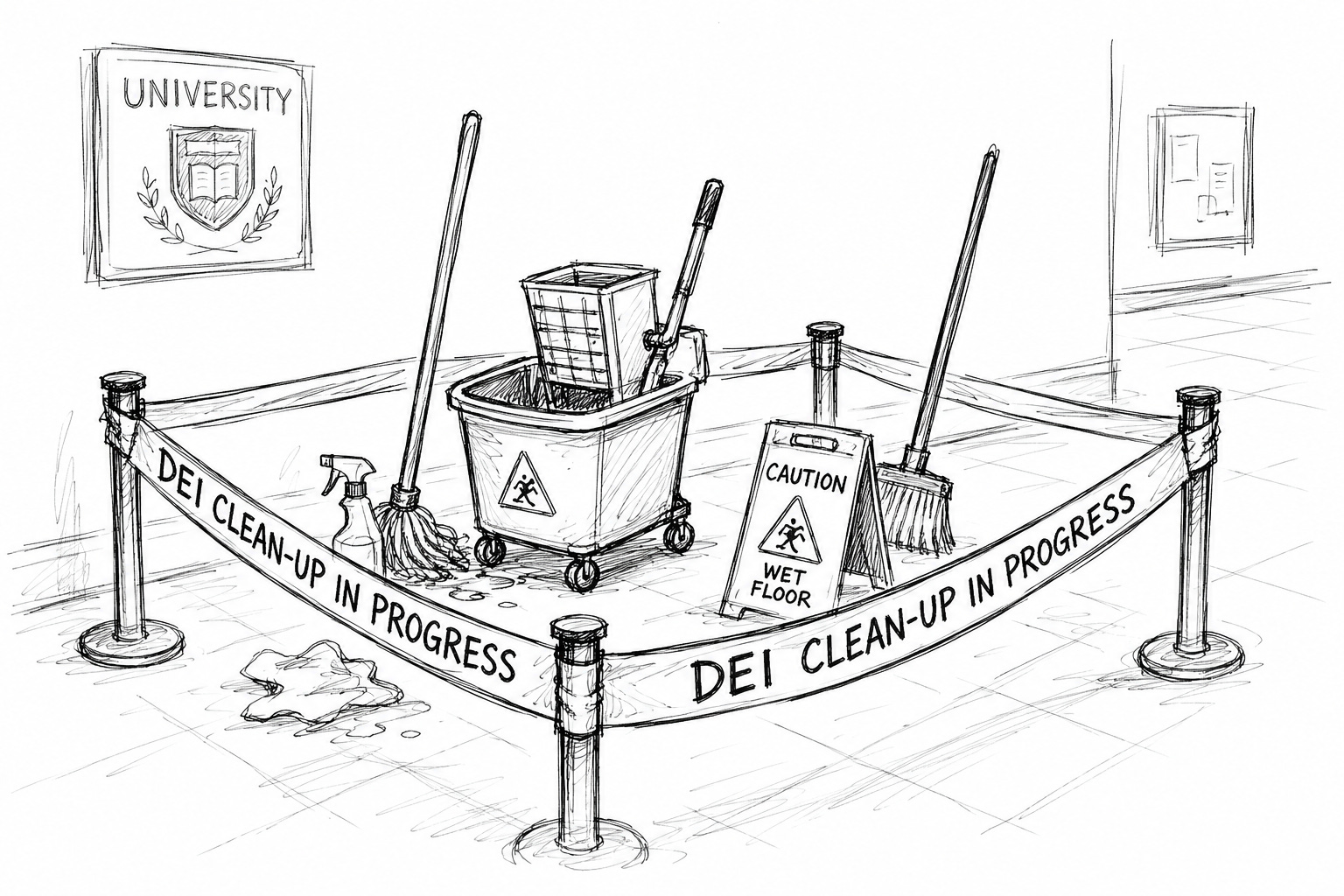
Correction is costly because it pulls people away from their usual productive work. The hours spent cleaning up DEI’s messes are hours not spent building, teaching, researching, writing, discovering, or creating something new. Correctors become institutional janitors, forced to spend their time cleaning up the ideological trash left behind by others.
Examples are everywhere. Individuals and organizations now devote enormous resources to correcting DEI-driven policies, such as Olympic rules allowing male athletes to compete in women’s sports. Others spend years challenging DEI’s legal overreach, including lawsuits over discriminatory hiring practices and the destruction of sex-based protections for women and girls.
Then there are the institutions created as alternatives to DEI-captured ones. Peterson Academy, the University of Austin, and the growing network of classical liberal schools all exist, at least in part, because so many existing educational institutions have been corrupted by DEI. The same is true of organizations founded to oppose DEI’s excesses, including Reality’s Last Stand, Do No Harm, The College Fix, and Critical Therapy Antidote.
Researchers pay this cost, too. They spend hours, days, and sometimes years correcting crazy DEI research that should never have passed peer review in the first place. Each week, Colin Wright and I devote many hours to this corrective work. But we are not alone.
Consider David Geary, a professor of psychology at the University of Missouri. In 2021, and again in 2025, Geary took time away from his usual research and teaching in evolution and cognitive development to write essays in Quillette exposing the blatant sex discrimination embedded in the World Economic Forum’s Global Gender Gap Index.
When serious scholars like Geary must spend their days on DEI clean-up duty, something valuable is lost. The public gains a necessary correction. But science loses the work those scholars might otherwise have done.
Residual Costs and the Clean-up Mission
DEI has imposed enormous costs through commission, omission, and correction. Some of the direct financial costs can be quantified. But many of the deeper costs are harder to measure: the wasted time, the institutional decay, the research never conducted, the careers derailed, the standards lowered, and the years now required to repair the damage.
And the costs are not confined to today and the past. They will persist for years.
In a recent analysis, I found that some aspects of DEI in academic articles appear to have peaked a year or two ago. But others have not. Even where the trend has started to decline, the prevalence of DEI language remains far higher than it was before 2019.
That means the institutional clean-up mission is far from over. Universities are now staffed by DEI-era hires who carry these assumptions into their teaching, research, mentoring, peer review, and administrative work. Even if formal DEI offices are dismantled, the ideology will live on inside departments, journals, classrooms, grant committees, and professional associations.
DEI has been a societal nuisance. It has wasted time and money, increased political polarization, lowered standards of performance and civility, and lied to people about the causes of their own circumstances.
None of this matches the image DEI activists like to project: empathy, kindness, inclusion, moral superiority. There is nothing especially empathetic, kind, or moral about uprooting the foundations of human freedom and flourishing and replacing them with lies, discrimination, and a return to tribal warfare.
Those engaged in DEI clean-up duty should not lose sight of the importance of the mission.
Thank you for supporting Reality’s Last Stand! If you enjoyed this article and know someone else you think might enjoy it, please consider gifting a paid subscription below.
If you enjoyed this article, you may also like…


One of my big concerns with DEI is that while yes, there has been pushback and some walking back of DEI, it never quite walks back to the original starting point. What happens instead is that some bad ideas/policies never quite go away, to the point where a generation of people come up who don't even realize that what they consider the status quo hasn't been so forever, and is actually quite recent. These bad ideas get entrenched as the institutional memory of the change (and the "reasons" for the change) fade.
One example is the Ethnic Studies requirement in California. Newsom signed into law Ethnic Studies as a graduation requirement for every California high school student, back in 2021. The implementation of this law has been slow in high schools, but community colleges and universities followed suit, so now Ethnic Studies is a general education requirement, even for associates degrees. To meet this requirement my own school had to hire several ethnic studies professors, as what used to be a barely-existent discipline became one with high enrollment basically overnight. Presumably this happened at every school, all over the state, costing taxpayers untold sums of money. I remember having a conversation with our nursing counselor at the time, who of course didn't want to be seen as going against DEI orthodoxy, but complained that the nursing associates is a high-unit degree already, so they had to remove a class directly related to nursing to make way for the Ethnic Studies course.
The law Newsom signed was based on two flawed studies that essentially said the opposite of what was claimed by the authors (Richard Sander did a wonderful take-down of the papers here: https://www.tabletmag.com/sections/news/articles/studies-fail-to-support-claims-new-california-ethnic-studies-requirement), but now that the law is in place and years have passed, this situation is the norm. Regardless of how much DEI is rolled back, Ethnic Studies as a requirement has become the norm, and most people have no idea what sort of shoddy research its implementation was based on, and it's unlikely at this point that that requirement will go away. In fact, a new standard is currently being developed to unite the CSU and UC GE requirements and it of course contains Ethnic Studies as a category.
IMO, the clean-up metaphor is premature. The battle is still being fought. Many more dragons need to be slain before we can start to bury their carcasses.
And it remains a battle whose outcome is not yet certain.
Almost all recent progress has come from actions of the Trump administration. And EVERY Democrat in Congress is still a big proponent of DEI.
If the Democrats win the Presidency in 2028, all that progress will very likely be reversed.
So: the #1 task of anyone who wants to defeat DEI should be to work to elect Republicans to as many offices as possible.