




Reality’s Last Stand is a reader-supported publication. Please consider becoming a paying subscriber or making a one-time or recurring donation to show your support.

About the Author
George M. Perry is a sports performance coach and writer in Houston, TX. His work on cancelation covers mental health, free speech and defamation law, institutional failures, moral panics, neuroscience, history, media, and more. Most everything is on Substack at Abuse of Process.
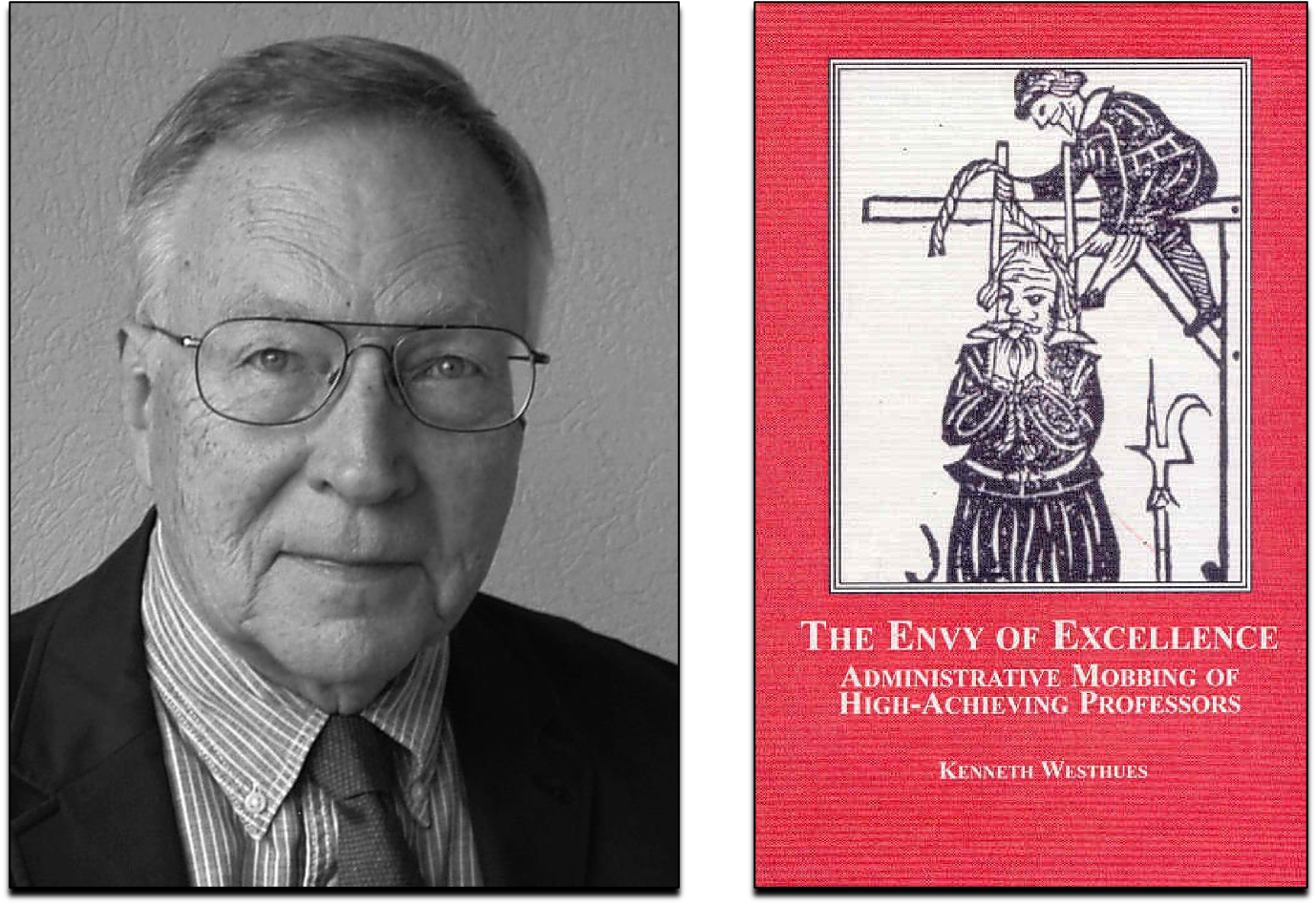
Usually, it’s someone from the outside joking that the whole academy, perhaps even all of society, is acting like a sociology department. Forty years ago, a sociology professor remarked to his dean, “Isn’t it a terrifying thought that the whole world may be becoming what our sociology department already is?” The professor, Kenneth Westhues of the University of Waterloo in Ontario, Canada, had already seen enough of a phenomenon that would sweep him up a few years later and become his main academic focus: workplace mobbing.
Workplace mobbing, cancelations, social eliminations… “There’s no need to get hung up on nomenclature. What matters is the horrific process, not the label,” Westhues says. He made a strong case for “social eliminations” in his 2005 book, The Envy of Excellence: Administrative Mobbing of High-Achieving Professors. “Cancelation” has the most currency in our culture and is my preferred term. “Workplace mobbing,” though, has gained the most traction in academia.
Higher education was the main focus of the workplace mobbing cases discussed at this year’s Niagara Conference on Workplace Mobbing. Presenters offered their analyses of why the frequency and intensity of workplace mobbing in academia have only increased since Westhues described universities as “settings where something odd and evil is afoot, something scarier and more elemental than occasional instances of professorial misconduct.”
“Why universities?” Ann Marie Flynn asked. “Because you get away with it.”
Flynn was the chair of the chemical engineering department at Manhattan College (now Manhattan University) until she became the target of a textbook case of university mobbing.
“The only way you can stop a mobbing is from the top down,” Flynn said. “But the university is very flat compared to the org chart of a company. There’s the faculty, the dean, the provost, the chancellor, and the president. It’s a very short pyramid.”
This means there are few institutional firebreaks once a mobbing begins.
