



Reality’s Last Stand is a reader-supported publication. Please consider becoming a paying subscriber or making a one-time or recurring donation to show your support.

About the Author
Holly Lawford-Smith is an Associate Professor in Political Philosophy at the University of Melbourne. Her latest book, Feminism Beyond Left and Right, came out with Polity in May. She writes semi-regularly for Quillette and Fairer Disputations. You can find her on X as @aytchellesse and on YouTube as @hollylawford-smith. She has just finished posting a (heterodox!) free weekly lecture series in the philosophy of feminism, based on the undergraduate course she taught for six years at the University of Melbourne.
The Australian Academy of the Humanities, Australia’s national body for the advancement of the humanities, held a symposium last week on academic freedom.
As a political philosopher who teaches an honors course on free speech and hate speech, as a passionate supporter of the UK’s Free Speech Union, which has helped countless academics in their battles against activist students and DEI-obsessed administrators, and as someone who has repeatedly faced challenges to her own academic freedom (both in teaching and in research), I was delighted that this event was taking place—and on my own campus to boot. I registered immediately.
I will admit that my enthusiasm dimmed somewhat when I scanned the programme and saw terms like “decolonial” and “trans refusals,” along with two trans-activist speakers and a representative from our tertiary education union—a union that has hardly covered itself in glory when it comes to defending gender-critical speech.
Still, there were plenty of talks and speakers that looked genuinely promising. Initially, Adrienne Stone and Peter Singer were both on the program—Stone, a law professor who co-wrote an excellent book about free speech and academic freedom in Australia; Singer, a philosophy professor emeritus who co-founded the Journal of Controversial Ideas in response to academic gatekeeping on contested topics. But Stone, for personal reasons, was unable to attend, leaving Singer as the only speaker with a public reputation for defending open inquiry.
The symposium turned out to be far worse than I could have imagined. I don’t mean this in the ordinary sense in which academic conferences are a predictable mix of good and bad talks. I mean that, as the day unfolded, the event became increasingly surreal. The best sense I could make of it was this: the Australian Academy of the Humanities wanted to be seen to have hosted an event on academic freedom, while simultaneously avoiding all of the difficult conversations that a serious event on that topic would inevitably require.
The first clue that something weird was afoot was the total absence of theory. It wasn’t until the third session of the day that anyone referenced a single theorist. Peter Greste invoked Isaiah Berlin’s distinction between positive and negative liberty, and Garret Hardin’s account of the tragedy of the commons, to argue that academic freedom is best conceived as a freedom from interference. In the final session, Peter Singer would finally introduce John Stuart Mill’s classic rationales for open debate.
The second clue was the unabashed left-wing virtue signalling. By my count, there were twelve separate acknowledgements of country, even though the event had already opened with a Welcome to Country by an Aboriginal Australian Elder. (At left-coded public events in Australia, the Welcome is preferred and the Acknowledgement is the fall-back; standard practice is to begin with one or the other, then move on.) One introductory speaker offered a rambling monologue against the Trump administration, framing threats to academic freedom as emanating exclusively from foreign right-wing governments. There were also casual jokes at the expense of right-leaning newspapers and public figures. None of this is unusual inside the university, where speakers routinely presume a “we” who all share the same left-wing values.
The third clue was the near total failure to name any specific topics where questions of academic freedom are actually contested. It is easy to defend an abstract principle; it is much more difficult to say, explicitly, that you defend open debate about these concrete topics or the expression of these particular views. One of the only speakers who did name such topics was Peter Singer, who explained that the Journal of Controversial Ideas publishes papers that face ideological gatekeeping elsewhere, and presented the audience with a list of subjects the journal has taken on. Perhaps if this had occurred in the first session of the day, things might have unfolded differently—but then again, there may be a reason Singer was placed on the final panel.
One of the speakers was so utterly charming that you could almost miss how tenuous his connection to academic freedom really was. Sean Turnell is an academic economist who was imprisoned in Myanmar after serving as an advisor to Aung San Suu Kyi, and he spoke about the support he received from the Australian Government during his ordeal. His story is extraordinary. But it frames the enemy of academic freedom as a foreign military junta (of course governments should work to free their political prisoners) while reducing the university’s own role in protecting academic freedom to virtually nothing.
It was members of the audience, not the speakers, who repeatedly raised the point that threats to academic freedom come just as much, if not more, from within the university itself.
This was never more evident than in the talks of two speakers in particular. Peter Anderson’s presentation was a textbook example of what Jason Stanley calls “undermining propaganda”: professing allegiance to an ideal while actively undermining it. Anderson’s talk, based on his doctoral research, was titled “Academic Freedom as a Decolonial Organisational Value.” But Anderson does not mean what most people mean by “academic freedom.” His proposal was to redefine academic freedom from an individual liberty held by academics to a collective right to self-determination possessed by Aboriginal Australians.
What that means in practice, as far as I can tell, is that Australian universities should be repurposed to serve the exclusive advancement of Aboriginal Australians. That is the exact opposite of academic freedom, for it would strip current academics of the liberty to determine their own research and teaching priorities. Anderson is not defending academic freedom as an organizational value at all; he is defending the prioritization of one particular social justice project as the primary organizational value, and in doing so in a way that would effectively end academic freedom as we know it. But by calling this reprioritization “academic freedom,” he is able to obscure the true nature of the proposal.
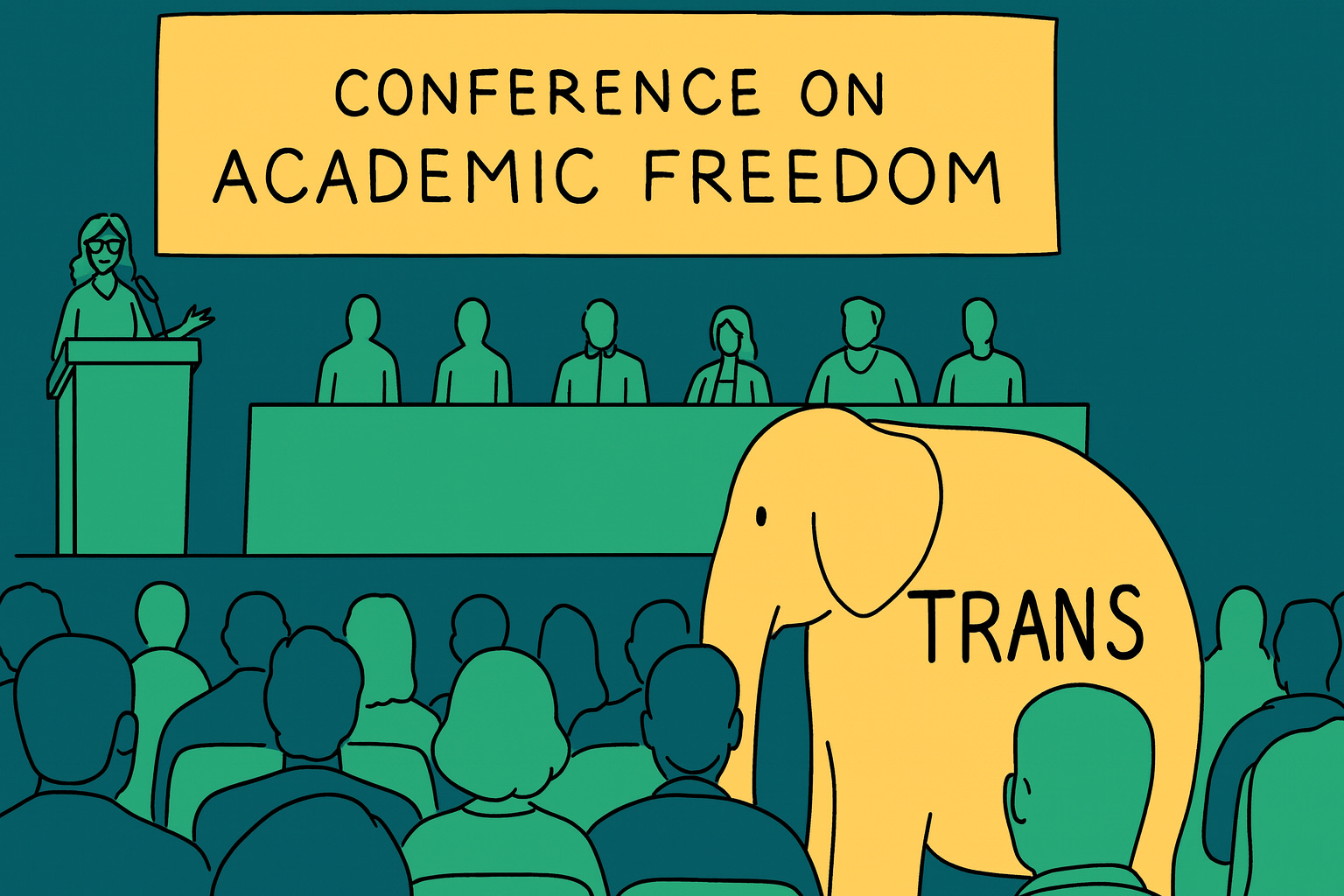
The talk by Yves Rees (a female historian who identifies as nonbinary), titled “Conducting Ourselves: Trans Refusals a la Code,” was by far the most unintentionally comical of the day. It was admittedly awkward to be one of the only gender-critical feminists in the audience while gender-critical feminism was dismissed as nothing more than prejudice. Still, given the way that trans activists tend to insulate themselves from the possibility of any challenge or criticism, it it probably a good thing that Rees had to face an audience with gender-critical feminists in it.
Rather than using her time to address academic freedom in relation to trans rights, Rees used it to grandstand about how she would not be discussing academic freedom in relation to trans rights—because, she claimed, gender-critical feminism is merely a façade for transphobic prejudice, and therefore no debate is permissible. What she did not spell out, of course, is what “trans rights” means in practice for activists like her: the elimination of any public debate or discussion about men accessing female spaces, services, and protections simply by declaring a “woman” identity. That includes men in women’s prisons, women’s sports, women’s shelters, and women’s changing rooms. Stating this explicitly would require engaging with the hard questions, so instead she evaded them. After sermon number one, Rees segued seamlessly into sermon number two, a political tirade about Gaza and concluded by defending academic freedom to criticize Israel.
If you’re wondering how she reconciled defending the right to criticize Israel while denying the right to criticize trans activism, you were not alone. We philosophers in the audience were whispering the same question among ourselves, and it was the first question raised by another attendee. In response, Rees dramatically declared that trans people are dying, as though this somehow entailed that debate about trans activism must be shut down. She did not explain how trans people are dying, or who exactly is killing them.
I left the symposium having learned nothing about academic freedom—though I did enjoy an excellent lunch (courtesy of the sponsor, I assume). The event left me wondering whether academia is in a far worse state than I had previously imagined, or whether something is simply very wrong within the Australian Academy of the Humanities in particular.
In my view, the most significant threats to academic freedom come primarily from within the university itself: from activist students, staff, and administrators, and from the institution’s growing obsession with “diversity” and “inclusion.” These pressures shape publishing and grant outcomes through peer review, and they shape teaching through student self-censorship. University communities are well known to skew left, and with that comes a characteristic prioritization of harm-avoidance. In conjunction with the recent conceptual inflation of “harm” to include mere discomfort or negative feelings—and a current institutional fixation on “cultural safety” for Aboriginal Australians, which risks being generalized to all cultural groups—there is a substantial threat to the freedom of research and teaching in Australia.
It is a travesty that an event that might have confronted these challenges chose instead to avoid even naming them.
If you enjoyed this free article, please consider upgrading to a paid subscription or making a recurring or one-time donation below to show your support. Reality’s Last Stand is a reader-supported publication, and your help is greatly appreciated.
If you enjoyed this article, you may also like…


There’s an strange form of parasitism in biology called “predatory brood parasitism” where one animal inserts its eggs or other offspring into the brood of another, convincing the host that the eggs or offspring are their own via mimicry. Then the parasite does its best to eject the other eggs or kill the offspring while taking their attention and nurturing.
In birds there are a few options - abandon the nest, kill the eggs or tolerate the parasite. In academia, the social cost is usually too high to remove the parasitic mimic, so it is tolerated.
A interestingly-named “Mafia Theory” also finds that if birds defend the brood, sometimes the parasite egg-layer will attack the host and destroy the nest and eggs.
This is precisely the game theory model of behavior now in “academia”, trans has displaced a legitimate focus for any number of disciplines, and fighting it can come at very high cost. The parasitic “toleration” response is the most common, but it is entirely at the cost of free speech.
Until academia evolves an effective response, it will remain completely compromised with parasitism.
In order to convince a generation that the earth is flat, the teachers must first be conned into believing. Then it is necessary to suspend free discussion so reality is obscured and critical thought is minimized. Reality is demonized by declaring anyone who believes the world is round is an “ist”. Marketing makes it “cool” and/or “compassionate” to believe the earth is flat. Humans being humans, they jump on board and ignore their doubts. The question that must be asked is why. How is easy to see as described above but why was this movement started in the first place. Until we start asking and answering “why” loudly and often, the efforts to divorce people from reality and suppress free speech will continue.