



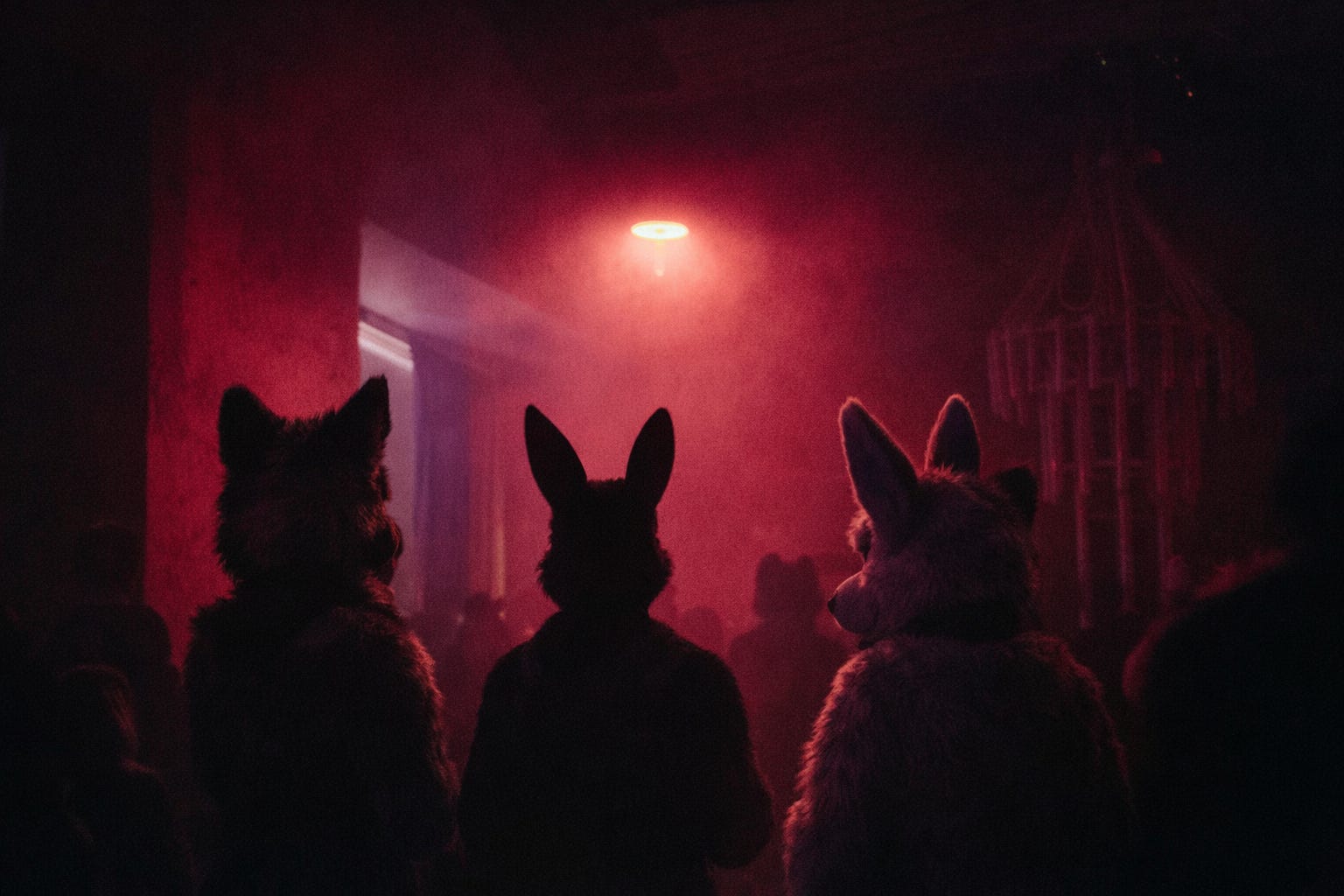
Reality’s Last Stand is a reader-supported publication. Please consider becoming a paying subscriber or making a one-time or recurring donation to show your support.

About the Author
Black Stag is the pseudonym of a writer and independent researcher, historian, and media scholar documenting the emergence of extremist ideologies historical trends, and media aesthetics in the furry fandom. He offers a first person perspective on the ground perspective of the fandom’s influence on society. He writes under a pseudonym due to the contentious nature of the subject and the documented hostility directed toward critics within the community. Subscribe to his Substack.
I’m a furry.
That’s probably not the sentence most readers expect to see at the beginning of an essay in Reality’s Last Stand. But it’s the truth, and it’s the place I have to start.
For more than two decades I’ve been part of the furry fandom—an online and offline subculture centered around anthropomorphic animal characters, artwork, role-playing, and elaborate costumes called “fursuits.” For most people on the outside, that description probably sounds odd, maybe even absurd and juvenile. But for those of us inside it, the fandom has often felt like something closer to a home: a place where creative people who never quite fit anywhere else could build their own communities.
For a lot of us, it still does.
But over the past several years I’ve watched something inside that community begin to change. Slowly at first, then more visibly. The shift has been subtle enough that many outsiders would never notice it, but those of us who have spent long enough in the fandom can feel it.
And in a few deeply disturbing cases, that shift has spilled out into the real world.
Thomas Crooks, the man who attempted to assassinate Donald Trump frequented in online spaces known for their furry fandom. Charlie Kirk’s likely assassin, Tyler Robinson, had a documented furry fixation, including a FurAffinity account, and even engraved one of his bullet casing with a well-known furry meme. The Dallas ICE facility shooter, Joshua Jahn, also appears to have been involved in the furry community based on several of his social media posts.
The details of those crimes are still being investigated and debated, and this essay is not an attempt to litigate any of those cases. I leave that for others to do.
What I want to explain, speaking as someone who has lived inside the fandom for more than twenty years, is the environment those individuals emerged from. The social dynamics, sense of identity, and ideological pressures that have slowly transformed parts of what was once a harmless, if eccentric, creative community into something dangerous.
Most furries are still exactly what they have always been: artists, hobbyists, animators, or ordinary people blowing off steam after work by inhabiting imaginary animal characters. But like many online subcultures, the fandom has developed pockets where extreme ideologies and apocalyptic ways of thinking fester unchecked.
This essay isn’t meant as an attack on the furry fandom as a whole. It is an attempt to explain how a subculture build around creativity and friendship has, in some corners, become vulnerable to ideological radicalization, social isolation, and increasingly dangerous rhetoric.
The fandom makes for a strange case study. It’s poorly understood by the public and frequently misrepresented by the media. But precisely because of that confusion, it offers a revealing window into how modern online communities can drift toward extremism without many people noticing.
I’ve spent twenty years inside this world. That comes with a certain responsibility to speak up when something is clearly going wrong.
And something is clearly going wrong.
A Subculture Much Larger Than People Realize
Most people have only the vaguest sense that furries exist at all. When they do hear about the fandom, it’s usually through jokes or sensationalized media coverage.
The reality is that the community is far larger and more economically significant than outsiders tend to assume.
Take conventions, for example. These gatherings are the public face of the fandom, and their scale surprises almost everyone the first time they see the numbers.
According to Wikifur, the flagship convention Anthrocon drew 18,357 attendees in 2025. Furry Weekend Atlanta reported 17,736, and Midwest FurFest nearly 16,800. Dozens of smaller conventions attract five thousand attendees or more. Worldwide, there are more than fifty major furry conventions.
For a few days each year, entire hotels—and sometimes entire downtown districts—fill with people wearing elaborate animal costumes.
Cities have learned to expect the surge. Pittsburgh, which hosts Anthrocon, has embraced the event so enthusiastically that local restaurants and bars treat it as a themed weekend. Bartenders stock extra straws so fursuiters can drink without removing their oversized costume heads. The convention’s estimated economic impact on the city approaches ten million dollars in just a few days.
At Anthro New England, some local businesses even offered a Furry discount.
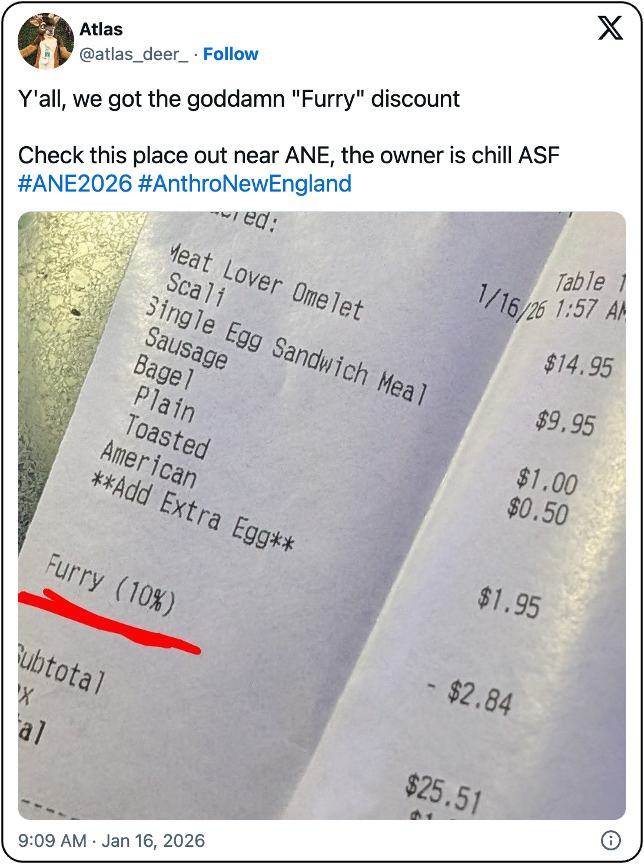
This pattern repeats wherever large furry conventions appear. What looks like a quirky hobby from the outside is, in reality, a substantial cultural ecosystem.
And conventions are only part of it.
The Creative Economy of the Fandom
An enormous cottage industry exists around the fandom’s creative output.
Fursuits themselves are highly specialized custom costumes. According to people in the industry, there are roughly a hundred full-time professional suit makers. Some have waiting lists that stretch years into the future.
The prices reflect that demand. It’s not unusual for a suit to cost $10,000 or more. A recent commission slot from the well-known maker GlitzyFox Studios sold at auction for $21,700. Another reportedly went for $50,000 in 2024.
Artwork is equally central to the fandom. Most members create an original character—called a fursona—that represents them within the community. Artists then produce custom illustrations of those characters.
Typical commissions might cost $200, but high-profile artists sometimes charge thousands. In rare cases, single illustrations have sold for $7,500 or more.
The digital world has expanded the economy further. Platforms like VRChat allow people to embody their fursonas as animated avatars. Base avatar models sell for $50 or more, while custom models can cost hundreds or thousands of dollars. Some creators specialize in accessories, clothing, or animation systems for these avatars.
Then there are VRTubers—streamers who broadcast on Twitch, YouTube, or TikTok using animated animal avatars. Successful ones run entire small businesses around their online persona, selling merchandise and subscriptions. I’ve heard about someone leave a professional career as a chef to stream as a fox character online. With moderate success, a VRTuber can make close to $90,000 a year streaming a few days a week.
In other words, the fandom isn’t just a hobby. It’s an interconnected digital economy.
Most participants, however, still treat it as exactly that—a hobby.
Hobbyists and “Lifestylers”
For the majority of people, being a furry is something they do in their spare time. They have careers, families, and other hobbies. Maybe they commission artwork occasionally or attend a convention once a year. Many never wear a fursuit at all.
If you met them in everyday life, you might never know they were involved in the fandom.
But there is another category of participant that has grown more prominent in recent years: what insiders sometimes call the “furry lifestyler.”
For these individuals, the fandom—and their fursona—becomes the center of their identity.
Their day often begins when they return home, surround themselves with objects and art that reflect the furry life they created, and leave their everyday self behind. Their social circles consist almost entirely of other furries. They may live together in shared housing. Their online presence revolves around their fursona rather than their real identity.
The culture surrounding these groups can become intensely insular. Sexual subcultures, heavy drinking, and sometimes drug use are common elements. Normal social boundaries blur. The outside world becomes distant, even hostile.
At that point, the fandom stops being a hobby and starts functioning more like a closed social ecosystem.
And closed ecosystems are vulnerable to radicalization.
Social Isolation and Radicalization
The furry community attracts a disproportionately large number of people who already feel socially isolated.
Many are neurodivergent. Many struggle with mental health issues. Some are simply individuals who never felt comfortable in traditional social settings.
None of that is inherently bad. Communities built around shared interests often provide support for people who might otherwise feel alone.
But isolation can also make people susceptible to ideological pressure.
Within insular online communities, political narratives can spread quickly and go largely unchallenged. Friend groups often reinforce those narratives rather than question them.
Over time, identity politics and extreme ideological positions have become increasingly common in certain parts of the fandom. Criticism of those beliefs is often interpreted not as disagreement but as a direct attack on personal identity.
And that reaction makes sense if you understand how identity works within furry culture.
The Fursona and the Inverted Social World
Most social relationships develop gradually.
Psychologists sometimes describe this process using social penetration theory, often visualized as an onion. People start with superficial conversation—weather, hobbies, small talk—and gradually move toward deeper personal disclosures over months or years.
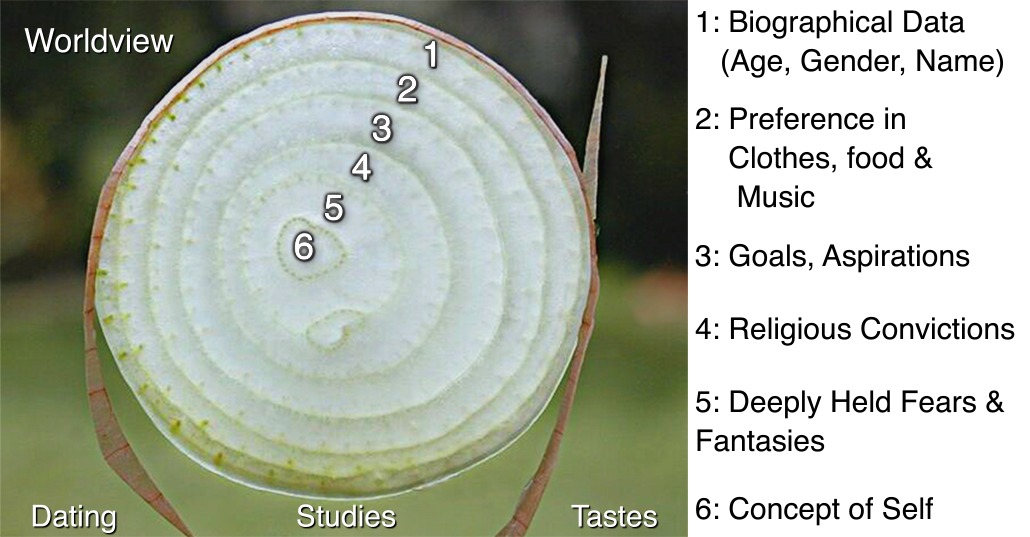
Furry culture often inverts that process.
Because much of the community developed online, interactions frequently begin with highly personal information. Someone’s profile might immediately reveal their sexual interests, kinks, political views, hobbies, and emotional struggles.
When furries meet each other online, they often begin conversations already deep inside the “onion.” Sexual topics may appear within the first few exchanges. We see their erotica, their porn, often in the form of art related to their fursonas.
Ironically, the most basic personal details—like someone’s real name—may remain unknown for years.
I’ve known people in the fandom for decades whose real names I still don’t know. They know me only by my fursona. I might know roughly what city they live in, but not their address.
Yet those friendships can feel intensely personal.
That inversion—deep emotional exposure paired with anonymity—creates a strange social environment.
It can foster intimacy. But it can also create instability.
Identity and Perceived Threat
For many participants, the fursona becomes deeply intertwined with their sense of self.
Criticism directed toward the culture surrounding that identity can feel like a personal attack. If someone perceives the outside world as trying to erase that identity, the emotional response can be extreme.
Political events sometimes amplify those fears.
For example, the overturning of Roe v. Wade triggered widespread panic within parts of the fandom. Some members interpreted it as evidence that broader LGBT rights—including same-sex marriage—were under immediate threat.
Many furries identify somewhere within the LGBT spectrum. According to surveys conducted by FurScience, roughly 60–70 percent of participants report same-sex attraction, with about 30 percent identifying as exclusively gay. The same surveys show relatively high numbers of respondents identifying as transgender or non-binary compared to the general population.
In a community with those demographics, political rhetoric can quickly become extreme and construed as existential.
Public figures like Donald Trump or Charlie Kirk are sometimes framed not simply as political opponents but as avatars of a movement bent on destroying the people within the fandom.
Most participants express that anxiety through rhetoric—angry posts, exaggerated language, dramatic memes.
But occasionally, individuals take that rhetoric seriously.
In hindsight, it is obvious that the fandom in its current form was predestined to create people like Thomas Cooks, Tyler Robinson, and Joshua Jahns.
Media Distrust and the Closed Circle
Another factor complicates the situation: the fandom’s long history of distrust toward the media.
In the early 2000s, most mainstream coverage of furries was sensationalistic or mocking. Television segments often focused exclusively on sexual aspects of the fandom or portrayed participants as strange curiosities.
Those portrayals left a lasting mark.
Convention organizers began actively training volunteers to keep reporters away from attendees. Media access was restricted. Online spaces locked down privacy settings. Communities closed ranks.
The intention was understandable—protect members from ridicule.
But the unintended consequence was an information vacuum. When communities isolate themselves from outside scrutiny, internal problems become easier to ignore.
Only recently has more positive media coverage begun appearing, often from outlets sympathetic to progressive politics. But even that coverage hasn’t fully rebuilt trust.
Many furries still instinctively assume that journalists are hostile.
How I Got Here
Ironically, the media coverage that introduced me to the fandom was exactly the kind that caused so many problems.
In 2001, MTV aired a short documentary by filmmaker Rick Castro titled “Plushies and Furries” as part of its Sex2K series. It portrayed the community in a lurid, voyeuristic way.
Yet it caught my attention.
Like many people who eventually join the fandom, I had grown up fascinated by anthropomorphic characters—Disney’s Gargoyles, episodes like “Tyger, Tyger” from Batman: The Animated Series, characters like Slappy Squirrel from Animaniacs.
Seeing adults who shared that fascination felt liberating.
I went looking for the community online and quickly found it: DeviantArt, early art forums like VCL, and eventually FurAffinity, which became one of the fandom’s central hubs.
I created my own character. I commissioned artwork. I started reaching out to artists whose designs I admired.
And something unexpected happened: I made real friends.
For years, the fandom felt genuinely inclusive. Creativity mattered more than politics. Artists and fans collaborated freely. People from different backgrounds connected through shared imagination.
Politics existed, but it stayed mostly in its own corners.
That began to change in the 2010s.
The Cultural Shift
Over time, ideological activism started permeating the fandom’s spaces.
Neopronouns, new sexuality and identity labels, and political slogans became increasingly prominent on profiles and banners. Social dynamics shifted toward enforcing ideological conformity.
At the same time, parasocial relationships—intense emotional attachments to online personalities—became more common.
The community grew more polarized. The middle ground shrank.
I watched as friend groups fractured, as harassment campaigns targeted dissenters, and as internal conflicts escalated—often between furries themselves.
Pornography remained abundant and often functioned as a distraction from deeper problems.
But beneath the surface, the culture was changing.
A Community at a Crossroads
None of this means the furry fandom is inherently violent or extremist. The overwhelming majority of participants are harmless hobbyists who just enjoy art, costumes, and imaginative characters.
But the structural conditions that exist within the fandom—social isolation, identity fusion, ideological echo chambers, and distrust of outside scrutiny—can create fertile ground for radicalization.
That’s why confronting these issues matters.
The goal is not to destroy the community. It’s to prevent it from destroying itself.
For me personally, speaking out about this is uncomfortable. It means criticizing a culture that shaped much of my adult life.
But silence would be worse.
Communities survive only when they’re willing to confront their own failures.
I hope the furry fandom can still do that.
And if it does, perhaps it can rediscover the creativity and openness that drew so many of us there in the first place.
This essay only scratches the surface.
In the weeks and months ahead, I will be publishing a series of longer essays on my Substack examining the culture of the fandom in detail: how its social networks operate, how ideological factions developed, and why certain online dynamics can push vulnerable people toward extreme worldviews.
I’m writing those pieces for readers primarily outside the fandom.
The uncomfortable truth is that furries are unlikely to solve these problems on our own. Communities that become insular often lose the ability to correct themselves. What is needed now is informed, thoughtful engagement from people willing to understand what is happening rather than dismiss it as a fringe internet oddity.
If you would like to follow the series as it develops, you can do so here:

If you enjoyed this free article, please consider upgrading to a paid subscription or making a recurring or one-time donation below to show your support. Reality’s Last Stand is a reader-supported publication, and your help is greatly appreciated.
If you enjoyed this article, you may also like…


I had some skepticism that this piece would be worthy of Reality's Last Stand when I read the first few sentences. However, I gave it a fair chance and kept reading. I found this to be well thought out, coherent, well presented, appropriate in how it introduced the Furry community to the reader, and well balanced in not overly delving into lurid or detailed descriptions of the Furry community. I will add more in a separate comment so that if people want to like what is in this comment (but not the other) they can do so.
I think that this article adds value to societal discussion and awareness of how radicalization and negative social behaviors can develop in a community that starts as innocuous and which at its core beliefs starts as innocuous (at least, relative to what we are talking about).