



Reality’s Last Stand is a reader-supported publication. Please consider becoming a paying subscriber or making a one-time or recurring donation to show your support.

About the Author
Frederick Prete teaches neurobiology at Lake Forest College. He received his PhD from the University of Chicago, where he ran a laboratory studying the neurophysiology of praying mantis visual systems, and he has taught in both biology and psychology departments. His work has been published in a variety of academic journals, including Science, the Journal of Experimental Biology, and the Journal of the History of Biology.
He has also written for online publications including Quillette, Minding the Campus, the James G. Martin Center for Academic Renewal, and the Foundation Against Intolerance and Racism, often on the history of biology, academia, and education. He has published two edited volumes in neurophysiology and behavior, including The Praying Mantids, published by Johns Hopkins University Press. He is currently Director of the Haptic Research Lab at Lake Forest College, where the lab develops haptic-enhanced mobility aids, including white canes, for people who are blind or low-vision. More information is available at www.hapticinsight.org.
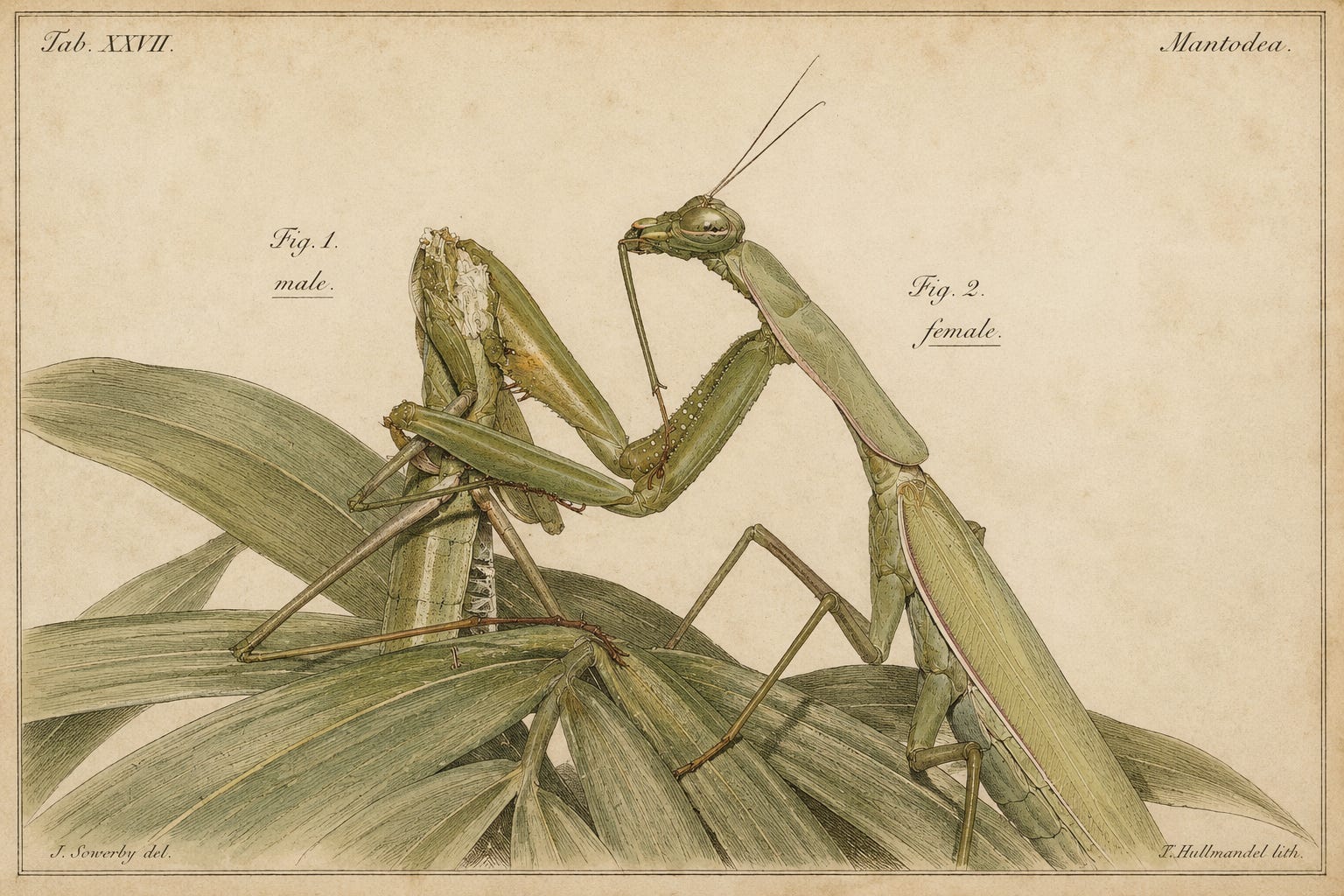
When I ask people what they know about the praying mantis, the most common answer—by far—is that the female eats the male during sex. In an informal survey I conducted at the University of Chicago and at Roosevelt University, 149 psychology students were shown a picture of a mantis and asked to write down one fact they knew about it. Of all the responses, “the female eats her mate” came up far more often than any other. The mantis’s cryptic appearance, its extraordinary hunting behavior, its remarkable visual system—none came close. Clearly, what most people think they know about the praying mantis is that it’s a sexually motivated cannibal.
Despite its erotic allure, however, the widespread belief that sex and cannibalism are linked in the mantis is wrong. To understand why—and why the belief persists—you have to go back a very long way. Not just to the 1886 article in the prestigious journal Science that is usually blamed for starting the modern myth. Much further. Back four thousand years, to ancient Mesopotamia, Egypt, and China, where the stories that shape our beliefs about this fascinating insect first emerged.
A Divine Creature
In the ancient world, the praying mantis was understood primarily through its posture. The insect holds its raptorial forelegs raised in front of its body in a way that, to human eyes, looks unmistakably like an attitude of prayer. Across the Middle East, Africa, and Europe, this posture inspired a persistent set of beliefs about the mantis’s spiritual nature. Ancient Sumerian cuneiform texts from the ninth century B.C. called it the “necromancer” and the “soothsayer of the field.” In Egypt, as early as 1550 B.C., the mantis appeared in The Book of the Dead as a minor deity, the “Bird-fly,” who guided the souls of the dead to the afterlife. The ancient Greeks named the insect mantis—meaning “prophet”—for its supposed ability to point lost travelers toward home, a legend repeated in European natural-history texts well into the seventeenth century.
The cultural contrast with the Far East is striking. In China and Japan, where the mantis had been carefully observed for centuries, the insect was celebrated not for its piety but for its ferocity. Ninth-century Chinese poets used the mantis as a metaphor for boldness; by the tenth century, mantids were being kept for organized fighting contests, a sport popular enough to produce its own monographs and a thriving trade in specialized equipment. While Europeans were writing about the mantis’s helpfulness to lost children, the Chinese were wagering money on how quickly one could dismember its opponent.
A Reputation Reversed
The Western reputation for mantid gentleness began to erode in the mid-eighteenth century. The first blow came from the German painter and naturalist August Johann Rösel von Rosenhof (1705–1795), who placed several mantids together in a glass jar for observation and found, to his astonishment, that they attacked one another with ferocious intensity, the victor invariably devouring the vanquished. More alarming than the fighting itself was Rösel’s finding that the mantids continued to kill and eat one another even when supplied with an abundance of other, perfectly adequate food.
The second blow came from an account involving a Mr. Dorthes, an entomologist traveling in France with the naturalist James Smith, whose observations were recorded in Smith’s 1807 travel narrative. Having placed a male and female mantis together in a bottle, Dorthes watched the pair mate, after which “the larger and stronger [female] . . . devoured the head and upper part of the body of her companion. But the most wonderful circumstance is, that a subsequent union took place; the life and vigor of the male being unimpaired by the loss of his head, as that part is not in insects the seat of the brain: this was no sooner concluded than his insatiable mate ate up the rest of his body!”
These accounts spread rapidly through the popular and scientific literature, displacing the image of the pious mantis and replacing it with something darker. They were repeated by virtually everyone who wrote about mantids, often juxtaposed with the older, kinder characterizations—as if the insect had two sides to its character, one gentle and one savage. George Shaw’s General Zoology of 1806, for instance, recorded both the legend of the mantis guiding lost travelers home and Rösel’s account of mantids fighting like hussars with sabers, cleaving opponents asunder with a single stroke.
The general distaste with which mantid cannibalism was viewed is evident in the widely read and influential Introduction to Entomology, written by the natural theologians William Kirby (1759–1850) and William Spence (1783–1860). Among the indirect benefits derived from insects, Kirby and Spence counted the fact that many species, by feeding on others, help keep insect populations in check. But however beneficial it might be to eat unrelated insects in excess numbers, eating one’s own kind was another matter entirely. “But before I quit this subject,” they wrote, “I may call your attention to what may be denominated Cannibal Insects, since in spite of those disclaimers who would persuade us that man is the only animal that preys upon his own species, a large number of insects are guilty of the same offence.” Prominent among them was the “cowardly and cruel” mantis, which appeared to engage in cannibalism out of sheer wantonness, even “when in no need of other food.”
The famous French naturalist Georges Cuvier (1769–1832), in his Animal Kingdom, reiterated the reports of Rösel and others and added his own assessment. The mantis, Cuvier wrote, was an anomalous insect with a fundamentally malevolent disposition—cowardly in that it would flee from an ant while freely destroying helpless flies. Most importantly, Cuvier restated the central claim that had by then become conventional wisdom: “They are so cruel and carnivorous that (even as hatchlings) they kill and eat one another, without being compelled to do so by hunger.”
The Birth of the Modern Myth
By the early nineteenth century, then, mantid behavior was understood as having two distinct components, corresponding to the two sides of the mantis’s character: it ate small prey for ordinary nutrition, and it ate its own kind out of viciousness. This framework was firmly in place by the time mating-related cannibalism became a subject of serious discussion, and it shaped how those new observations were interpreted.
The story as most people know it today traces back to a 500-word anecdote published in 1886 in the journal Science by the entomologist Leland O. Howard. Howard described witnessing a female mantis bite off a male’s head during mating. The observation was brief and the sample size was one, but the story spread with extraordinary speed and tenacity.
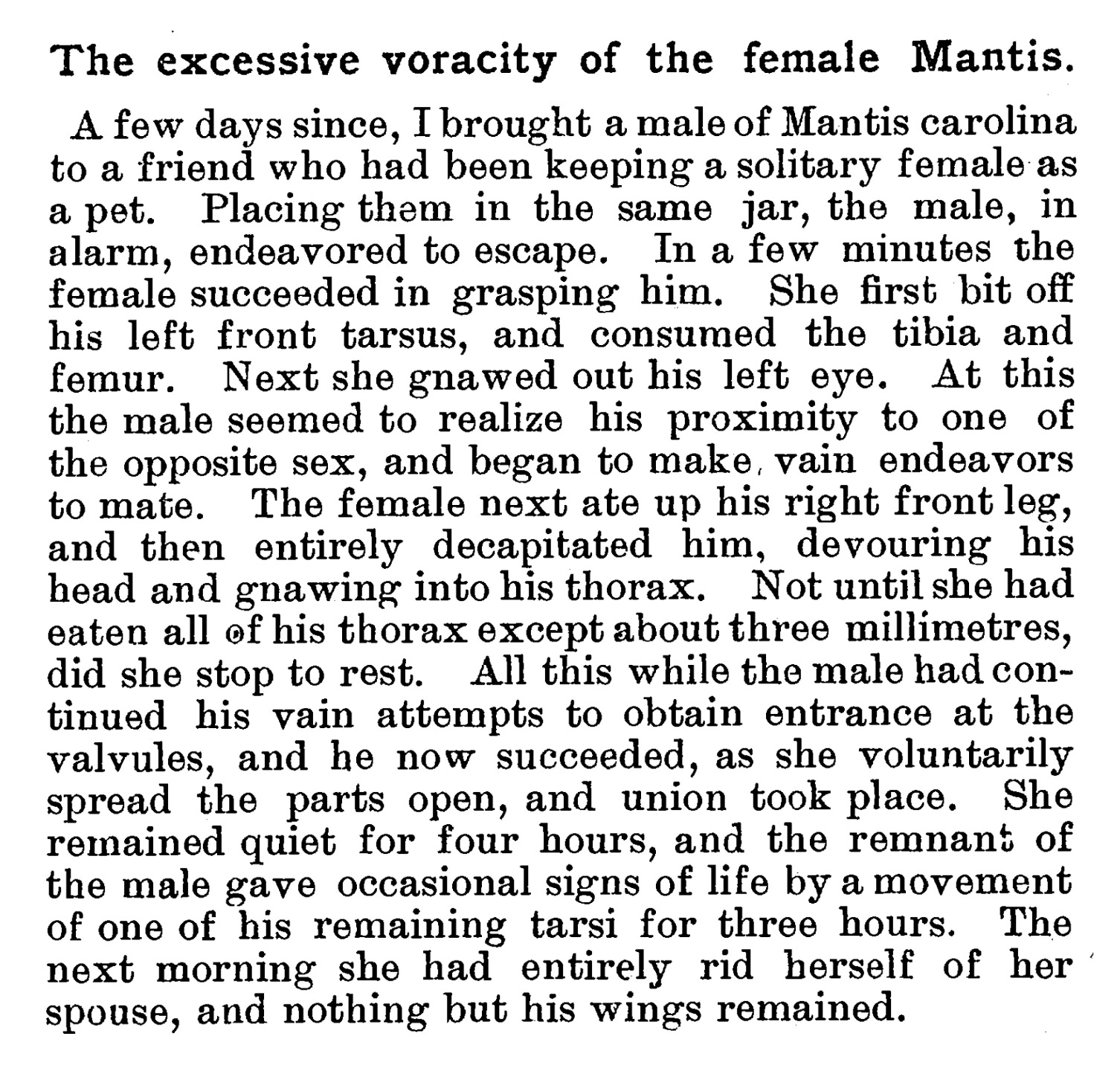
What gave the observation its staying power was not its scientific rigor. It was how neatly it fit into an explanatory framework that had been building for more than a century. The mantis was already understood as an insect of dual character—pious on the outside, murderous within. Mating-related cannibalism was not a puzzling anomaly; it was confirmation. It slotted perfectly into a way of thinking about the insect that stretched back to Rösel’s jar and, before that, to the ancient legend of the mysterious creature that prayed.
The most influential popularizer of this view was the French entomologist Jean Henri Fabre (1823–1915), whose vivid and widely read Souvenirs entomologiques described mantid mating in the most dramatic terms. Fabre observed females consuming males and interpreted what he saw as an expression of some deep, primitive female nature. “Manners were not gentle in those epochs, which were full of lust to destroy in order to produce,” he wrote; “and the Mantis, a feeble memory of those ancient ghosts, might well preserve the customs of an earlier age.” Of the females he observed, he wrote: “I have seen the same Mantis treat seven husbands in this fashion. She admitted all to her embraces, and all paid for the nuptial ecstacy with their lives.” And of the moment of decapitation itself: “I have seen the thing with my own eyes, and I have not yet recovered from my surprise.”
Fabre’s prose was influential enough to set the terms of the debate for decades, despite the fact that his methodology was essentially nonexistent. He described what he saw under highly artificial conditions—captive animals in unfamiliar environments, crowded together and often hungry—and from those observations drew sweeping conclusions about the nature of the species.
The Headless Husband
The Dorthes account, combined with Fabre’s observations, prompted a question that turned out to be scientifically productive, even if it began from a flawed premise: How was it physiologically possible for a decapitated male mantis to continue mating? The neurophysiologist Kenneth Roeder investigated this question in the 1930s and found a real answer. In male mantids, the nerve ganglia that control copulatory movements are located in the abdomen, not the head. Decapitation does, however, remove the brain’s coordinating influence over those ganglia, producing more vigorous and prolonged copulatory movements in a headless male than in an intact one—analogous to the vigorous, undirected running of a freshly decapitated chicken.
This was a genuine finding. The problem was what happened next: it was interpreted not as an interesting neurophysiological fact about the organization of the insect nervous system, but as evidence that decapitation had evolved as a functional component of mantid mating. The female, it was argued, bites off the male’s head specifically to improve the efficiency of copulation—a grim but elegant solution to a reproductive challenge. This explanation was immediately and widely accepted.
What went largely unheeded was Roeder’s explicit argument against this interpretation. He pointed out that mating-related cannibalism occurred in only a minority of cases, and that the conditions under which it was most likely—captivity, crowding, and food deprivation—were artifacts of the laboratory, not features of mantid life in the field. Cannibalism, he argued, was neither a regular nor a necessary part of mating behavior.
But he was ignored.
In truth, mating-associated cannibalism was simply one instance of a broader, more mundane behavior. Mantids of every age and sex eat one another under ordinary predatory circumstances—a fact well documented since Rösel’s jar. What happens between mates is more specific, and stranger, than the myth allows. In some cases, the female simply catches and eats an approaching male before he ever gets the chance to mount her, exactly as she would any other prey. Sometimes, when mounting does occur, she reaches back to remove the perturbance, grabs the male’s head—the only part she can reach—and pulls it forward into her jaws. She continues eating through the head and into the thorax until what remains is too short for her to grip, at which point she lets go. The abdomen and stub of thorax that remain stay mounted on her, still copulating. That image—a headless, half-eaten male continuing to mate—was the genuinely startling observation at the center of the whole controversy.
Roeder’s neurophysiological model carried real institutional weight. He was among the founding figures of American neuroethology, and an explanation bearing his name was not easily set aside. But the decapitation model was not the only part of his legacy that would reinforce the sexual-cannibalism myth. There is a coda to this part of the story that never made it into the published record.
The 1959 paper that became the standard reference on what praying mantids actually recognize as prey—Rilling, Mittelstaedt, and Roeder’s “Prey Recognition in the Praying Mantis”—grew out of an experiment Susan Rilling conducted as a student in Roeder’s lab. She made a series of simple paper lures, all roughly fly-sized, some fitted with artificial wings, and dangled them on strings in front of tethered mantids to see which ones provoked a strike. Every lure she built was fly-like. She never tested anything shaped like a mantid, another insect, or anything larger. Unsurprisingly, the mantids readily struck at the fly-sized lures, and Rilling concluded that fly-sized objects are what trigger a mantis’s prey-catching response.
By Mittelstaedt’s own account, he and Roeder did not think the experiment was worth publishing: its design was too narrow to support the conclusion Rilling wanted to draw from it. In a letter to my research assistant years later, Mittelstaedt recalled that Rilling nagged the two of them until they finally agreed to publish it—that she clamored for entrance into immortality, as she viewed it. The paper was published in 1959, and because its senior coauthors were already leading figures in neuroethology, it carried an authority the experiment itself did not deserve. Nonetheless, for the next three decades—until my own research at the University of Chicago—Rilling’s paper stood as the only systematic word on what praying mantids identify as prey.
Taken together, Roeder’s neurophysiological model and his student’s behavioral study gave the two prevailing theories everything they needed to lock together into a single, self-consistent account: ordinary predatory behavior is triggered by fly-sized objects, while cannibalism is a separate, nonpredatory sexual behavior that exists to elicit vigorous copulatory behavior from the male. Roeder himself had intended neither finding to support that interpretation. His model of decapitation was meant as a narrow, mechanistic account of ganglion function, not a theory of sexual selection, and he had explicitly argued against treating mating-related cannibalism as regular or necessary. But once his authority and his student’s experiment were read together, the combination took on a teleological cast that neither result, on its own, was meant to support.
Once that interpretation took hold, everything that failed to fit it dropped out of the literature. Reports of male-on-male cannibalism, female-on-female cannibalism, cannibalism among sexually immature mantids, and even the ordinary predatory case of a female eating a male outside a sexual encounter—all common enough in the eighteenth- and nineteenth-century literature—quietly disappeared from later accounts. What remained was a two-part story: predatory attacks on fly-sized prey, and sexual cannibalism by adult females. Everything else became functionally invisible.
What the Evidence Actually Showed
By the mid-twentieth century, evidence against the prevailing theory had quietly accumulated. Field observers found mating-related cannibalism far harder to document in the wild than laboratory studies suggested, while researchers who varied captive conditions found that well-fed, uncrowded females rarely cannibalized their mates at all—a relationship between hunger, stress, and cannibalism that the ruling theory had little reason to examine. Just as neglected was the sheer breadth of the mantid diet: frogs, lizards, small birds, mice, snakes, turtles, and insects of every kind. That range sat uneasily with the idea that mantids had evolved specifically to catch flies—an idea that owed less to any study of wild predation than to the historical convenience of feeding captive mantids flies.
None of this was, strictly speaking, new information. Reports of mantids taking prey far larger than flies had appeared periodically since the mid-eighteenth century and continued throughout the twentieth. But they appeared mostly in the ecological literature, where field researchers documented mantids as opportunistic predators of whatever prey happened to be available, rather than in the neurophysiology and behavior literature that had absorbed Roeder’s and Rilling’s work.
For decades, the two bodies of research ran on separate tracks, each largely unread by the other. Ecologists cataloguing mantids eating birds, mice, and lizards were not in conversation with laboratory researchers building experimental paradigms around fly-sized lures and decapitated ganglia, and the divide was never bridged. Meanwhile, it was the sexual-cannibalism story—vivid, faintly lurid, and endlessly retellable—that captured the field’s imagination, not the more mundane finding that mantids are generalist predators that eat whatever they can catch.
The dichotomy between normal fly-catching and abnormal, sexualized cannibalism survived as long as it did partly because the evidence that would have dissolved it was being published in a different literature, for a different audience, and was never brought into the same conversation as the story everyone already wanted to tell.
A Ruling Theory
The concept of the “ruling theory”—drawn from the geologist T. C. Chamberlin—describes what happens when a hypothesis becomes so deeply embedded in a field’s assumptions that contradictory evidence can no longer dislodge it: confirming observations are taken as confirmation, while disconfirming ones are dismissed as anomalies. Mantid research became a case study in exactly this. Two mutually reinforcing theories—that the mantis has a normal, fly-catching side and an abnormal, cannibalistic side, and that cannibalism of mates is a specialized reproductive strategy rather than ordinary predation—created a framework so internally coherent that, in practice, it became impossible to disconfirm.
If a mantis ate a fly, that was normal. If it ate a mate, that was special. No observation could challenge the distinction, because the distinction itself explained everything.
What the Mantis Actually Is
The most defensible interpretation of the evidence is also the least dramatic: the praying mantis is a generalized, opportunistic predator. It eats what it can catch and subdue—neither a specialized fly-catching machine nor an insect with a mysterious cannibalistic dark side, but an animal pursuing available prey with the tools it has across an unusually wide range of prey types and sizes.
Cannibalism occurs in mantids, as it does in many predatory species, when conspecifics are available, predators are hungry, and alternative prey is scarce. It is not a behavioral specialty, not an intrinsic feature of mating, and not an expression of some ancient, primitive female nature. It is opportunistic predation, no more and no less—and the fact that we have spent centuries interpreting it otherwise says more about our own storytelling than about the insect.
The myth of the sexually cannibalistic mantis is a remarkable case study in how science can go wrong. It begins with genuine observations that were genuinely surprising. It passes through generations of storytellers—priests, poets, naturalists, neurophysiologists—each of whom found in the insect a reflection of something they already believed. It survives not because the evidence supports it, but because the framework surrounding it renders disconfirming evidence invisible. And it persists today, in every classroom where a student is told that the female praying mantis eats her mate, as if that were a simple fact about the natural world rather than a story we have been telling ourselves for four thousand years.
This essay is adapted from: Prete, F. R. & Wolfe, M. M. (1992). “Religious supplicant, seductive cannibal, or reflex machine? In search of the praying mantis.” Journal of the History of Biology, 25(1), 91–136.
See Steven Pinker Live This September
Join Steven Pinker for an evening of wide-ranging conversation about language, human nature, rationality, and progress, followed by questions from the audience. Whether you are a longtime reader or simply curious about his work, this North American tour offers a rare chance to hear one of today’s leading public intellectuals discuss and develop his ideas at length.
Tickets available here, or click the banner below.

If you enjoyed this free article, please consider upgrading to a paid subscription or making a recurring or one-time donation below to show your support. Reality’s Last Stand is a reader-supported publication, and your help is greatly appreciated.
If you enjoyed this article, you may also like…


