



Reality’s Last Stand is a reader-supported publication. Please consider becoming a paying subscriber or making a one-time or recurring donation to show your support.

About the Author
Dr. Colin Wright is an evolutionary biology PhD, Manhattan Institute Fellow, and CEO/Editor-in-Chief of Reality’s Last Stand. His writing has appeared in The Wall Street Journal, The Times, the New York Post, Newsweek, City Journal, Quillette, The Washington Examiner, and other major news outlets and scientific journals.
Over the past decade, a wave of pseudoscientific papers has tried to dismantle one of biology’s most fundamental truths: that there are only two sexes—male and female. These papers often claim that viewing sex as binary isn’t just outdated, but oppressive, and that it’s more accurate to say sex exists on a broad and continuous “spectrum.” To the public, this barrage of activist-driven research has created the illusion that biology has undergone a paradigm shift where biologists no longer believe in a simple male–female distinction, but instead see sex as a complex, multidimensional phenomenon that defies classification.
But that scientific revolution never actually happened. It was declared into existence by activists and a handful of ideologically captured scientists who sidelined their commitment to scientific objectivity for political reasons. Those who objected were labeled bigots or transphobes. I know because I was one of them. For more than seven years I’ve been pushing back against this wave of pseudoscience, and only recently has the tide begun to turn. Fortunately, it’s no longer automatic career suicide to defend the binary nature of sex, and even left-leaning outlets and scientific journals are beginning to relax their censorship on the topic.
This cultural shift was badly needed. For years, I’ve been asked by parents, lawmakers, and even fellow scientists what peer-reviewed papers they could cite that clearly explain why biological sex is binary. It was a fair request, but the answer was surprisingly difficult to provide. While countless research papers are premised on the notion that sex is rooted in whether an organism produces sperm or eggs, none were devoted entirely to articulating that foundational premise. The binary nature of sex was treated as self-evident, like the existence of gravity: an observable fact so basic that scientists never felt the need to spell it out.
That silence created an opening. Activists and ideologically captured scholars rushed to fill the void, flooding journals with papers advancing politically useful redefinitions of sex. With few rigorous alternatives to cite, even well-meaning scientists and policymakers found themselves forced to reference activist frameworks as if they were authoritative.
Earlier this month, I published a Commentary in the journal Archives of Sexual Behavior titled “Why There Are Exactly Two Sexes.” In it, I reaffirmed the scientific foundation that males and females are defined by whether an organism has a reproductive system with the biological function of producing sperm or ova, respectively. I also outlined five recurring frameworks that activists use to deny this reality:
Conflating “mating types” with sexes.
Treating atypical sex chromosomal variations as new sexes.
Using overlapping variation in any single trait between males and females to portray sex as a “spectrum.”
Treating the two sexes as statistical clusters of multiple traits.
Claiming that sex exists at multiple independent “levels” that can’t be unified across the body.
Every argument I’ve encountered against the sex binary fits into one or more of these five categories. And activists tend to switch between them whenever convenient, even when the frameworks contradict each other. The goal isn’t to be scientifically accurate, but to win a political fight that requires the binary view of sex to be viewed as an oppressive colonial construct instead of a scientific fact.
Recently, I was alerted to a new paper presenting an argument I hadn’t specifically encountered before. Diethard Tautz, a prominent biologist and former director of the Department of Evolutionary Genetics at the Max Planck Institute for Evolutionary Biology, coauthored a study in the journal eLife titled “Fast evolutionary turnover and overlapping variances of sex-biased gene expression patterns defy a simple binary sex classification of somatic tissues.” He’s been promoting the paper in popular outlets as evidence that “bodies aren’t simply male or female.” Given that using gene expression to argue against the sex binary was new to me, I decided to examine the paper’s findings and arguments to see if they actually support such a conclusion—or whether, like every other supposed “refutation” of the sex binary, it fits neatly into one of the five erroneous activist frameworks I outlined in my recent commentary.
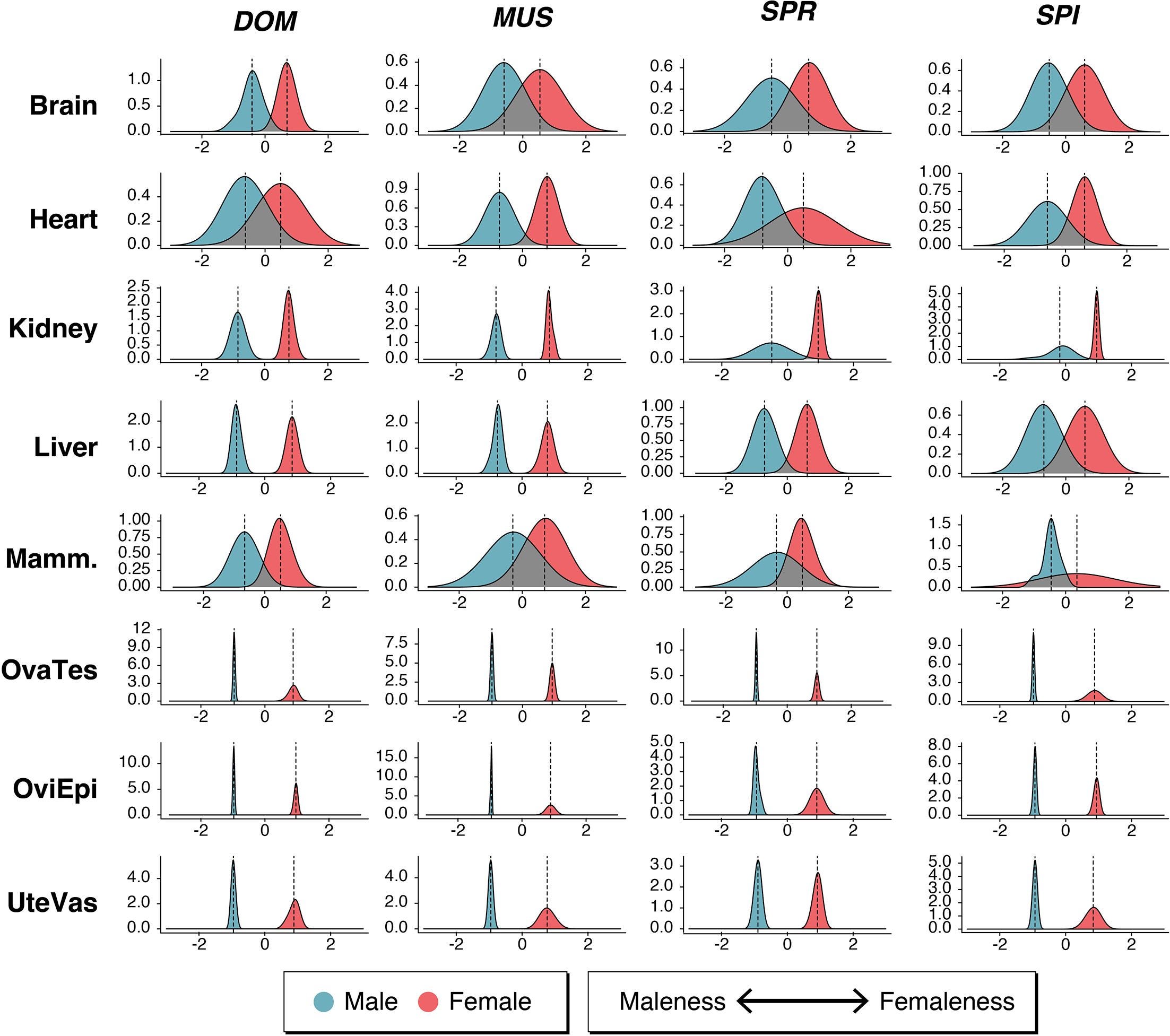
Tautz and his colleagues looked at how certain genes are expressed differently in males and females across various tissues in mice and humans. They developed a “Sex-Biased Gene Expression Index” (SBI) to quantify whether the expression of certain genes in a tissue leaned more “male” or “female.” They found that while gonadal tissues (testes and ovaries) showed clear binary differences in gene expression—as one might expect given that they’re vastly different tissues—some somatic tissues (like the liver, kidney, or heart) showed partial overlap in these expression patterns between males and females
This is presented as though it were a profound discovery. But it isn’t. No one (to my knowledge) has ever claimed that the existence of two gamete types means every single trait in the body must also come in two neat, discrete male and female forms. Quite the opposite. Evolutionary biology has long recognized that the fundamental reproductive asymmetry between males and females—one producing small, motile gametes and the other producing large, nutrient-rich ones—results in different selective pressures that create average, not absolute, differences between the sexes. Overlap in gene expression between the sexes doesn’t challenge the binary nature of sex any more than overlapping height distributions does.
Ironically, Tautz and his coauthors even acknowledge the basic biology that undermines their argument. “The different interests of males and females lead to sexual conflict,” they write, “characterized by opposing evolutionary constraints on the genes that mediate sex differences.” They go on to explain that “the sexual phenotypes of adult individuals are generated by hundreds to thousands of genes with sex-biased expression.”
This is, of course, correct. But notice their use of the terms male and female in the above quote. The authors appear fully capable of separating out males and females as a distinct and separate entities from their evolutionary “interests” and “genes that mediate sex differences.”
The problem is not with their data but with how they frame it. Tautz and colleagues take a familiar, trivial and uncontroversial fact—that many sex-linked traits vary in degree rather than kind—and present it as proof that the sexes themselves are fuzzy or fluid categories. Their argument falls squarely within the third framework I outlined in my Archives of Sexual Behavior Commentary: using overlapping variation in any single trait between the sexes to depict sex as a continuous “spectrum.”
In this case, rather than focusing on so-called “intersex” conditions that result in atypical or ambiguous genitalia, the authors simply apply the same reasoning to gene expression. Their logic, when boiled down, goes like this:
People claim sex comes in two (binary) forms: male and female.
Our data show that patterns of gene expression in males and females overlap.
Therefore, sex is not binary.
This is a textbook strawman. It totally misrepresents what the sex binary refers to—the binary distinction between sperm and ova that define males and females, respectively—and replaces it with the false statement that binary gametes must entail binary everything else. Having constructed that convenient fiction, the authors then “disprove” it by pointing to overlapping variation in gene expression. But this overlap has nothing to do with what makes someone biologically male or female. It simply confuses downstream traits that differ by degree with the underlying reproductive function that defines the sexes themselves.
The paper’s own figures completely refute its framing. They depict two distinct blue and red populations that refer to males and females respectively, and label the X axis as degrees of “maleness” and “femaleness.” But on what basis were the individuals assigned to the blue (male) and red (female) groups? And how would they know what patterns of gene expression represent greater “maleness” or “femaleness” unless they already knew which animals were males and females by the universal gamete-based definition? In other words, the binary they claim to challenge is the same one they rely on to interpret their data.
As I wrote in my recent paper:
Traits are labeled “male-typical” or “female-typical” because they correlate with males and females already identified independently—ultimately by reference to gametes. In other words, the model presupposes the binary categories rooted in gametes it seeks to replace and then infers those categories back from their correlates.
That circular logic exposes the self-refuting nature of the argument. To claim that overlapping gene expression between males and females “defies” a binary model of sex is to rely on the very binary that makes such a comparison possible in the first place.
To be clear, the paper itself isn’t bad science. The data are solid and add useful information about how sex differences in gene expression evolve. The problem is the framing. Instead of presenting their findings straightforwardly as evidence of variable gene expression between males and females, the authors felt compelled to package them up as a challenge to a bigoted and oppressive “binary narrative.”
It’s hard not to see the political motive. Tautz has publicly said his work “supports the idea that gender categories should fundamentally be abandoned” and has spoken against sex-based legal protections. Unfortunately, we live at a time where ideological conformity in science opens doors to grants, speaking invitations, and praise from peers.
In the end, the paper by Tautz and colleagues is an otherwise solid study unnecessarily burdened by culture-war rhetoric. The data tell an uncontroversial story: sex differences in gene expression exist, they vary in degree, and they evolve quickly. The idea that this somehow “defies” the binary classification of the sexes is where it veers into nonsense.
The data tell one story. The spin tells another. Biology hasn’t changed. There are still two sexes.
This essay was originally published in City Journal on November 20, 2025.
If you enjoyed this free article, please consider upgrading to a paid subscription or making a recurring or one-time donation below to show your support. Reality’s Last Stand is a reader-supported publication, and your help is greatly appreciated.
If you enjoyed this article, you may also like…


I'll warrant that most of these "sex-spectrum" proponents don't have a problem making a binary choice when it comes to who they want to date.
This strategy to claim sex is non-binary is just a word game -- they are saying the word "sex" should mean some a non-binary phenomenon instead of a binary phenomenon (gametes), which they acknowledge is real. The underlying facts aren't in dispute, just what the word "sex" refers to, like what the meaning of "planet" should be. They need to convince us that this new paradigm is a better way to talk. Considering that sexual reproduction is the thing we're talking about, there's just no way.