



Reality’s Last Stand is a reader-supported publication. Please consider becoming a paying subscriber or making a one-time or recurring donation to show your support.

About the Author
Taylor Trandahl spent years running high-profile digital marketing campaigns in Hollywood before joining conservative media nonprofit PragerU in 2020. There he helped launch and grow Amala Ekpunobi’s YouTube channel to over 2.5 million subscribers as creative producer. He now serves as Executive Producer for her independent media and comments on culture, faith, and current events on YouTube, X, and Instagram.
I live in Nashville, where half a million people recently signed a petition to stop a data center from being built near the zoo. People are worried that it will jeopardize the safety of the animals, waste water, drive up electricity prices, and cause a host of other problems.
All of that sounded really bad, so I decided to look into these claims. But the more I did, the more the opposition began to look like panic rather than reasoned argument. And I’ve started to think the same may be true of the broader data-center debate unfolding across the country, where 7 out of 10 Americans now oppose having a data center built in their area.
It’s not hard to understand why. Almost everything I had heard about data centers framed them negatively.
I had never heard, for instance, that in the small town of Quincy, Washington, tax revenue from data centers helped pay for a new high school, sports complex, hospital, library, police station, and fire department. Data centers created enough jobs to employ 10 percent of the town’s population and helped reduce its poverty rate from 30 percent in 2012 to 6.2 percent in 2024.
I had never heard that teachers in Richland Parish, Louisiana, received $50,000 bonuses thanks to increased tax revenue driven by data centers.
I didn’t know that Loudoun County, Virginia—the “data center capital of the world”—had created 15,000 jobs, increased school budgets by tens of millions of dollars, and poured resources into police and fire departments, libraries, parks, community centers, roads, bridges, child-protection services, and mental-health services—all while cutting property taxes every year for the past decade.
In Ellendale, North Dakota, annual sales-tax collections were about $400,000 before the data-center buildout. In the first seven months of 2026 alone, the town took in $3.5 million. That windfall allowed the small town of 1,100 people to repave its streets, renovate its senior center, and fund public safety, while local restaurants, gas stations, and hotels saw revenues rise by as much as 30 percent. Property values also increased tenfold, while residents’ electric bills fell by an average of $250 per household thanks to the state’s revenue-sharing law.
I didn’t know that for every one of the several hundred jobs created to operate a data center, another six to seven jobs are created elsewhere in the economy—meaning that the data centers employing 900 people in Quincy are responsible for five or six thousand additional jobs around the country.
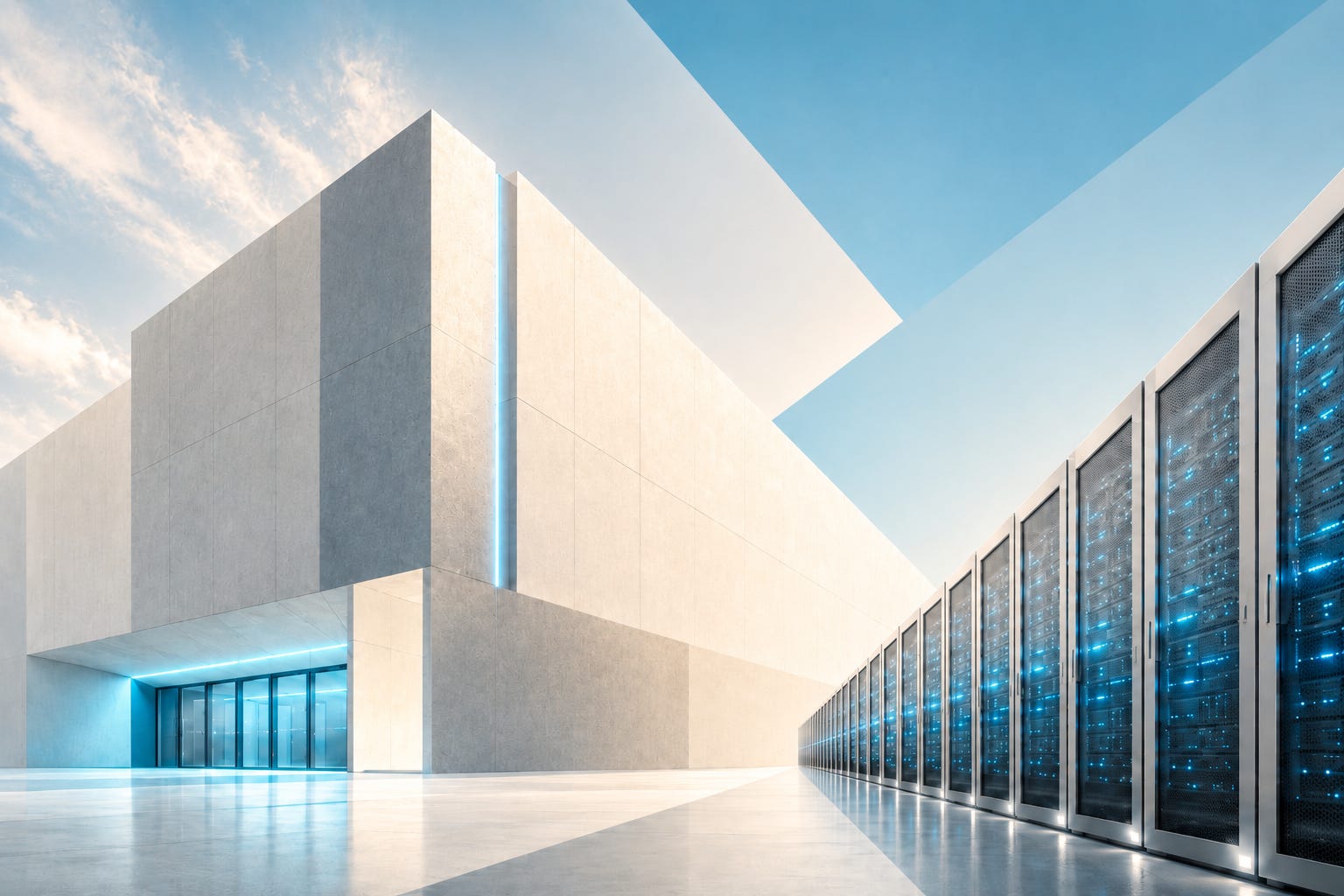
I also didn’t appreciate that “data center” is actually a bit of a misnomer. The term makes them sound like ominous warehouses where evil tech companies store our information so they can spy on and control us. In reality, data centers are part of the physical backbone of the modern economy. The videos you stream, the photos you save in the cloud, the apps on your phone, and the systems that keep hospitals, banks, and small businesses running all depend on them.
Just last week, pharmaceutical company Moderna’s stock price surged after it announced progress on what has been described as a literal “cancer vaccine”—an incredible medical breakthrough made possible in part by AI technology powered by data centers.
At this point, you’re probably thinking this is starting to sound like a propaganda piece for data centers. What about the zoo animals? What about wasting water? What about driving up electricity prices? Fair enough. So let’s talk honestly about the downsides.
First: water. It’s true that many data centers require considerable amounts of water for cooling—roughly 164 billion gallons per year nationwide. That is a lot—until you put it in context. Golf courses use an estimated 500–750 billion gallons annually, residential lawns around 3 trillion gallons—yes, with a “T”—and agriculture roughly 43 trillion gallons. Agriculture accounts for about 90 percent of annual U.S. water consumption. Data centers account for just 0.14 percent.
There’s another important distinction to make. Older data centers are more likely to rely on evaporative cooling, which consumes water without returning it directly to the local water supply. Many newer facilities, including the one proposed near my home in Nashville, instead use closed-loop, recycled-water, or air-cooling systems that can dramatically reduce water consumption.
What about electricity? After all, it’s well established that data centers are power hogs. But so far, researchers have found no statistically significant impact on residential electricity bills when costs are properly allocated. Developers work with local utilities and regulators to determine whether the grid can accommodate the additional demand. Data centers also pay “large-load tariffs” designed to offset the costs they impose on the system. In some cases, their enormous demand can actually spread the grid’s fixed costs across more customers and lower residential electricity bills.
President Trump also recently expanded the voluntary Ratepayer Protection Pledge, under which major technology companies and utilities commit to covering the costs of new power generation and grid infrastructure required by AI data centers rather than passing them on to residential customers. The pledge is voluntary rather than a binding regulation, but participating companies appear to be following it in both spirit and practice.
Then there’s noise. Here in Nashville, one of the biggest concerns is that zoo animals such as clouded leopards, which can be sensitive to mechanical noise, could be disturbed by the persistent hum of data-center cooling equipment. That strikes me as a perfectly reasonable concern.
But here the evidence is lacking on both sides. The zoo has offered no “specific evidence that data centers would pose a unique problem” for its animals. At the same time, the company cannot definitively demonstrate that the animals would not be adversely affected.
For its part, the developer has promised to keep noise levels below the limits required by local zoning codes and to implement additional measures, including acoustic planning and sound walls. It’s also worth noting that, on the decibel scale, “data centers are a bit louder than libraries and a bit quieter than pickleball courts.” The proposed site is also located in an industrial park beside a major railyard and is already home to a smaller data center.
Given these facts, I’ll leave judgment to you—and to the courts now litigating the company’s case against the city of Nashville. But whatever the outcome, the issue is anything but black and white.
Other concerns about data centers include light pollution, their land footprint, and their generally unattractive appearance. But lighting can be reconfigured relatively easily. As for land use, U.S. data centers are projected to occupy a total area roughly the size of Rhode Island by 2030. For comparison, the land currently used to grow corn for ethanol—which may actually be environmentally worse than the gasoline it replaces—already covers an area roughly the size of New York State.
And yes, data centers may not be pretty to look at. But what major infrastructure is? I’m not arguing that one should be built in every suburban enclave. That’s what zoning is for. Local governments can concentrate data centers in industrial areas and impose reasonable requirements on their design, lighting, landscaping, noise, and appearance.
This debate has also emerged at a strange economic moment. People on both sides of the political aisle are decrying an “affordability crisis” in which grocery prices have surged by more than 30 percent since 2019, the home-price-to-income ratio has risen to nearly twice its historical benchmark, and 49 percent of American families lack the resources to cover their essential expenses.
But the affordability crisis is really a symptom of a deeper economic malaise. Cumulative inflation is up 30 percent since 2020. The national debt just crossed $40 trillion—about $116,800 for every person living in the United States. The federal deficit has reached $1.8 trillion this year alone. Social Security and Medicare are projected to face insolvency within the next decade.
So how does America climb out of this economic hole? How do we bring prices down, raise living standards, and make life more affordable again?
I don’t think anyone has the complete answer. But I’m fairly certain we won’t get there by building less infrastructure, enabling less innovation, surrendering technological competitiveness, and generating less economic growth.
The simple reality is that data centers are among the most valuable economic investments a modern city, state, or country can make. Yes, they use a lot of water and electricity. Yes, they can be noisy and unattractive. But most of these problems can be managed through good planning—and what, realistically, is the alternative?
In the early nineteenth century, nobody had ever traveled faster than a galloping horse. Anti-railway “experts” warned that traveling at more than 20 or 30 miles per hour could cause brain damage, paralysis, suffocation, miscarriage, blindness, and even spontaneous psychotic breaks. Railway surveyors faced organized obstruction, sabotage, riots, and physical beatings. Aristocrats funded propaganda campaigns, anti-railway activism, and legal efforts to halt construction.
I can’t help but think of these historical parallels when I see Nashville responding to today’s data-center panic by attempting to retroactively seize the company’s land through eminent domain—even though the company legally purchased the property and received regulatory approval to build. And while the public concern is certainly real, it’s not entirely organic: recent reporting has discovered that China is spending billions on foreign-influence campaigns designed, in part, to stoke American opposition to AI infrastructure.
Now, let me take off my Big Tech shill hat for a moment: I honestly don’t love any of this. I’m not much of a tech nerd. I don’t love the AI revolution, and I have serious concerns about what it could mean for society and for our humanity. I work in the social-media world, so I’m probably more familiar with the downsides than most. There are days when I’d gladly unplug from the algorithms, throw away my smartphone, and go live the way human beings were “meant” to live—whatever that means.
But for better or worse, this is the time in which we live.
One of my favorite escapes from my Internet-saturated brain is reading and rereading J.R.R. Tolkien. In The Fellowship of the Ring, Frodo Baggins, despairing that he has been unwillingly swept up in the affair of the Ring, tells Gandalf: “I wish it need not have happened in my time.”
I often think of Gandalf’s reply: “So do I, and so do all who live to see such times. But that is not for them to decide. All we have to decide is what to do with the time that is given us.”
At the end of the day, make up your own mind. I’m not some die-hard data-center booster, and I don’t particularly care if we differ in opinion on whether they are a net benefit or not. Nobody is paying me to say any of this. What bothers me is watching misinformation and irrational fear push people toward policies that may ultimately leave them—and everyone else—worse off in the long run.
So yeah, if I have to decide what to do with the “time given me” on this particular issue, I generally come down in favor of building data centers.
Now that you have the facts, you can decide for yourself.
If you enjoyed this free article, please consider upgrading to a paid subscription or making a recurring or one-time donation below to show your support. Reality’s Last Stand is a reader-supported publication, and your help is greatly appreciated.
If you enjoyed this article, you may also like…


Having built data centers [D/C] (the networks in them) its been interesting to watch the evolution from the early business owned, to the co-locations, to the early-cloud, to this era in 2020-2026.
I also am cautious as we evolve the designs in the current era.
Sadly there are to falsehoods that draw away from the central issues, some of which Taylor touched on, but the devil is in the details.
Data centers once the mark of a medium to Fortune 100 empire, gave way to co-locations where you could rely on infrastructure to house your gear and take real estate issues OFF your shoulders, eventually virtual server farms let you even rent the hardware, free of ownership woes.
This was refined as the art of offering ??AAS (whatever-as-a-service) weeded out those who couldn't deliver. Somewhere in this era the roots of cloud also found its footing and evolved.
Eventually pricing feel from commercial level costs to anyone-can-rent-cloud-space.
I've used/managed space at the mid-high level commercial end for F100 employers, and found the sweet spot for using full cloud services or running a big of 'BYOS' mixed with cloud.
Up into the 2020s cloud services were present, IN SIZE, but unobtrusive to the public.
Digital currency triggered the need for more compute power, and the scales began to tip as you could no longer hide D/C growth.
The media hype and meme-storms of AI/Skynet/Job-loss/data-privacy setup a perfect storm to stoke everyone's concerns.
Classic data privacy concerns are on the rise, and sadly need far more attention then D/C footprints.
D/C growth is significant, clearly. And far to many attribute it to the needs for AI. Which requires one very important observation:
---- AI ain't! Its not a thinking machine there is no sentience, its a damned impressive step, but its not AI.
Sadly the gulf between building more D/C to improve the hyper processing of ai (assistive intellect) and real Intelligent systems couldn't be worse. The public generally believes the sales hype, and many respond by oppressing compute power to keep the feared daemon in the box.
The REAL ISSUES:
-Rapid D/C expansion:
-The impact to water is far more limited then activists complain about. The industry will pivot on close-systems and dry solutions to handle permitting issues and is glad to defeat the activism by offering a solution and keeping the D/C onslaught at full tilt.
-This is nothing more then a COMMODITY, its not the cutting edge its not the defining business tool of our time. It IS the same thing that just-in-time shipping, tactical deployment of resources at a moments notice, massive dynamic trucking solutions always have been to a free market.
-Local/Community benefit: There is no significant Long Term employment boon behind such D/Cs. The phases of building, initial operation, and any expansion will always draw from local labor pools, as well as draw from national businesses who grow up to rapidly deploy that infrastructure. The community may see some benefits (even cool ones) but in general its just the industry model again. BUT the business model does not support huge staff, the operational margins demand it.
-Environmental impact: Water impact in modern D/Cs will become far less impactful then the old ones. Cost and community pressure will ensure it (thank God)
The real environmental key is location/location/location. The municipalities need to get invovled and stay invovled, the people need to know. You may not like a refinery but no petro-no go_go. These concentrations of 'Compute' are part of our world we need to wisely manage their footprint as successful businesses and as citizens around them.
Electricity is the real pivot point. Self-powered D/Cs are the best ( nuclear may have its day). But most certainly the local grid needs to be forced into TRANSPARENCY. Residential power planning is nothing like the load/demand planning for industry. A huge facility that does not offset jobs or tax base (the small # of places it does need to be noted/framed) should not get sweetheart deals that are passed on to the local community.
D/Cs seldom are designed for the local community, they are built to integrate nationally with 'sibling facilities' to offer global (if not national) services that anyone [usually business] can lease. And their are no 2ndry benefits from transport or road taxes because compute services leave on wire/fiber/satellite, never creating a taxable commodity for the municipal coffers.
End Thoughts:
Do we need datacenters: With open eyes we need to realize they power the cyber-industrial complex, and we need to realize how much is necessary.
Do they need to be on EARTH: Even now Musk is doing, what a number of us have dreamt of, LOW-ORBIT where solar power is perfect, connectivity needs only open space, facility issues are dramatically reduced.
Should AI be the motivation: Most surely the sales pitch and head bobbers would have you believe its true. The current 'ai' (assistive intellect) is amazing, dynamic, and most conversational hyper-search resource we hoped for in the winters of '93. BUT its not AI.
In fact if you research the past 2 winters of AI, you'll see we are on the cusp of the 3rd winter in many folks view. Its likely the mergence of Robotics and LLMs into rudimentary automatons may get us to the next season of AI.
Its time to wakeup, smell the coffee, use all this compute power for whats needed, and NOT OVERBUILD the D/Cs only to let someone else eat the loss and cost as so often happens with overbuilt 'great ideas'
Just the thoughts of an old D/C builder, Lights out datacenter designer, and LLM engineer
I don't think this piece belongs on reality's last stand. This is written by someone who was ignorant about data centers, referred to those neutral words as ones that sounded like something ominous, and then the piece continued to talk about things where the author is evidently ignorant. This is an opinion piece, not a truth piece, and it is not even by an expert in the field. It is the equivalent of a high schooler's essay. A core aspect of reality's last stand is criticizing when platforms are given to works that should not have one. This piece should not be given a place on a platform like this.