



Reality’s Last Stand is a reader-supported publication. Please consider becoming a paying subscriber or making a one-time or recurring donation to show your support.

About the Author
Dr. Colin Wright is an evolutionary biology PhD, Manhattan Institute Fellow, and CEO/Editor-in-Chief of Reality’s Last Stand. His writing has appeared in The Wall Street Journal, The Times, the New York Post, Newsweek, City Journal, Quillette, The Washington Examiner, and other major news outlets and scientific journals.
Author’s Note
In 2025, I published a Commentary in Archives of Sexual Behavior titled “Why There Are Exactly Two Sexes,” in which I laid out the empirical case for the binary nature of sex and addressed several of the most common activist frameworks used to deny or obscure it. The piece has since been accessed more than 30,000 times on the journal’s website, making it the 11th most accessed paper in the journal’s 55-year history.
In January 2026, Dana Mahr, a German scholar of science and technology studies, published a Letter to the Editor critiquing my Commentary through the lens of “feminist epistemology.” I did not find the critique persuasive, to put it mildly. I was invited to respond, and respond I did.
Ever since I began writing publicly about the biology of sex in response to the spread of sex-and-gender pseudoscience, all I have wanted is serious academic debate. Instead, I and others who have tried to defend biological reality—among them Carole Hooven, Emma Hilton, Alex Byrne, Jerry Coyne, Richard Dawkins, Tomas Bogardus, Heather Heying, and others—have routinely been met with personal attacks and sneering dismissal rather than substantive engagement.
That has begun to change. Over the last decade, as dissenting academics have refused to be silenced or driven out, activists have lost some of their ability to suppress debate through censorship, stigma, and institutional pressure. Increasingly, they are being forced to defend their ideas in public, such as in court and, at last, on the pages of academic journals. That is unlikely to end well for ideologies that treat the sexes as social constructs. Such ideas may survive within the insular ideological circles found in many humanities departments, but they collapse on contact with reality and serious criticism.
I am extremely pleased to have this exchange on the academic record. Some early reactions on X suggested that responding was pointless because scholars like Mahr are too ideologically committed ever to change their minds. Perhaps. But neither Mahr nor any other postmodern academic are ever my primary target audience. The audience I primarily write for is the broader scientific community and the general public, who I believe are still fully capable of recognizing the difference between a clear, good-faith argument and rhetoric designed to obscure, evade, or manipulate. Just as importantly, I hope this exchange helps model what scholarly disagreement should look like: direct engagement with arguments, not snark, slander, or character assassination.
If you enjoy my response below, please consider sharing it on social media.

I welcome Mahr’s (2026) Letter to the Editor critiquing my Commentary (Wright, 2025) on the nature and number of the sexes. Academic disagreement provides an opportunity to clarify points of dispute and potential confusion, and to equip both the scientific community and the broader public with a more accurate understanding of the underlying biology. Because debates about sex are increasingly consequential for public policy, I appreciate the opportunity to respond to Mahr’s specific points. For clarity, I address my disagreements in the order they appear.
Mahr’s first critique is that I allegedly treat the binary “two-and only two” nature of sex as an “a priori” assumption, and that this “presumes a neutral, context-free scientific fact.” Mahr writes that “The very act of defining ‘male’ and ‘female’ by gametes is not a purely descriptive truth but a choice shaped by historical and cultural norms.” While I agree that the labels we assign to things are human conventions—we could have used different words than male and female—the substantive claim at issue is not a label but the observable and recurring natural reproductive phenomenon of anisogamy.
My argument is not “a priori” in the sense of being asserted before observation. It is an a posteriori argument based on the observation that, across anisogamous taxa, individuals participate in reproduction via reproductive systems with the function to produce either small gametes (sperm) or large gametes (ova) (Hilton & Wright, 2023; Minot, 1888). The nomenclature we use for these reproductive classes is a human convention, but the underlying biology is not. Here’s an analogy: Humans named “water” long before we knew its composition, and only later discovered through experiment that it is a molecule composed of two hydrogen atoms and one oxygen atom (H2O) (Edelstein, 1948; Eisenberg & Kauzmann, 1969). We could have chosen a different name for the molecule, but its structure was what it was before we discovered it and would remain the same regardless of what we called it. Likewise, the two reproductive strategies based on producing either small and large gametes predate any human categorization by over a billion years (Butterfield, 2000).
Mahr then rejects my claim that the gamete-centered definition is objective or universal, calling such claims a “god trick” and an “illusion of view-from-nowhere,” and appealing to feminist epistemology to argue that scientific categories are historically and socially situated. In the broad sense, science is indeed a human activity embedded in history. But it does not follow that biology cannot therefore describe objective, mind-independent features of the world. Many scientific claims are objective in the relevant sense: The Sun sits at the center of our solar system (Copernicus, 1543); water is composed of hydrogen and oxygen in a 2:1 ratio (von Humboldt & Gay-Lussac, 1805). Humans had to discover these facts and represent them through language and models, but their truth is not dependent on culture. Likewise, male and female as reproductive classes based on gamete size are an observable, general phenomenon that makes these categories coherent, comparable across taxa, and explanatorily useful (Hilton & Wright, 2023). The question is not whether or how scientists are “socially situated,” but whether the proposed classification tracks a real and recurrent functional distinction in nature. In anisogamous species, it does.
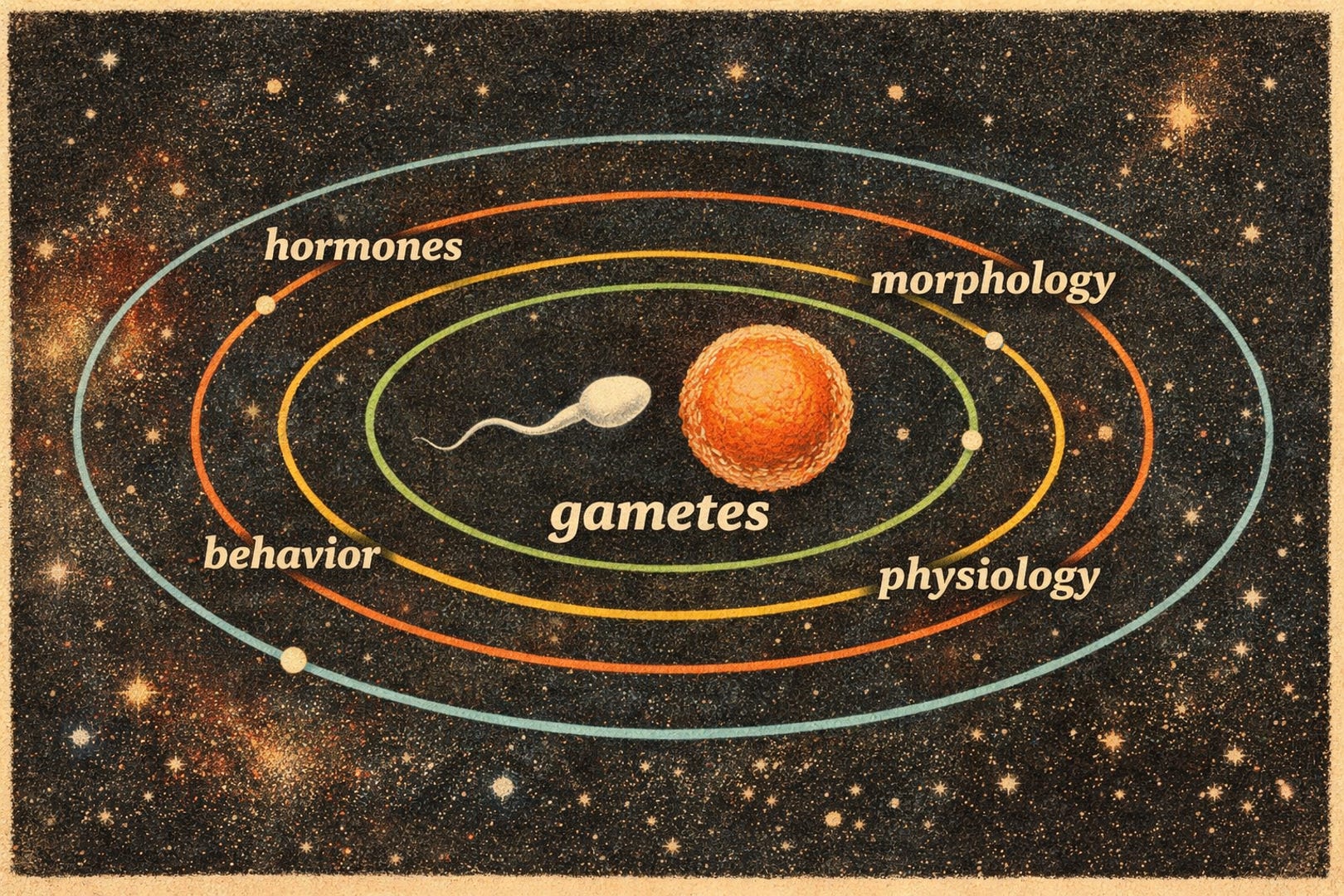
Mahr next argues that a gamete-based definition “ignores the many other biological features that vary (chromosomes, hormones, brain structures, etc.),” and claims that the “biological elements commonly linked to ‘sex’ (including cells, tissues, molecules, structures, and pathways) do not neatly divide into two distinct categories.” From this, Mahr concludes that defining sex “strictly by gamete size is a reduction that omits these complexities.” This objection is addressed directly in my original Commentary’s discussion of “polythetic” accounts of sex (Wright, 2025). There, I described the polythetic view as one in which sex is treated as “an aggregate of traits—chromosomes, gonads, gametes, hormones, neuroanatomy, secondary sex characteristics, and other sexually dimorphic traits—and individuals are assigned degrees of maleness or femaleness according to how their overall profile aligns with what is considered male-typical or female-typical.”
The difficulty with this view is not that trait variation is uninteresting, but that polythetic models conflate determinants and downstream correlates of sex with sex itself. As I wrote, “Traits are labeled ‘male-typical’ or ‘female-typical’ because they correlate with males and females already identified independently—ultimately by reference to gametes.” In other words, the polythetic view collapses in on itself because it depends on the very classificatory foundation—male and female as functional reproductive classes rooted in gametes—it seeks to replace.
The gamete-based definition does not deny biological variation; it organizes it. Chromosomes, hormones, genital development, and many dimorphic traits vary—sometimes substantially—within each sex, and development can produce atypical outcomes. But variation in correlates of sex is not the same thing as variation in sex itself. In anisogamous organisms, the universal distinction that makes “male” and “female” biologically comparable across taxa is reproductive function with respect to sperm versus ova (Bogardus, 2025). This is also why it is a mistake to treat any of these correlates, whether individually or collectively, as constitutive of sex.
For instance, there is nothing inherently “male” about a Y chromosome as such. In mammals, the Y chromosome happens to play a central role in triggering male development (Wilhelm et al., 2007); in birds, the sex chromosomes differ (ZW systems) (Ellegren, 2000); and many reptiles lack sex chromosomes entirely (Janzen & Paukstis, 1991). Yet despite the diversity of sex determination mechanisms (Bachtrog et al., 2014), the sex classes across taxa remain intelligible and comparable because they remain anchored in gamete size. This is also why sex change in sequential hermaphrodites is intelligible: We identify the transition precisely by a shift in which type of gamete the organism’s reproductive system has the function to produce (Avise & Mank, 2009). Without gametes as the universal defining trait, “male” and “female” lose all cross-taxon coherence and become nothing more than meaningless labels attached to shifting bundles of correlates.
Mahr then takes issue with my claim that definitional clarity has “scientific and societal benefits,” arguing that “rigid essentialism about sex often undergirds exclusionary norms,” including when “policy-makers or courts cite ‘science’ to restrict transgender rights.” This concern highlights an important distinction. One issue is descriptive: What an individual’s sex is as a biological classification in anisogamous species. Another is normative: What rights or accommodations a society ought to adopt for males and females. My claims about the number of sexes and how they are defined are not grounded in a preference for any policy outcome, but in what makes the categories biologically coherent and explanatorily useful. People are free to advocate for many different policies regarding sport, bathrooms, or even social recognition. But while biology can and should inform policy, policy preferences should never be used to dictate biology.
Finally, Mahr writes that the binary view “risks invalidating the lived experiences of intersex and gender-diverse individuals,” references “non-binary genders,” and invokes the claim that “a large body of research shows that about 2% of people have intersex traits that challenge a simple XX/XY schema.” My Commentary was intentionally about the biology of sex, not gender identity, roles, or expression. Those are separate topics that are irrelevant to how many sexes there are and how they are defined in evolutionary and reproductive terms.
With respect to the claim that “about 2% of people have intersex traits that challenge a simple XX/XY schema,” it is both misleading and, as presented, poorly supported by the citations provided (Fausto-Sterling, 1993, 2025). The widely repeated “2%” figure is arrived at by adopting an overly expansive definition of “intersex” as deviation from a “Platonic ideal of physical dimorphism at the chromosomal, genital, gonadal, or hormonal levels” (Blackless et al., 2000). Because conforming to a “Platonic ideal” is an impossibly high standard, this approach dramatically inflates prevalence by counting many non-ambiguous conditions as “intersex.” In response, Sax (2002) argued that if “intersex” is to retain a clinically meaningful definition, it should be “restricted to those conditions in which chromosomal sex is inconsistent with phenotypic sex, or in which the phenotype is not classifiable as either male or female.” Under this narrower, realistic, and clinically useful definition, the prevalence estimate drops two orders of magnitude to approximately 0.018%. However, the existence and prevalence of DSDs or “intersex” conditions are irrelevant to the question of how many sexes there are. While developmental variation may produce sexually ambiguous phenotypes in extremely rare cases, they do not constitute additional or intermediate sexes because they do not result in reproductive anatomy with the function of producing novel gamete types beyond sperm and ova.
In sum, Mahr’s critique is mainly about the sociology of categories and the policy implications of scientific debates. Those are fair topics to discuss, but they do not change the biological basis for how the sexes are defined. The sex binary is not an “a priori” assumption, but an empirical observation that there exist only two distinct gamete types in anisogamous species. Treating sex as a polythetic bundle of correlates confuses the determinants and downstream effects of sex with sex itself, and ultimately relies on the gamete foundation it seeks to undermine.
The renowned geneticist, Dobzhansky (1973), wrote that “Nothing in biology makes sense except in the light of evolution,” highlighting evolution as the unifying framework that makes life’s diversity, complexity, and interconnectedness comprehensible. I contend that a parallel statement applies similarly to reproductive biology: Nothing in the biology of the sexes makes sense except in the light of gametes.
If you enjoyed this free article, please consider upgrading to a paid subscription or making a recurring or one-time donation below to show your support. Reality’s Last Stand is a reader-supported publication, and your help is greatly appreciated.
If you enjoyed this article, you may also like…


As always, clean and clear. It must get exhausting arguing elementary science with non-scientists.
Scientific reality is what persists after sociologists go to their eternal rest in the oblivion of meaninglessness.
I enjoy the debate sometimes though, like a cat enjoys playing with a mouse before eviscerating it.
It is difficult to believe these individuals might actually believe the nonsense they present, however given the overwhelming plethora of diverse. insane, illogical, delusional ideas presented as reality in recent times, it is quite possible they are members of the cult of the unreality. “Follow the money” is also a universal truth that could persuade belief that these people are nothing more than opportunistic charlatans.