



Reality’s Last Stand is a reader-supported publication. Please consider becoming a paying subscriber or making a one-time or recurring donation to show your support.

About the Author
Joe Figliolia is a policy analyst at the Manhattan Institute where he writes about ethics, society and culture with a particular focus on pediatric gender medicine. His writing has appeared in City Journal, The Dispatch, and the New York Post, among others. Figliolia earned an MA from NYU’s Center for Experimental Humanities.
The conceptual foundations of youth gender medicine embrace several contentious assumptions about the nature of gender dysphoria and cross-sex identification. A recent paper in the Journal of Sex and Marital Therapy, however, provides an important clinical corrective to some of the dominant cultural narratives surrounding “gender diversity.”
As the authors point out, clinical practice for trans-identified youth is often shaped by activist-driven assumptions that can overshadow—and flatten—the clinical complexity of individual patients. As recent malpractice suits lay bare, these ideological tenets can override nuance and stated guardrails, with potentially lifelong consequences for patients.
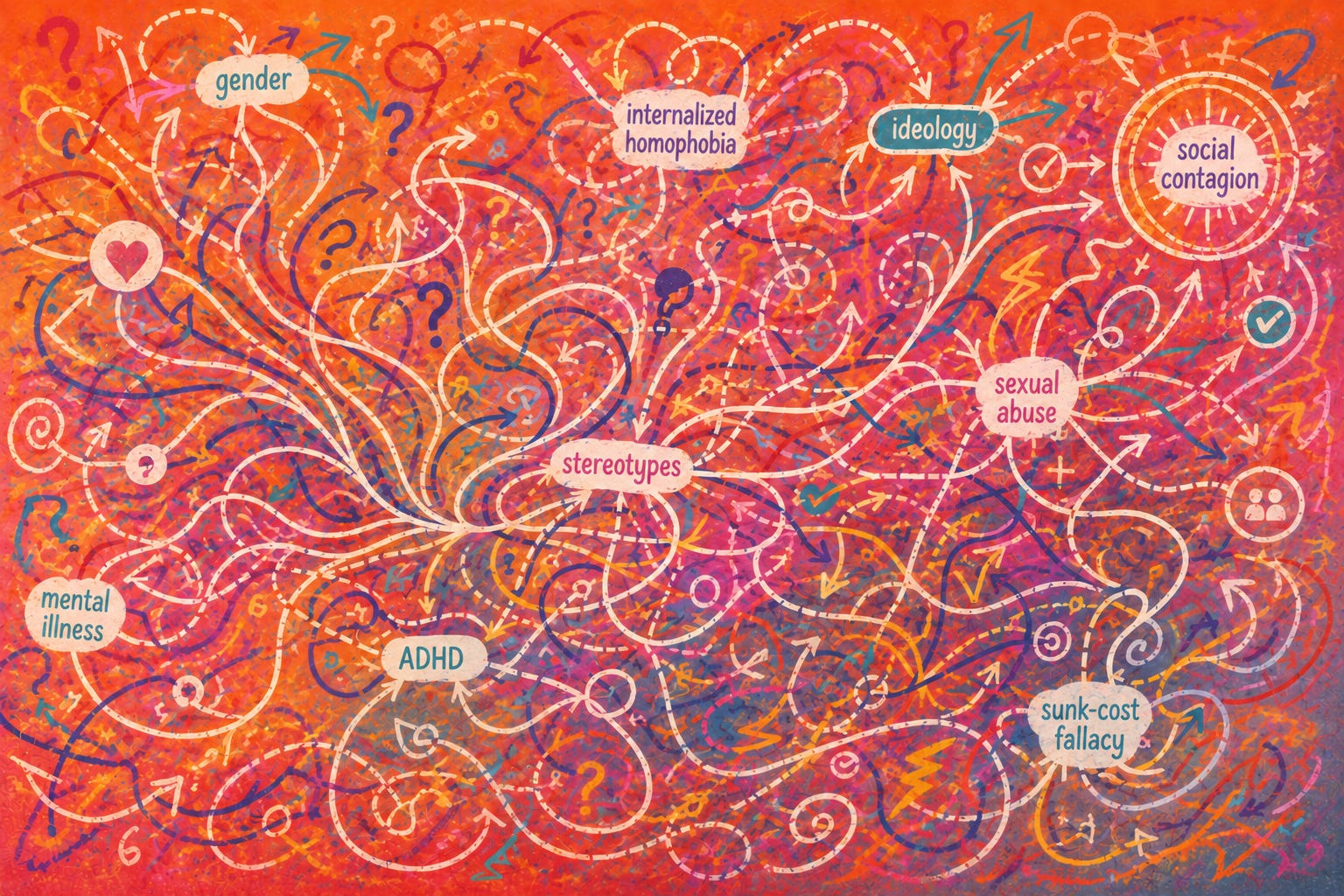
In Exploring the Psychological Mechanism of Transition and Detransition, researchers Lal and Levine draw on thirty-seven retrospective autobiographical accounts from detransitioners to propose several overlapping developmental and psychological pathways that may contribute to trans-identification. The proposed mechanisms include social contagion, neurodevelopmental disorders, dissociative responses to sexual abuse, distress over same-sex attraction, and fears surrounding adult sexuality and sex stereotypes.
This developmentally nuanced and psychologically rich approach to case formulation stands in marked contrast to that of many “affirming” clinicians, who often take self-declared identities at face value, treating them as innate and immutable. Lal and Levine, by contrast, argue that trans-identification may function more as an idiom of distress—a culturally available framework through which diffuse psychological distress is interpreted and expressed. In this way, the study challenges central tenets of the gender-affirmative model, deepens our understanding of the clinical needs of trans-identified patients and detransitioners, and makes the case for new clinical models that can better conceptualize and address the factors contributing to trans-identification.
Crucially, nearly all study participants reported that social and institutional forces played a role in their initial transitions, lending support to concerns about social contagion in the rapid rise of transgender identities in recent years, particularly among young people.
Notably, some participants compared gender ideology to a “mimetic virus.” They described learning about transition through online forums and being socialized into the tenets of “gender ideology” through interactions with both peers and adults.
Participants also reported that their exposure to gender ideology was not confined to the digital world but extended into schools, where it was sometimes actively reinforced by staff. “Several participants described school environments where social transition was actively encouraged by staff, sometimes overriding parental hesitation,” the researchers noted. In this account, schools can function as another stop on what critics have called “the transgender conveyor belt”—a network of institutional practices, professional guidance, and laws that tip the scales toward “affirmation.”
Another transition pathway emerging from the interview data involves the relationship between neurodevelopmental disorders such as autism and ADHD and self-appraisals related to one’s “gender.” Notably, one-third of the sample reported a neurodevelopmental diagnosis.
In retrospect, participants with autism diagnoses believed that their traits such as black-and-white thinking, sensory sensitivities, and social difficulties were sometimes misattributed to gender dysphoria. Some also suggested that adopting a transgender identity and entering a rule-based community with relatively clear social expectations helped mitigate social challenges associated with autism. Similarly, some participants with ADHD reported that gender transition itself became a “hyperfixation” that provided mental stimulation and a concrete goal to work towards.
A second, overlapping pathway emerging from the autobiographical accounts involved transgender identification as a dissociative response to sexual abuse or trauma. Nearly half the sample (N = 17) suggested that this played a role in their transition. Participants often reported that transitioning was motivated less by a strong desire to be perceived as the opposite sex than by a desire to escape their own sex. One female participant, for example, described how her transition was catalyzed by profound discomfort with the sense that her body was “on display” for boys and men.
These themes dovetail with another pathway identified by the researchers which involves a fear of adult sexuality and gendered expectations (N = 12). Among boys in this subgroup, most described their transition as a “flight from manhood” and, in some cases, as a way to suppress a sexuality they regarded as “inherently evil” because of pervasive negative stereotypes about masculinity. Other boys and men felt unable to live up to masculine ideals and therefore concluded that they could not succeed as men by the stereotypical and regressive logic of “gender identity” theory.
Interestingly, another transition theme to emerge was that, for some young people, identifying as and transitioning to the opposite sex was perceived as less stigmatizing than openly acknowledging their same-sex attraction.
Eleven detransitioners identified with this theme, with one male participant remarking that he “100%” transitioned to avoid the shame he associated with homosexuality. A female participant similarly reported that being a “trans man” created less social friction than living as a masculine lesbian. These accounts echo critics such as Andrew Sullivan, who have long argued that the rise in trans identification is partly driven by the “conversion” of same-sex-attracted youth who have not yet matured into their adult sexuality.
The study also provides insight into potential mechanisms that may help maintain trans-identification, including “validation euphoria” and the sunk-cost fallacy. These mechanisms could help explain why reports of patient regret are often delayed for years. And while detransition is often assumed to be rare, the true rate among today’s cohort of trans-identified youth remains virtually unknown.
Lal and Levine’s interviews with detransitioners also help identify potential catalysts for identity change. Interestingly, each involved an event or consequence that disrupted participants’ earlier self-conceptions. This finding is consistent with observations from gender-critical clinicians, who note that patients often fare better when their attention shifts outward, away from an intense internal fixation with being perceived as the opposite sex. Reported catalysts included unexpected life events, losing “affirming” friends or communities—which exposed individuals to perspectives outside their previous social circles—and medical complications from transitioning.
Unfortunately, because because the accounts of detransitioners challenge the orthodoxy of the affirmative-care model, their considerable needs are often overlooked by the same institutions and communities that championed their initial transitions. In the interviews, participants described feeling abandoned by the medical establishment and ostracized by former trans peers, suffering psychological distress related to medicalization, and experiencing embarrassment and shame as they returned to living as their sex.
As part of recent settlement agreements with the Department of Justice, Texas Children’s Hospital, the Cleveland Clinic Foundation, and Connecticut Children’s have agreed to establish first-of-their-kind clinics dedicated to detransition care. While this is a step in the right direction, detransitioners’ needs will likely extend well beyond procedural reversals to include psychological, social, and community support.
Lal and Levine’s study has limitations, but it nonetheless provides valuable insight into what one cohort of detransitioners believes motivated their transitions, sustained their identities, and ultimately led them to reject the medical-transition pathway. As the authors note, qualitative research can also generate hypotheses for future quantitative studies. Taken together, the findings provide further support for critics who argue that the “affirmative” model is incompatible with clinical best practices and lacks the psychological and developmental nuance that should be fundamental to sound clinical care.
Of course, such reforms are easier said than done. The American Psychological Association, the American Psychiatric Association, and the National Association of Social Workers have largely embraced the activist premises underlying youth gender medicine. Those commitments are reflected in their practice guidelines, professional education and training standards, and, in some cases, continuing-education requirements.
Concerned practitioners and researchers should summon the courage to press for systematic reviews requirements in support of policy statements, ideologically balanced panels when such policies are developed, and full transparency regarding conflicts of interest among committee and panel members. More fundamentally, these disciplines must move away from justifying experimental interventions on the basis of identity claims or civil-rights imperatives and recognize that distress, not identity, is the proper object of treatment.
See Steven Pinker Live This September
Join Steven Pinker for an evening of wide-ranging conversation about language, human nature, rationality, and progress, followed by questions from the audience. Whether you are a longtime reader or simply curious about his work, this North American tour offers a rare chance to hear one of today’s leading public intellectuals discuss and develop his ideas at length.
Tickets available here, or click the banner below.

If you enjoyed this free article, please consider upgrading to a paid subscription or making a recurring or one-time donation below to show your support. Reality’s Last Stand is a reader-supported publication, and your help is greatly appreciated.
If you enjoyed this article, you may also like…


This is an excellent article, indeed—thoughtful, insightful, and balanced.
From my perspective as a biological psychologist, this more nuanced approach is both correct and welcome, but it still falls short of capturing the dynamic nuances of human behavior. That is simply a limitation of our language, experimental design, and ability to understand complex biological phenomena. Anyone who understands neuroscience should have realized from the outset that something as complex as “gender dysphoria” will have dynamic, interacting causative factors that, by definition, will change over time both within and between individuals. This nuanced approach gets us closer to a clear understanding, but that understanding may never be definitive because causation in biological systems is often not definitive. I discussed this in my Substack article, “There Is Biological Evidence for Gender Identity, but It’s Not What You Think.”
That said, given the inherent ambiguity in determining precise causes for complex human behaviors, one should immediately be struck by the fact that trying to “cure” such conditions should not include irreversible and damaging medical procedures. My heart goes out to those who have suffered due to this fundamental misunderstanding of biology.
Thank you again for an excellent essay.
Sincerely, Frederick
We who divorced suddenly full time crossdressing husbands attest to the politically-driven diagnostic, therapy and medical practices. The rush to body modifications is not just in the under age category, its rampant in the treatment of adults. All for the same reason: find the new cloud nine of the altered body. If instead a program of the following 5 practices would be followed, many would desist in the cross-sex ideation: 1. remove or cover all mirrors in the home 2. severely curtail online social media activity 3. detailed psychological examination of past experiences involving abuse, trauma & grief 4. reconnect to nature through visits to wildlife preserves and wildflower gardening 5. schedule altruistic work to improve the lives of orphans and other vulnerable populations around the world, including a savings account for the money not spent on crossdressing clothing, make-up and jewelry, to be distributed to reliable organizations.