



Reality’s Last Stand is a reader-supported publication. Please consider becoming a paying subscriber or making a one-time or recurring donation to show your support.

About the Author
Dr. Colin Wright is an evolutionary biology PhD, Manhattan Institute Fellow, and CEO/Editor-in-Chief of Reality’s Last Stand. His writing has appeared in The Wall Street Journal, The Times, the New York Post, Newsweek, City Journal, Quillette, The Washington Examiner, and other major news outlets and scientific journals.
This essay was originally published in The Washington Examiner on April 22, 2026.
The Montana Supreme Court’s decision last week in Kalarchik v. State should put to rest the right’s celebratory mantra that “woke is dead.” It isn’t. In a 5–2 ruling, the court upheld a preliminary injunction blocking enforcement of key parts of Montana’s 2023 law, SB 458, and related agency policies that defined sex in binary, biological terms and limited changes to birth certificates and driver’s licenses. The ruling does not finally invalidate the law, but it allows Montanans with transgender or “nonbinary” identities to continue changing the sex marker on identity documents while the constitutional challenge proceeds. More importantly, the majority signaled its view that the challenged policies likely violate Montana’s constitution, holding that “transgender discrimination is, by its very nature, sex discrimination” and subjecting the state’s policy to strict scrutiny.
That outcome matters well beyond Montana, because it shows how thoroughly activist ideologies about sex and gender have penetrated elite institutions, including courts in conservative states. Montana’s legislature had attempted to define sex in law using objective biological criteria tied to reproductive function, while excluding “psychological, behavioral, social, chosen, or subjective experience of gender.” The court majority treated the refusal to translate gender identity into official sex classification as a form of unlawful sex discrimination.
Many of these sex-denying policies were not a result of some revolutionary scientific discovery, but from a form of linguistic capture. Existing legal terms were instead reinterpreted and redefined. “Sex,” once understood as a biological classification, was gradually made to include “gender identity,” a subjective feeling. Once an objective biological anchor is gone, policy will go wherever activists want to pull it. Montana’s law tried to reinstate that anchor, and failed.
That has been the standard pattern. The cultural campaign against the biological reality of sex began in niche activist blogs, women’s studies departments, and obscure ideological magazines. But it eventually moved into mainstream journalism and then into scientific and scholarly journals, where it acquired the prestige that courts and bureaucracies necessarily treat as authoritative.
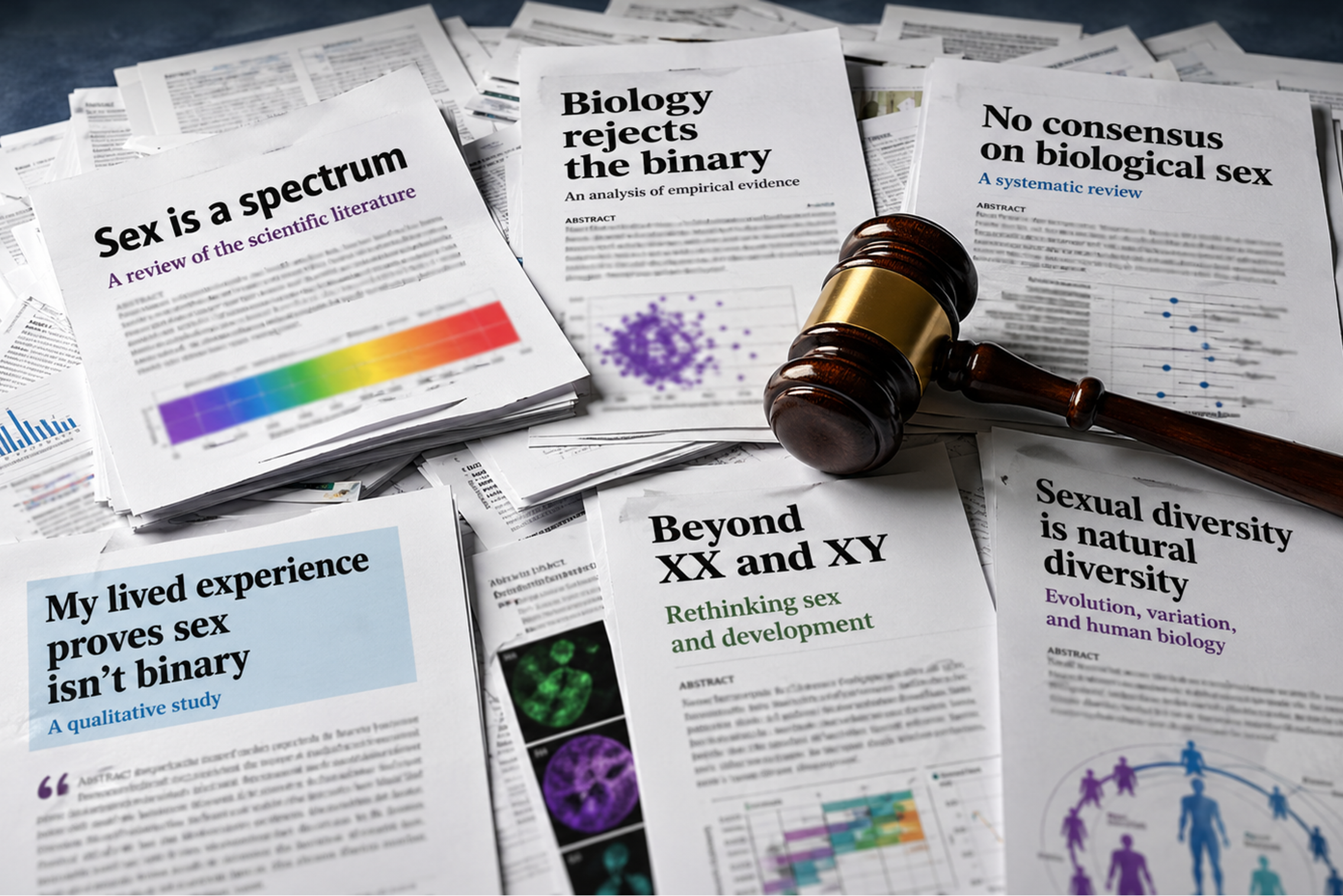
In just the last few weeks, many outlets have been promoting this sex pseudoscience. Princeton anthropologist Agustin Fuentes argued in Science Politics that government efforts to define sex as a biological binary incorporate “falsehoods and erroneous assertions.” IFLScience ran a piece insisting there is “no clean definition” of biological sex. A piece from the Trans Advocacy & Complaints Collective declared that “sex does not fit neatly in boxes.” A new BioScience paper reported that teaching students “the diversity of biological sex” increased LGBTQIA+ students’ “sense of belonging.” And an Ecology Letters paper concluded that there is “no current consensus” on biological sex. It’s safe to say that the war on biology hasn’t slowed down. It has, in my estimation, been dramatically accelerating.
The main issue is not that these arguments are simply wrong, but that they create the appearance of scientific doubt around fundamental biological facts. Once enough papers and essays circulate claiming that sex is a spectrum or based on clusters of mutable traits, or something with “no consensus” definition, judges and policymakers can present themselves as merely choosing among competing expert views. But this is a manufactured controversy, because the basic biological claim that males and females are reproductive classes rooted in anisogamy (sperm vs ova) has not been overturned. Activists have merely expanded the topic from sex to everything associated with sex—hormones, morphology, behavior, developmental pathways, social roles—and then act as though the resulting complexity is proof that sex itself defies categorization.
That sleight of hand was on display in a recent debate at the University of Delaware between Fuentes and philosopher Tomas Bogardus. Before the debate even began, the moderator had to defend the legitimacy of discussing whether biological sex is binary at all, noting that some critics objected to the event’s very occurrence on the grounds that it could harm vulnerable communities.
Yet the debate also exposed why the activists have vehemently held a position of “no debate” for so long. Fuentes explicitly conceded that humans have two sexes—male and female—and said that when he speaks of sex as a spectrum, he does not mean three sexes or five sexes. Instead, his strategy is to widen the discourse around sex itself to what he called “sex biology,” a much broader category encompassing every axis that bodies, behaviors, endocrine systems, morphology, etc., can vary between the sexes. He emphasized overlapping distributions in height, weight, hormones, fat deposition, and other traits, then argued that because these traits are not distributed in perfectly discrete ways that a binary framing is not biologically sound or useful. Bogardus, by contrast, kept returning to the central question of the debate: what sex is, and how many there are. His (correct) answer was that male and female are functional reproductive classes rooted in producing either sperm or ova, and that variation in correlates of sex does not negate the sex categories themselves.
Of course it is true that not every sexually dimorphic trait is binary. Of course males and females overlap in countless characteristics. No biologist thinks every trait in an organism fall into in two perfect, non-overlapping bins. That has never been the claim. The claim is that in anisogamous species (those that reproduce by fusing sperm and ova) there are two sexes because there are two reproductive functions based on two gamete types. This is precisely the point I made in my 2025 Archives of Sexual Behavior commentary, “Why There Are Exactly Two Sexes.” I also addressed the routine attempts to dissolve sex into trait clusters, and explained why these activist models actually presuppose the gamete-based model they seek to replace.
The legal implications of activist pseudoscience are so serious because once sex is no longer understood as a reproductive classification but as an aggregate of partly overlapping traits, it becomes infinitely malleable. Courts can then say that because people differ in complicated ways and because some sex-related traits do not line up neatly, the state has no principled basis for keeping sex distinct from identity. This is how law begins to privilege a pseudoscientific account of human beings while portraying those defending the true biological understanding of sex as ideologues.
My own paper was recently the target of a Letter to the Editor in the same journal by the German scholar Dana Mahr. I welcomed the criticism, because robust public debate about the facts is healthy. But rather than making a scientific refutation of my paper, Mahr chose to critique it from a “feminist epistemology” perspective, arguing that defining male and female by gametes is simply a choice shaped by historical and cultural norms. In my published response, I pointed out that while the labels we assign the reproductive classes “male” and “female” are conventional, the underlying reproductive phenomenon is not. The fact that anisogamous organisms reproduce through the fusion of two gamete types is no more created by language than the molecular structure of water is created by language. The real issue is whether our categories track a mind-independent feature of nature. In the case of biological sex, they do.
Our exchange encapsulates the entire conflict. On one side is the view that biology describes real features of the world. On the other is the claim that concepts literally create the world, and that our definitions should therefore bend toward achieving social and political goals.
Some people still proclaim that woke has peaked, is now trending down, and that the country is finally moving on. There is some truth to that politically, because the backlash against woke is real and the public is more skeptical and informed than it was five years ago. The Trump administration has moved to restore biological language in federal policy, and more scholars are now willing to defend basic biological realities in print. But surveying the daily output of academia, which I do regularly, gives no indication that the activist project is in retreat. It is simply consolidating. If you want to know where the next round of policy battles will come from, do not watch the news or scroll your social media feed. Read the journals.
Some of my colleagues believe we have entered the “lawfare” stage of this conflict. The people who are reachable have now heard the arguments and chosen their side. The fight is no longer mainly about consciousness-raising, but policy implementation. Which view of sex will be written into state and federal policy? Which view will courts treat as authoritative? Which view will medical boards, licensing agencies, school systems, and bureaucracies be able to cite as settled expertise? Those questions will be answered, in large part, by what appears in the academic literature. Progressives understand this, and are playing the long game by saturating academic journals with ideological nonsense.
The Montana decision should be understood in that light, and serve as a warning. Even in a red state, after years of public controversy, and after legislators tried to write biological reality back into law, the highest court in the state treated that effort as unconstitutional discrimination.
This is why serious scholars, now more than ever, must start actively engaging with activist pseudoscience in academic journals. Social media posts and think pieces are not nearly enough to combat the left’s slow manufacturing of expert consensus where it matters most.
If you enjoyed this free article, please consider upgrading to a paid subscription or making a recurring or one-time donation below to show your support. Reality’s Last Stand is a reader-supported publication, and your help is greatly appreciated.
If you enjoyed this article, you may also like…


I won’t be happy until Colin Wright is presenting his argument for the binary, gamete-based understanding of sex before the SCOTUS. I haven’t seen anyone do better when it comes to calmly and plainly addressing and refuting the “sex traits ARE sex” argument.
Biologically speaking, there are only two sexes, period. Practically speaking, identification documents present problems. Why do we put biological sex on legal identifying documents? They link back to birth certificates, providing continuity of identity, plus there are real practical and medical reasons. But if a trans person presents at an ID checkpoint, let’s posit looking convincingly like one sex but identified as the other, it poses hassles.
There is a simple solution, though it is probably too guileless and “nonbinary” for our polarized, sophistical culture: call a spade a spade. “Trans women are women” is arm-twisting sophistry. Trans women are … trans women. And vice versa. Let them identify themselves as such. If there is no shame in being transgender, why lie about it? If we are not aiming to outlaw it out of existence (which can’t be done, and shouldn’t be attempted), why not just acknowledge it? A legal ID document would thus indicate both biological sex at birth and, if different, gender of presentation. That would at the very least speed up airport security lines and actually reduce, not increase, discrimination and “misgendering.” You can’t be unjustly unmasked if you’re not masked in the first place