



Reality’s Last Stand is a reader-supported publication. Please consider becoming a paying subscriber or making a one-time or recurring donation to show your support.

About the Authors
Robert Deaner, PhD, is a Professor in the Department of Psychology at Grand Valley State University. His research uses an evolutionary perspective to illuminate sex differences and their portrayal.
Mike Lombardo, PhD, is a Professor Emeritus of Biology at Grand Valley State University. His research interests include the evolution of sports and throwing in humans and cooperation and behavioral ecology in birds.
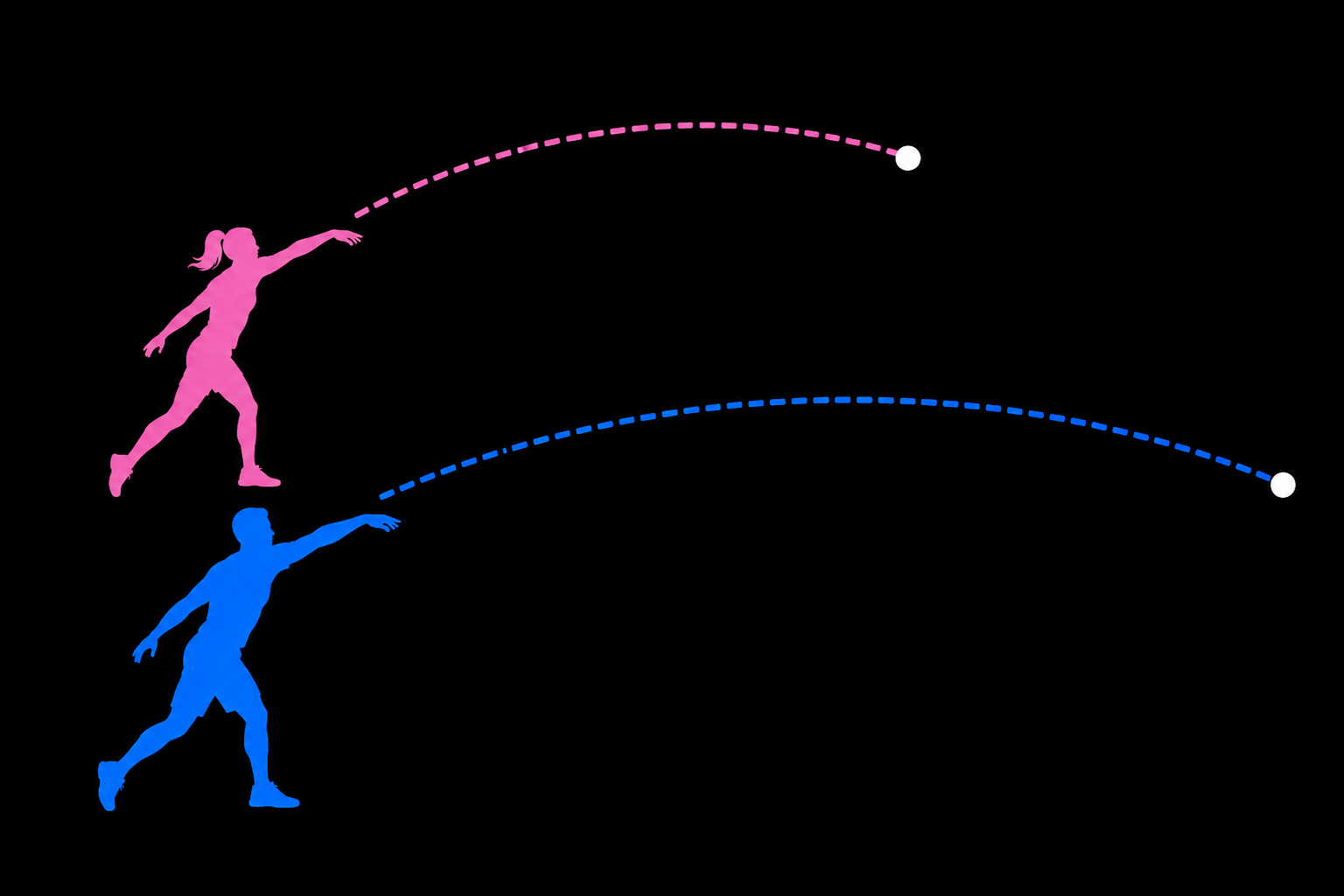
The phrase “throw like a girl” is a crude stereotype, but, like many stereotypes, it contains more than a grain of truth. In fact, the sex difference in overhand throwing is one of the largest behavioral sex differences ever measured.
Psychologists typically express group differences in standard deviations. Among young children, boys outperform girls in throwing distance and velocity by about 1.5 standard deviations. The gap widens across childhood and adolescence. By late adolescence and adulthood, estimates are generally around two standard deviations or greater. Thomas and French’s classic meta-analysis remains a useful starting point for examining this sex difference.
A difference of two standard deviations is roughly the same magnitude as the familiar adult sex difference in height. It means that the average man throws as well as or better than about 98 percent of women.
The raw numbers make the point just as clearly. In one study of young adults, men threw a tennis ball at an average velocity of 29.4 meters per second, compared with 18.6 meters per second for women. In other words, the women averaged about 63 percent of the men’s throwing velocity. At elite levels, the sex difference remains large. In modern track and field competition, men throw the javelin about 30 percent farther than women despite using a heavier javelin. The sex difference in javelin performance is therefore substantially larger than the familiar male advantages in running and jumping events.
These are group averages, not rules about individuals. The distributions overlap, some girls and women throw extremely well, and training matters. Nonetheless, the sex difference is large, appears well before puberty, and generally increases with age.
* * *
In 2018, we published two review articles in The Quarterly Review of Biology. The first, Born to Throw, examined the ecological circumstances that may have favored the evolution of powerful human throwing. The second, On the Evolution of Sex Differences in Throwing, explored why throwing ability is so strongly sexually differentiated.
We argued that throwing probably first became important in threat displays and physical conflict and was later incorporated into hunting and power scavenging—that is, driving predators and other scavengers away from kills. Because males participated far more often in dangerous physical combat and more often in hunting, we proposed that selection for throwing-related traits was stronger in males.
Our claim was never that training and culture do not matter, that every boy throws better than every girl, or that girls and women should be discouraged from throwing activities. We argued only that the large average sex difference in throwing is partly innate.
Readers interested in a shorter account of the underlying research can read our article How Humans Became the Best Throwers on the Planet in The Conversation.
More recently, developmental biologist Anne Fausto-Sterling published Throwing Like a Girl: A Critique of Past Approaches and an Illustrated Proposal for a Path Forward in Biology of Sex Differences. Much of her article challenges our evolutionary account. We responded in a commentary published in Evolutionary Psychological Science. Free versions are available through Springer SharedIt and PsyArXiv.
Our disagreement is about throwing, but we think it illustrates something much larger: how Blank Slate thinking can persist even among researchers who readily acknowledge that nature and nurture interact.
Steven Pinker popularized the Blank Slate metaphor in his 2002 book The Blank Slate. In its most extreme form, the Blank Slate view holds that humans possess little meaningful evolved psychological structure and that culture and socialization therefore do nearly all the work in producing behavioral differences, including differences between girls and boys and between women and men.
Few serious scholars explicitly defend that position today. Instead, they say that nature and nurture interact.
Good. They do.
The problem begins when we ask what biology is actually allowed to explain.
See Steven Pinker Live This September!
Interested in learning more about The Blank Slate? This September, you can ask Steven Pinker about it yourself.

More than two decades after its publication, Pinker’s The Blank Slate remains one of the most important books ever written. Its central argument was simple: human beings are not infinitely malleable products of culture. We have a nature, shaped in part by evolution, and any serious attempt to understand society must begin by confronting the facts of human psychology rather than wishing them away.
That commitment to following evidence wherever it leads has defined Pinker’s career. This September, the Harvard psychologist and bestselling author will bring that approach to the stage for a series of live events across the United States and Canada.
Pinker will explore the ideas that have animated decades of his work—from human nature, language, and rationality to violence, progress, and the forces that shape modern society. He’ll also discuss themes from his latest book, When Everyone Knows That Everyone Knows.
These events offer something interviews and short lectures rarely can: the chance to hear Pinker develop his arguments at conversational length and then put your own questions to him during the audience Q&A. If The Blank Slate left you with questions—or convinced you that its warnings are even more relevant today—this is your opportunity to continue the conversation in person.
TOUR DATES: New York (Sept. 1), Boston area (Sept. 10), Chicago (Sept. 11), San Francisco (Sept. 12), Montreal (Sept. 13), and Toronto (Sept. 15).
Tickets and event details are available through Steven Pinker’s official tour website.
Why Fausto-Sterling Matters
Fausto-Sterling is not an incidental figure in modern debates about sex. Her famous 1993 essay The Five Sexes helped popularize the idea that the familiar male-female binary is biologically inadequate. She proposed additional “sexes” based on intersex conditions and argued more broadly that sex should be understood as a continuum.
Those arguments became enormously influential. In our view, they also created lasting confusion by encouraging people to mistake variation in sexual development for evidence that biological sex itself is not binary. But when it comes to sexual reproduction, the distinction is straightforward: females are organized around producing ova and males around producing sperm. There is no third gamete type or reproductive role, and intersex conditions do not create one.
One of us has examined these arguments in an essay for Skeptic. Other evolutionary biologists, including Colin Wright, have also offered detailed treatments of the issue.
We will leave that debate there. In this essay, our dispute with Fausto-Sterling concerns a different question: Can an important behavioral difference between males and females be partly biological?
Fausto-Sterling emphasizes that nature and nurture are “entangled.” Fine. We agree. The problem is that after making this concession, she allows biology to explain essentially nothing.
Misrepresenting Our Evolutionary Argument
Fausto-Sterling portrays recent challenges to “Man the Hunter” as a serious problem for our hypothesis. Women, she argues, hunted more than traditional accounts acknowledged. She therefore concludes that the idea that women experienced less selection for throwing prowess needs to go “back to the drawing board.”
There is an immediate problem with this critique: hunting was not our primary evolutionary scenario. Combat was.

We said this explicitly. Both of our 2018 papers proposed that throwing first arose in threat displays and fighting and was later incorporated into hunting. Indeed, the abstract of Born to Throw states that “throwing first arose during agonistic interactions and was later incorporated into hunting by human ancestors.” This was not a stray speculation buried in a footnote. It was the central evolutionary scenario we proposed.
The evidence overwhelmingly indicates that physical aggression, lethal combat, and warfare are heavily male-biased behaviors. That part of our hypothesis therefore matters greatly.
Fausto-Sterling does not merely give combat too little attention. She effectively recasts our hypothesis as one centered on hunting and then attacks that version instead.
We cannot know whether this reflects careless reading or something less innocent. What we can say is that her readers are not given an accurate account of the hypothesis she claims to be criticizing. That is poor scholarship.
That said, hunting was an important secondary component of our hypothesis, so her treatment of that evidence deserves attention as well.
Woman the Hunter
A 2023 paper by Anderson and colleagues, The Myth of Man the Hunter: Women’s Contribution to the Hunt Across Ethnographic Contexts, received enormous publicity. After reviewing ethnographic descriptions of 63 foraging societies, the authors reported evidence of women hunting in 79 percent of them.
The finding quickly spread as evidence that “Man the Hunter” was a sexist myth, and Fausto-Sterling embraced it as a challenge to our evolutionary scenario.
There was, however, a serious problem. Roughly a year before Fausto-Sterling submitted her paper in 2025, a 15-author team—including numerous researchers with extensive experience studying hunter-gatherers—published Female Foragers Sometimes Hunt, Yet Gendered Divisions of Labor Are Real. The authors identified problems with sample selection and coding, as well as a more fundamental problem with what the 79-percent statistic actually measures.
The basic issue is easy to understand: asking whether women ever hunt is not the same as measuring how sexually differentiated hunting is.
Imagine a society in which 100 men hunt regularly and one woman hunts occasionally. If an ethnographer mentions her, that society can be coded as “women hunt.”
Technically true, but nearly useless for estimating the magnitude of the sex difference.
Hagen, one of the critique’s authors, illustrated the problem using individual-level records from a large cross-cultural dataset on foraging. Males accounted for the overwhelming majority of hunting records and about 99.7 percent of the recorded hunted meat.
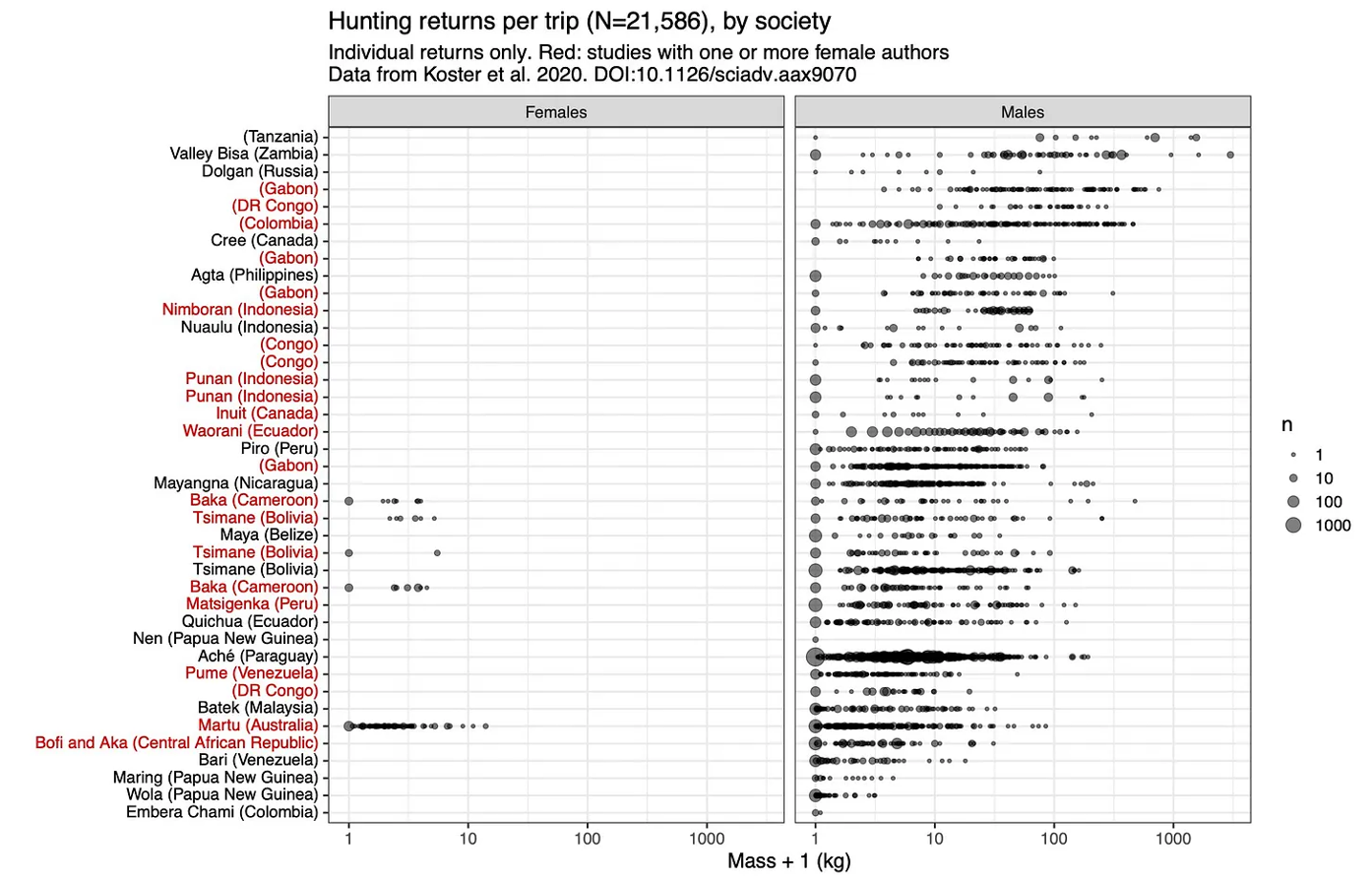
The dataset was not designed to provide an unbiased global estimate, and Hagen emphasized several reasons for caution. Nevertheless, it vividly illustrates how little the binary variable “women hunt: yes or no?” tells us about the magnitude of the sexual division of labor.
Women sometimes hunt. Of course they do. But that does not mean hunting is not strongly sexually differentiated.
In sum, both components of our evolutionary scenario—male-male combat and hunting—remain highly plausible and are supported by substantial evidence.
What Happened to the Rest of the Evidence?
Fausto-Sterling’s treatment of the evolutionary evidence is only part of the problem.
Our 2018 argument did not rest on a handful of studies showing that boys throw farther and faster than girls. We reviewed evidence on throwing velocity and distance, accuracy and targeting, elite performance, training and sports experience, cross-cultural behavior, prenatal androgen exposure, shoulder and arm anatomy, and injury patterns.
Fausto-Sterling engages with only one part of that evidence: sex differences in children’s throwing.
Consider experience. Girls improve when they practice throwing. Of course they do. The important question is whether differences in experience explain most or all of the sex difference.
The evidence suggests they do not. In Does the Throwing “Gender Gap” Occur in Germany?, Ehl, Roberton, and Langendorfer studied German children partly because throwing sports were less culturally prominent there. Boys nevertheless displayed more advanced throwing patterns than girls. More strikingly, there was almost no overlap in throwing velocity, with a sex difference of roughly five standard deviations.
An especially informative study examined Aboriginal Australian children. Historical accounts suggested that Aboriginal girls and women had substantially more throwing-related experience than is typical in Western societies. The Aboriginal girls threw better than girls in several comparison samples. In other words, experience mattered. Yet Aboriginal boys still threw faster than Aboriginal girls. The sex difference was smaller than in U.S. samples but remained large, at about 1.4 standard deviations. Thomas and colleagues’ study of Aboriginal Australian children illustrates what a genuine interactionist account would predict: environmental experience can alter performance without erasing an underlying sex difference.
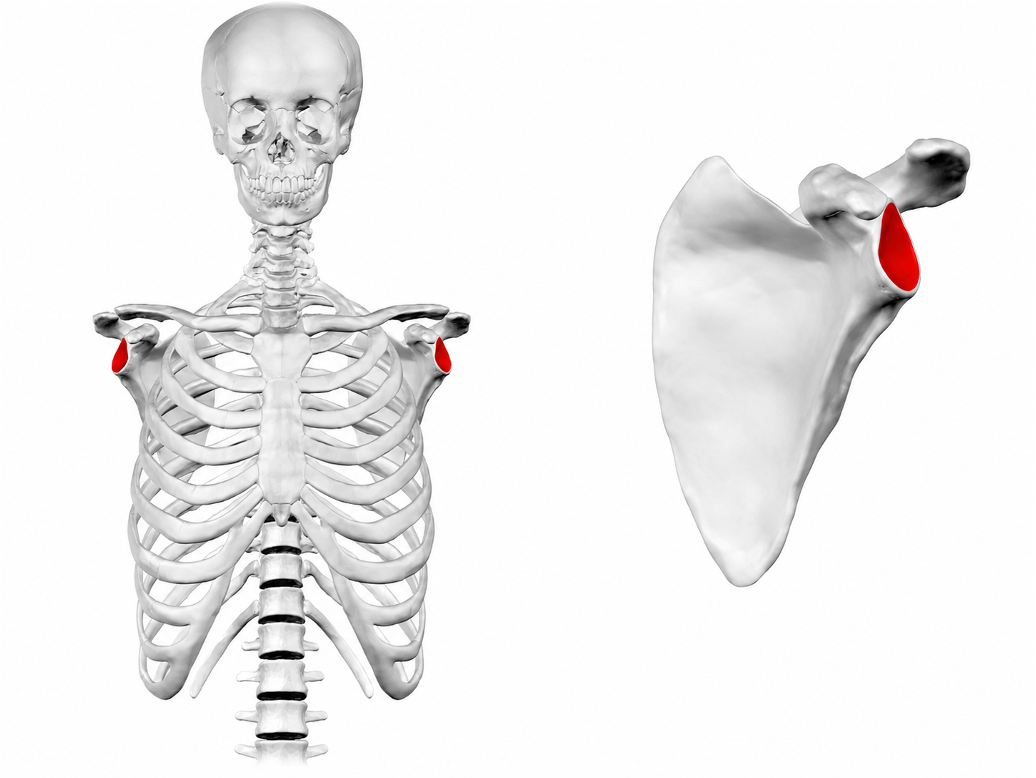
Then there is anatomy. Our review identified numerous sexually differentiated features of the shoulder and upper body that contribute, or plausibly contribute, to throwing performance. Consider just one: the glenoid fossa, the socket of the scapula where the upper arm articulates with the shoulder.
Across the eight adult samples we reviewed that measured glenoid height or breadth, males had larger dimensions in every case. The median sex difference was about 2.3 standard deviations—a very large difference, despite some overlap between the male and female distributions. Sex differences in glenoid dimensions can even be detected in young children.
No single finding proves our evolutionary hypothesis. What matters is the convergence of developmental, cross-cultural, performance, and anatomical evidence. Fausto-Sterling does not seriously grapple with that convergence.
Apparently It Can’t Be Innate If It’s Not Present at Birth
Fausto-Sterling makes an especially puzzling developmental argument when discussing the early emergence of the sex difference. She notes that throwing differences are “not there at birth, when infants cannot even lift their head.”
Well, yes.
Many evolved traits and capacities—such as walking and talking—are absent at birth and emerge only through development. An innate predisposition does not need to appear fully formed in a newborn. Genes regulate developmental pathways. Hormones act at particular stages. Bones and muscles grow. Nervous systems mature and respond to experience.
A newborn’s inability to throw therefore tells us essentially nothing about whether later sex differences in throwing are partly innate. Treating “not present at birth” as evidence against an evolved contribution confuses innateness with neonatal expression.
For a developmental biologist, that is a remarkable mistake.
Statistically Controlling Away What Needs to Be Explained
Fausto-Sterling makes another blunder in her use of statistical control.
She discusses Roberton and Konczak’s study of children’s overarm throwing, which measured developmental components such as humeral motion, trunk and forearm action, stepping, and stride. Once those components were entered into a regression model, sex explained little additional variation in throwing velocity. Fausto-Sterling highlights the authors’ description of sex as “redundant with developmental level.”
But this analysis describes the difference; it does not explain its cause.
Suppose we tried to explain the male-female difference in height by entering femur length, tibia length, and torso length into a regression. Once those components were included, sex would add little additional predictive power for total height. That obviously would not show that the height difference is nonbiological. It would merely identify the physical components through which the sex difference is expressed.
Ten Babies Cannot Settle the Question
Fausto-Sterling’s article also includes an empirical component: an exploratory analysis of ten infants—five boys and five girls—with especially detailed discussion of one boy and one girl. The five boys began active ball play at an average age of 9.7 months, compared with 12.1 months for the girls. Fausto-Sterling also observed more ball-related interaction in some mother-son dyads and uses these observations to illustrate how different experiences might send boys and girls down different developmental pathways.
The observations are interesting and may point to real environmental contributions. They cannot, however, answer the most important causal questions. Did mothers create the difference by treating sons and daughters differently? Did the infants differ in their attraction to balls and thereby elicit different responses from their mothers? Did both processes contribute?

Observations of ten infants cannot tell us.
More fundamentally, Fausto-Sterling treats developmental and evolutionary explanations as though they compete, when they should complement one another. A complete account must address both how a sex difference develops and why natural selection may have favored the underlying predispositions.
Children are not passive recipients of socialization. They seek out some experiences and avoid others, differ in what captures their attention, and may elicit different responses from parents. Parents, in turn, influence their children. Ridley captured this dynamic in the title of his 2003 book, Nature Via Nurture: biological predispositions often develop through experience rather than instead of it.
There is also a striking asymmetry in Fausto-Sterling’s standards of evidence. She questions whether studies of sex differences in children’s throwing across eight countries can support broad conclusions, partly because some samples were modest. By our calculation from the studies listed in her own Table 1, the median sample size was 160. Yet she is willing to draw theoretical lessons from a study of just ten infants, with much of the detailed narrative resting on only two of them.
Small samples, apparently, become more illuminating when they point in the preferred direction.
The Modern Blank Slate
This is where the throwing dispute becomes more interesting than throwing itself. Few scholars today explicitly embrace the strong Blank Slate. The standard language—including Fausto-Sterling’s—is interactionist: nature and nurture interact; genes and environments interact; biology and culture interact.
For many sex-and-gender scholars, however, this interactionist language amounts to little more than lip service. Again and again, reasonable observations about development or social influence are used to prevent biology from explaining much of anything.
A trait is plastic, so biology is discounted. Parents treat boys and girls differently, so parental behavior is presumed to have created the difference. Practice changes performance, so the original difference is treated as socially produced. Development mediates a difference, so developmental processes are treated as alternatives to evolutionary ones.
The premises may be true. In each case, however, the conclusion does not follow.
Consider nutrition. It strongly affects height, but no serious person concludes that the average sex difference in height is therefore socially created. Or consider walking. Experience helps children learn to walk, but habitual, efficient bipedal locomotion depends on evolved anatomy and developmental machinery.
Saying that nature and nurture are “entangled” is therefore correct, but it does not answer the question of what each contributes. Throwing provides one unusually clear example. Occupational interests provide another—and one that matters far more in ordinary modern life.
From Throwing to Occupational Interests
Throwing probably mattered greatly throughout much of human evolutionary history but matters relatively little for most people today. Occupational interests are almost the reverse. Our hunter-gatherer ancestors never had to decide whether to become computer programmers, carpenters, graphic designers, nurses, or elementary-school teachers. Yet the interests that shape such choices now have major practical consequences.
One of the largest and best-replicated psychological sex differences involves the people-things dimension. In their 2009 meta-analysis, Men and Things, Women and People, Su, Rounds, and Armstrong analyzed data from 503,188 people. Men showed greater interest in working with things, while women showed greater interest in working with people. The difference was nearly one standard deviation, and the sex difference in engineering interests was even larger.
More recently, Stoet and Geary analyzed the occupational aspirations of 473,260 adolescents across 80 countries and economic regions. In every country, more boys aspired to things-oriented and STEM careers, while more girls aspired to people-oriented careers. These differences also tended to be larger in countries with greater female empowerment.
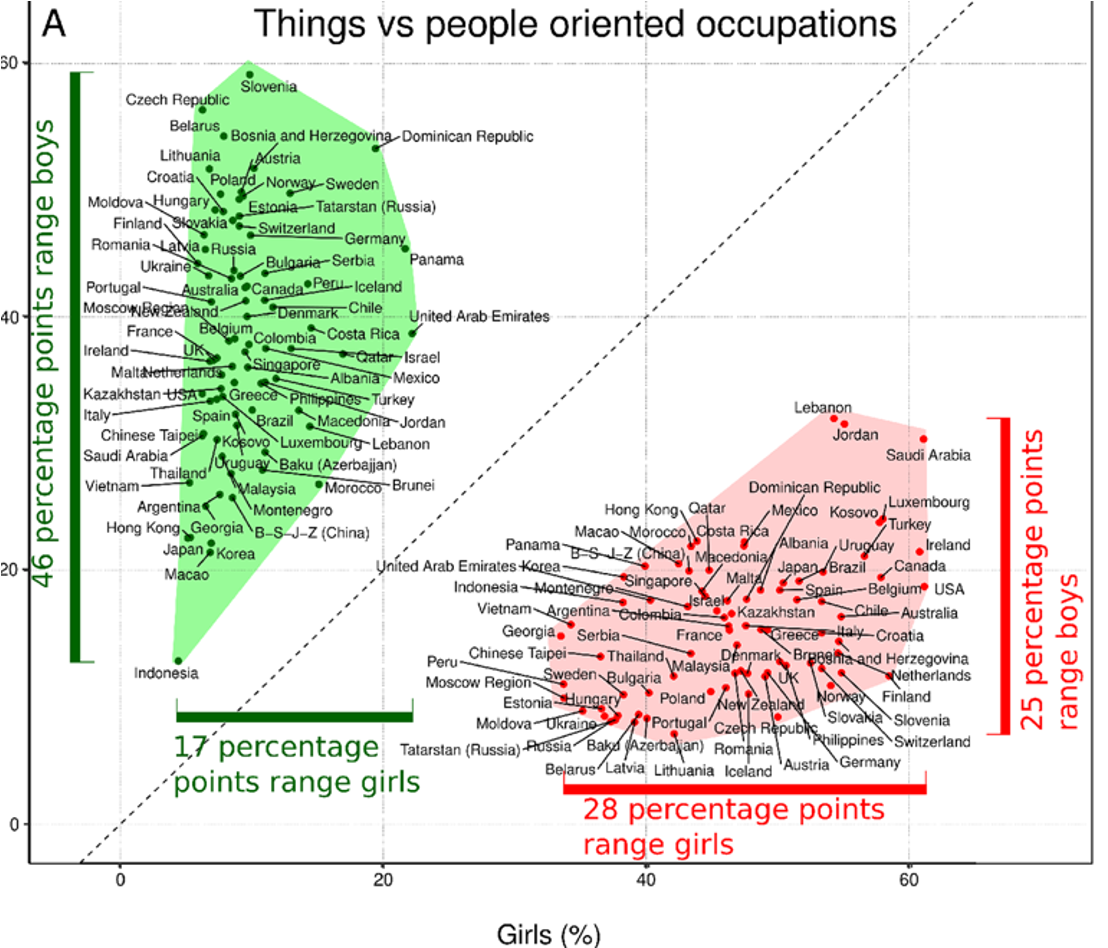
Cross-national comparisons cannot settle questions of causation, but the recurrence of these differences across societies is difficult to reconcile with a socialization-only account.
Relevant differences also appear long before young people begin choosing careers. A meta-analysis of 75 studies found robust sex-typed toy preferences, while a longitudinal study by Kung found that gender-typed play at age three and a half predicted gender-typed occupational interests at age 13.
None of this proves that occupational interests are innate. Socialization begins early too.
Evidence consistent with a hormonal contribution comes from congenital adrenal hyperplasia, or CAH. Females with classic CAH experience unusually high prenatal androgen exposure. Beltz, Swanson, and Berenbaum found that females with CAH showed greater things-oriented interests than unaffected females, while Frisén and colleagues found that women with CAH were more likely than controls to work in male-dominated occupations, especially among those with the form associated with the greatest prenatal androgen exposure.
CAH cannot by itself establish the effects of prenatal androgens because the condition has consequences beyond hormone exposure, and sample sizes are necessarily modest. But when considered alongside the large population-level sex difference, its early developmental precursors, and its recurrence across cultures, the CAH evidence makes a purely socialization-based account increasingly difficult to sustain.
Biology Gets a Courtesy Mention
So how do scholars who describe themselves as interactionists, yet remain deeply skeptical of evolutionary explanations, respond to this evidence?
A 2021 exchange about sex differences in STEM provides a striking example.
STEM interests are not identical to the broader people-things dimension, but the connection is direct. Engineering, physics, and computer science are among the most things-oriented fields, and broad differences in occupational interests help shape who enters them.
In Men, Women and STEM: Why the Differences and What Should Be Done?, Stewart-Williams and Halsey argued that sex differences in career-related preferences—including people-things interests—reflect both biological and cultural influences and contribute to unequal participation in STEM.
El-Hout, Garr-Schultz, and Cheryan responded in Beyond Biology: The Importance of Cultural Factors in Explaining Gender Disparities in STEM Preferences. They accurately acknowledge that Stewart-Williams and Halsey’s position is interactionist: both social and biological factors contribute. They then write, “There are three reasons why we find the biological explanation troubling.”
From there, nearly all of their explanatory attention turns to culture: stereotypes, “masculine defaults,” belonging, classroom environments, self-promotion, and interventions intended to make STEM settings more attractive to women.
Much of this evidence is useful, even compelling. For example, high-school girls reported greater immediate interest in taking a computer-science course after encountering a classroom without stereotypically “geeky” cues. That shows that environmental cues can shift expressed interest. It does not show, however, that the effect persists, alters career choices, or explains the broader sex difference in occupational interests.
More importantly, evidence that environments can influence interests tells us nothing about whether innate predispositions also contribute. Yet this is the rhetorical implication of El-Hout and colleagues’ argument: evidence for social influence is treated as though it weakens the case for biological influence. The inference does not follow.
El-Hout and colleagues then make a different kind of argument: biological explanations may have undesirable social consequences. They warn that such explanations can reinforce stereotypes and describe them as “treading on dangerous ground.”
Some biological claims may indeed have undesirable social consequences, and that matters when scientists consider how to communicate their findings. But it tells us nothing about whether those claims are true.
Fine, Joel, and Rippon employ a similar strategy in their widely circulated essay Eight Things You Need to Know About Sex, Gender, Brains, and Behavior. Most of their cautions are valid: distributions overlap, brains are plastic, development is complicated, and environmental effects occur. But none of those observations shows that psychological sex differences are not substantially influenced by biology.
This is the recurring move. Begin with a sound observation about overlap, plasticity, development, or social influence. Then treat it as though it undermines the possibility of an innate biological contribution.
The premise is true. The implied conclusion does not follow.
Back to Throwing: What Evidence Would Count?
So let’s return to throwing and ask a more precise question: What evidence would refute—or at least substantially weaken—the hypothesis that the male throwing advantage partly reflects innate factors?
Suppose carefully controlled studies found that the sex difference disappeared once boys and girls received equivalent training and experience. Suppose the difference did not consistently appear across cultures. Suppose prenatal androgen exposure was unrelated to throwing-relevant behavior. Suppose males and females showed no systematic differences in anatomy relevant to throwing.
Would those findings weaken our hypothesis? Absolutely.
But much of the evidence points in the opposite direction. The male advantage appears across cultures, emerges early, persists even when training and experience are taken into account, and is accompanied by relevant anatomical and hormonal evidence. No single finding proves our hypothesis. Taken together, however, the evidence makes a socialization-only explanation difficult to sustain.
The researchers who produced this evidence deserve more than silence. Many spent years designing demanding developmental, cross-cultural, anatomical, hormonal, and training-controlled studies precisely to test whether socialization alone could explain the difference. Imagine doing that work, only to see Fausto-Sterling write about the same question as though the research does not exist whenever its findings are inconvenient for her argument. That is more than selective citation. It is a shabby and deeply disrespectful way to treat both the researchers and the evidence.
The Blank Slate Zombie
The strong Blank Slate—the idea that human psychology is largely written by culture—has been declared dead many times. Yet it refuses to stay dead. That is why we think of it as a zombie.
Today, biology is usually acknowledged. Nature and nurture interact. Fine. But the Blank Slate survives through two recurring moves. First, reasonable observations—that traits are plastic, parents influence children, experience matters, and development mediates behavior—are treated as though they rule out an innate contribution. They do not. Second, evidence that could challenge a socialization-only explanation is ignored, minimized, or sidestepped.
Fausto-Sterling uses both moves. Together, they make the Blank Slate effectively unfalsifiable—and therefore impossible to kill. That may be rhetorically effective, but it is not science. Science requires allowing evidence to overturn the story you would prefer to believe.
See Steven Pinker Live This September
Join Steven Pinker for an evening of wide-ranging conversation about language, human nature, rationality, and progress, followed by questions from the audience. Whether you are a longtime reader or simply curious about his work, this North American tour offers a rare chance to hear one of today’s leading public intellectuals discuss and develop his ideas at length.
Tickets available here, or click the banner below.
If you enjoyed this free article, please consider upgrading to a paid subscription or making a recurring or one-time donation below to show your support. Reality’s Last Stand is a reader-supported publication, and your help is greatly appreciated.
If you enjoyed this article, you may also like…


Great piece. I've worked in youth sports for years and there are real differences. In knowing those differences, we can help boys and girls improve in their respective sex-based sports programs. For instance, the women's game in basketball is different than the men's game in basketball--often played below the rim vs above the rim. Sure there are similar elements to the game, like getting the ball through the hoop but the biological differences impact how the game is played.
Caitlin Clark is arguably the best shooter in the WNBA, a professional basketball player who has not been compromised in any way by a type of cultural bias. She has received elite training since she was a young child. There is no way she could compete in the NBA or Men's NCAA. It has everything to do with biological determinism in a country that recognizes the marriage of nature and nurture to help a person like Caitlin Clark thrive.
By not accounting for the large influence of biological realities, one does more harm than good. Fausto-Sterling insists on a utopian purge of inconvenient realities because it does not fit an ideological worldview. And biological determinism is the reason there are no women pitching in the MLB, not cultural bias.
Thanks for this great piece so we can truly explore the best ways to nurture the nature of our sons and daughters and help them thrive. Sean Kullman, Co-author, Boys, A Rescue Plan
We've got to stop using the term "intersex" and call it out every time it appears in print, as an obsolete and misleading term. Men who ideate a female persona, especially in the boomer generation (this encapsulates and describes my ex husband) use the intersex term to describe their "brains." The proper term is Disorder of Sexual Development, DSD. Some researchers co-opt this term with the word "difference," as in "Differences of Sexual Development," but this is also misleading. Normal sexual development in XY chromosomal males results in non-ambiguous genitalia, identifiable at birth and often detectable during the time in utero. A disorder such as the one Imane Khelif has, 5-ARD, can result in ambiguously appearing genitalia and a misidentification of the child as female. We must be specific and use the most accurate language in discussing sex and "gender." It's the only way forward.