



Reality’s Last Stand is a reader-supported publication. Please consider becoming a paying subscriber or making a one-time or recurring donation to show your support.

About the Author
Dr. Greg Brown is a professor of Exercise Science at the University of Nebraska at Kearney. His research focuses on the effects of nutritional supplements, physiological responses to exercise, and sex differences in sports performance. He has over 60 peer-reviewed publications and is an active member of several professional organizations, including the American College of Sports Medicine and the National Strength and Conditioning Association. He enjoys running, hunting, fishing, and spending time with his family. He and his wife, Amber, have two sons, one daughter in law, and a grandson.
The International Olympic Committee’s 2026 policy on protecting the female category acknowledges a basic fact: males retain substantial performance advantages across sports. But the IOC’s accompanying FAQ suggests that some precision sports, including shooting and archery, may be less affected by these differences.
At first glance, that seems plausible. Shooting and archery appear to reward skill, focus, and technique more than raw strength or speed. There is no sprinting, no jumping, no tackling, no collision. Just focus, control, and precision. So it is easy to assume that because these sports depend so heavily on skill, biological differences between males and females should matter little, if at all (Hamilton et al., 2021).
But that assumption does not match my experience.
I have been involved in shooting and archery since I was five years old. Across five decades, I have used air rifles, handguns, rimfire and centerfire rifles, shotguns, recurve bows, and compound bows in both recreational and hunting contexts. I have also taught archery, firearm safety, and shooting skills to youth and college students.
My academic and professional background is in human performance. I hold a bachelor’s degree in Physical Education, a master’s degree in Exercise Science, and a Ph.D. in Health and Human Performance. I also spent more than two decades as a professor of exercise science. Across all those settings—on the range, in the field, and in the classroom—I have observed the same pattern: even in sports that emphasize precision and technique, physical differences between males and females can meaningfully affect performance.
At first, those differences are not always obvious. Beginners in archery and shooting usually start in roughly the same place. Everyone has to learn stance, grip, aim, breathing, and follow-through. But with practice, certain patterns begin to emerge.
Some shooters can hold a bow at full draw or a pistol at arm’s length for longer periods without shaking, even after repeated shots. Others fatigue more quickly. And when fatigue sets in, accuracy declines.
These differences are often described as differences in “skill.” But they are not only skill. They are also rooted in anatomy and physiology.
Consider archery. Drawing a bow requires upper-body and shoulder strength. The archer must pull the bowstring backward against the resistance created by the bow’s limbs until reaching the anchor point. Then the archer must hold the string steady while aiming before releasing the arrow.
With a recurve or straight bow, resistance increases throughout the draw because the limbs bend farther as the string is pulled back. A compound bow works differently. Its system of pulleys and cables creates a “let-off” effect, reducing the amount of force required to hold the string at full draw.
But the let-off does not eliminate the strength requirement. A compound bow with a 70-pound draw weight may require only about 35 pounds of holding force while aiming. Yet the archer must still smoothly generate the full 70 pounds of force at some point during the draw.
Holding a bow at full draw is not passive. It is an isometric strength task. The muscles of the upper back, shoulders, and arms must remain contracted while the archer aims (Spancken et al., 2021; Zemkova & Zapletalova, 2022). Similarly, holding a pistol at arm’s length requires continuous stabilization from the shoulder to the hand while minimizing tremor (Mon-Lopez et al., 2020).
In both cases, the athlete is resisting movement rather than creating it. And that resistance depends directly on muscular strength and endurance.
On average, males have substantially greater upper-body strength than females, even before puberty, and that gap widens significantly afterward (Hunter et al., 2023; Joyner et al., 2025; Nuzzo, 2025; Nuzzo & Pinto, 2025). This matters because the same physical task imposes a different relative burden depending on the athlete’s maximum capacity.
A bow that requires 30 pounds of force to draw represents a much higher percentage of maximal strength for a weaker archer than for a stronger one. The same is true of holding a pistol steady over time. So while the equipment may be identical. The physical demand represents a greater challenge to females than males.
That difference in relative effort has a predictable consequence over repeated shots: fatigue.
Fatigue is the enemy of precision. As muscles tire, small oscillations increase, stability declines, and shot-to-shot consistency suffers. In archery, fatigue can appear as a loss of smoothness while drawing the bow, increased movement at full draw, or shaking arms that cause the arrow to rattle on the rest. Accuracy deteriorates accordingly.
In firearm shooting, fatigue may show up as a loss of smoothness when raising the weapon to shooting position, tremor in the sight picture, noticeable movement of the muzzle, or jerking of the trigger. Each can reduce accuracy. Even slight instability can produce measurable differences in performance, especially over repeated attempts (Lakie, 2010).
The same principle applies in sports like skeet and trap, where the shooter must shoulder a shotgun again and again. Tired muscles do not bring the gun into firing position as quickly or effectively. The result is that the shooter engages targets a fraction later, when they are slightly farther away and more likely to slip through gaps in the shot pattern.
Because males, on average, operate at a lower percentage of their maximum strength when shouldering a rifle or shotgun, holding a pistol at arm’s length, or lifting and drawing a bow, they are generally less susceptible to fatigue and better able to maintain consistency over time.
This is not a matter of effort or determination. It is a matter of physiology.
Equipment can amplify these differences.
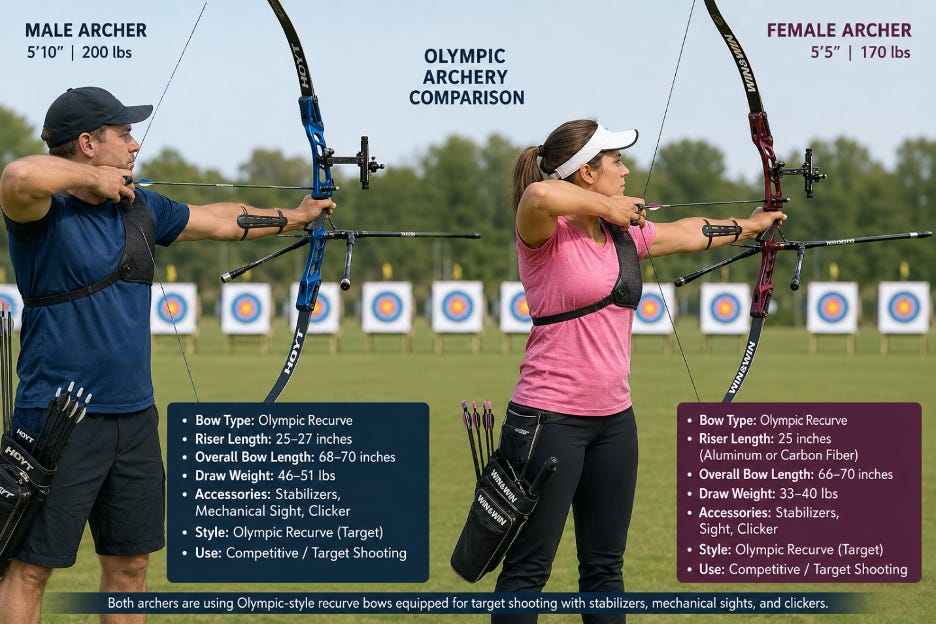
In archery, greater strength allows an athlete to use a bow with a higher draw weight. Higher draw weights produce faster arrow speeds, flatter trajectories, and less sensitivity to small errors in distance estimation or environmental conditions such as wind. In practical terms, stronger archers can use equipment that is more forgiving. In Olympic archery, men typically use bows with draw weights of about 45 to 55 pounds, while women typically use bows in the 35- to 45-pound range.
But lowering the draw weight for female archers does not necessarily eliminate the physical difference between the athletes.
Suppose a male archer has roughly 40 percent greater upper-body strength. A 46- to 51-pound bow may still represent a lower relative demand for him than a 33- to 40-pound bow represents for a female archer. Using midpoint values, the male archer’s 48.5-pound draw weight is equivalent to about 34.6 pounds after adjusting for his strength advantage. The female archer’s 36.5-pound draw weight, by contrast, remains a direct demand on her available strength.
So even when equipment is scaled downward, the female archer may still face greater relative strain. That matters most over repeated shots, when fatigue, postural stability, and the ability to hold steady at full draw become increasingly important.
Body size also matters. Males are, on average, taller, heavier, longer-limbed, and have more lean body mass than females (Hunter et al., 2023; Joyner et al., 2025; Tucker et al., 2024). In archery, a longer draw length allows more energy to be transferred to the arrow, increasing arrow velocity. In shooting sports, greater body mass can improve inertial stability, making the athlete less affected by small perturbations and better able to tolerate recoil. A larger body also means that the same draw weight represents a smaller challenge relative to body mass, which should make repeated draws less fatiguing.
Recoil is another factor that is easy to overlook.
In firearm shooting, especially in disciplines involving repeated or rapid fire with shotguns or centerfire rifles, the ability to absorb recoil and return the firearm efficiently to the target is critical. This is not merely theoretical. Anyone who has finished four or five rounds on a trap range, taking 25 shots per round, knows that even light shotshell loads and a relatively soft-recoiling shotgun produce a substantial cumulative impact on the shoulder.
For larger athletes with greater muscle mass and strength, it is simply easier to tolerate and stabilize against that repeated force, resulting in more consistent performance over time.
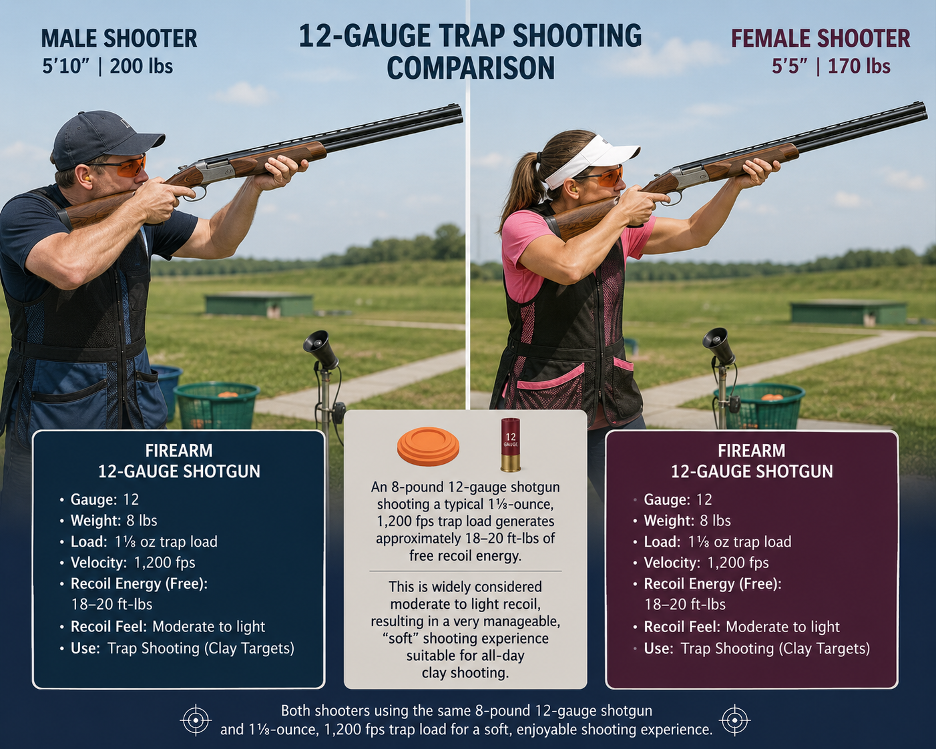
The shotgun and load may generate the same free recoil energy for both shooters, but recoil is not experienced equally by all shooters.
Over a 125-shot trap session, cumulative exposure can reach roughly 2,250 to 2,500 foot-pounds of recoil energy. For a 5-foot-10, 200-pound male shooter, that may remain manageable across the session. For a 5-foot-5, 170-pound female shooter, the same recoil impulse may feel sharper and become more fatiguing as the shots accumulate.
So even when the equipment is identical, and even when the recoil is objectively “moderate,” the physical demand is not identical. Body size, strength, shoulder anatomy, and fatigue can make the same shooting event meaningfully more demanding for one shooter than another.
None of this suggests skill does not matter. Of course it does. Precision sports require fine motor control, concentration, repetition, and discipline. There is also substantial overlap between individuals, meaning many females outperform many males.
But overlap does not negate average differences. Nor does it erase the effects those differences can have on performance.
Participation patterns in these sports reflect some of these realities. Archery and shooting sports remain predominantly male, both recreationally and competitively. That is evident in industry demographics, media coverage, and the makeup of most shooting ranges and archery clubs. Many factors likely contribute to this imbalance. But the physical demands associated with strength, stability, and fatigue resistance may help shape both initial participation and long-term retention.
Efforts to increase female participation are worthwhile. But available evidence suggests that many girls and women value female-only sporting opportunities. Eliminating female-only categories in shooting sports is therefore unlikely to increase female participation. In some cases, it may discourage it.
These patterns are not incidental. They reflect the same underlying physiological differences that shape performance in these activities.
The better conclusion is this: sports like archery and shooting are not strength-dominated, but they are strength-influenced.
Stability, fatigue resistance, and equipment handling all contribute to accuracy. And all are shaped, at least in part, by physical capacity. Those capacities differ, on average, between males and females.
It is true that in some archery and shooting competitions, male and female scores may appear similar. At first glance, that might suggest sex does not meaningfully influence performance in these sports. But similar outcomes do not necessarily mean identical underlying demands.
Given well-established differences in muscle mass, strength, and body size, female athletes likely need to operate closer to their physiological limits to achieve the same steadiness and control. They may require greater technical adaptation, more refined motor control, or more deliberate strategies for managing fatigue and equipment constraints, including lower draw weights or recoil compensation.
In that sense, similar scores may reflect different physiological costs rather than identical performance conditions.
This fits with a broader body of research showing that males outperform females across a wide range of physical performance measures, including strength, power, and endurance (Brown et al., 2025, 2026a, 2026b; Hilton & Lundberg, 2021; Hunter et al., 2023; Joyner et al., 2025; Lundberg & Menickelli, 2025; Tucker et al., 2024). These differences are not confined to obvious power sports. They matter in any activity where physical capacity influences performance, even indirectly.
After years behind bows, rifles, and shotguns, one lesson stands out: what looks like pure skill is often skill expressed through the body.
And the body matters.
The target does not respond to intentions or beliefs. It reflects the interaction between technique and physical capacity. Precision is not the absence of strength. In many cases, it depends on it.
If you enjoyed this free article, please consider upgrading to a paid subscription or making a recurring or one-time donation below to show your support. Reality’s Last Stand is a reader-supported publication, and your help is greatly appreciated.
If you enjoyed this article, you may also like…


I sometimes have to remind myself that, twelve years ago, the US was swept up in #MeToo, and we were all told we had to protect women from bad actors. Nowadays, women are forced to justify the restrooms they use, the facilities they enjoy and even the sports they play, and when they try they are called bigots. So in a little more than a decade, this nation went from "Believe women" to "Shut up, Karen."
The female sports category was created because males and females are different, with differences starting to develop in embryos long before birth.
That is the only reason necessary. If you're not a genetic female, you should be participating in another category.