



Reality’s Last Stand is a reader-supported publication. Please consider becoming a paying subscriber or making a one-time or recurring donation to show your support.

About the Author
James L. Nuzzo, PhD, is an exercise scientist and men’s health researcher. Dr. Nuzzo has published over 80 research articles in peer-reviewed journals. He writes regularly about exercise, men’s health, and academia at The Nuzzo Letter on Substack. Dr. Nuzzo is also active on X @JamesLNuzzo.
One of the most troubling trends in contemporary academia is the systematic attempt to erase or radically redefine ordinary language—especially words with clear, longstanding meanings. Critical, feminist, and queer theorists are driving much of this linguistic demolition, and their work should be called out plainly whenever possible.
Earlier this year, the academic journal Feminist Theory published a perfect example of this phenomenon: a paper titled “‘I’ve grown fearful of any rustle behind me’: defining anticipating discriminatory violence as violence.” It was written by three academics at Canadian public universities—Celeste E. Orr, Alessia Mastrorillo, and Nicholas Hrynyk—and supported by a federal grant from the Social Sciences and Humanities Research Council of Canada. In other words, taxpayers funded it.
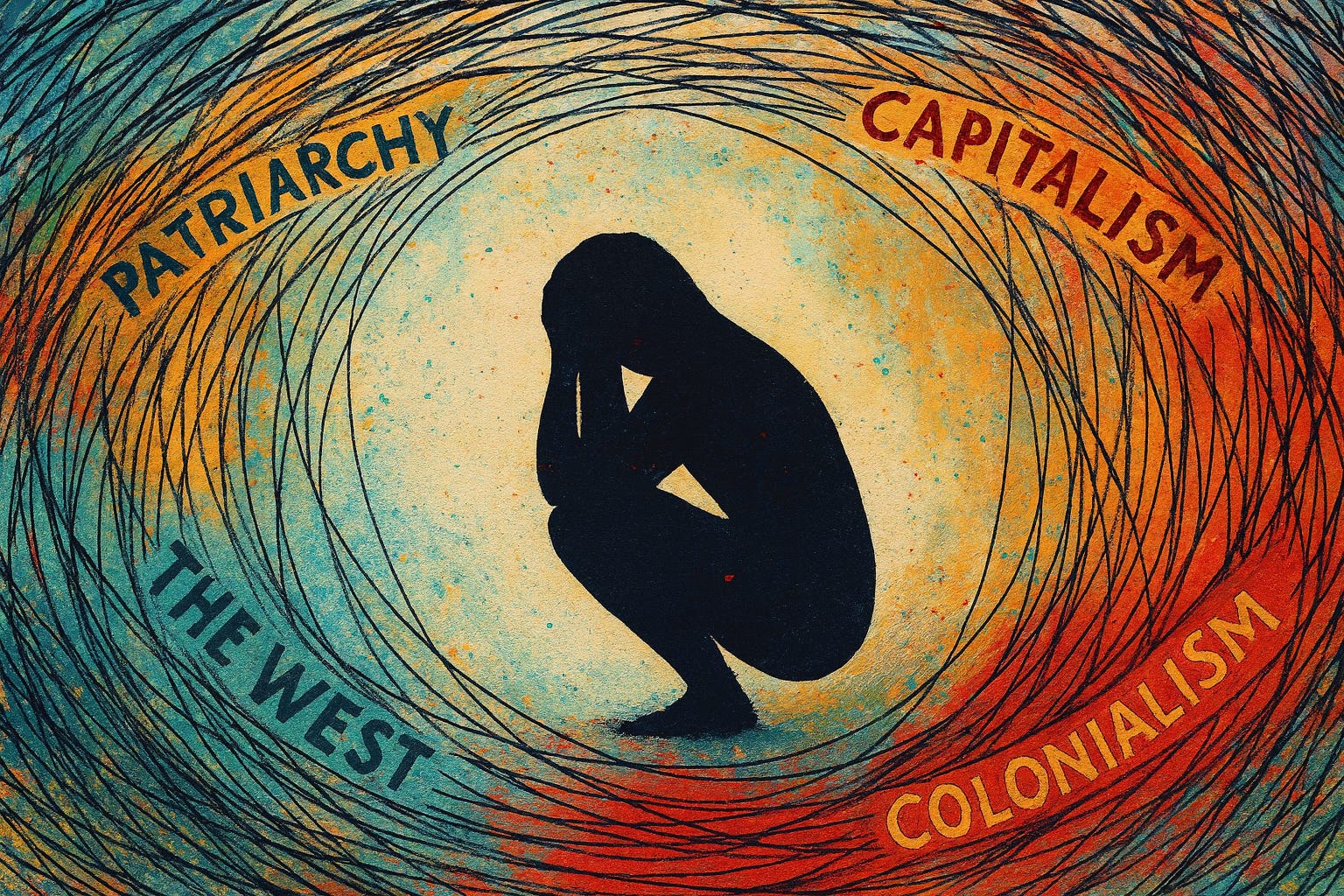
The authors advance a simple but astonishing claim: that “anticipating discriminatory violence is violence in and of itself.” They argue that violence need not involve an action, a perpetrator, or even intent. They contend that simply living in what they describe as a “Western capitalist cisheteropatriarchal” society is itself a form of violence, because such societies are “systems of oppression,” and therefore “[a]nticipating violence is the logical consequence of living under systems of oppression.”
Below are a few representative quotes from the paper:
We propose that violence does not require a clear intentional ‘actor’, and a clear ‘event’ need not have taken place. Rather, violence can (and does) occur via the seemingly innocuous and minute actions and discourses found in society and culture.
[F]irst we contest the common assumption that violence is intentional. The idea that violence needs to be intentional is a long-held myth that functions to deny various forms of violence. Second, we challenge the idea that violence requires a clear perpetrator. Systems of oppression and discriminatory ideologies enact violence, but there often is no clear perpetrator.
In short: fear equals violence, systems count as perpetrators, and the absence of an event does not matter.
Why This Idea Is Absurd
The authors’ premise collapses on contact with basic logic. Anticipating flying on an airplane is not flying on an airplane. Anticipating eating a banana is not eating a banana. Anticipation of a thing is, by definition, not the thing itself. This is why Orr and colleagues’ claim violates one of the foundational principles of logic: the Law of Identity. A cannot be B, and B cannot be A. If violence has not occurred, and may never occur, one cannot coherently claim that its anticipation is the event itself.
But the argument deserves scrutiny for several additional reasons: the authors’ salaries are publicly funded, their idea has support within academia given that it passed peer review, and if adopted into law or policy, their framework could have unpredictable and serious consequences. It also distracts from discussions about real violence—physical harm inflicted by real perpetrators—which societies actually do need to address.
What “Violence” Actually Means
The word “violence” already has a stable definition across major dictionaries. None of them include “anticipation”:
Merriam-Webster: the use of physical force so as to injure, abuse, damage, or destroy.
Britannica: the use of physical force to harm someone, to damage property, etc.
Collins: behaviour which is intended to hurt, injure, or kill people.
Cambridge: actions that are intended or likely to hurt people or cause damage.
A few patterns emerge immediately. Violence is a behavior or action that actually occurs. Several definitions explicitly include the element of intent, directly contradicting Orr and colleagues’ claim that intent is irrelevant. And all assume a perpetrator, because “behaviour,” “actions,” and “physical force” imply an actor by definition. Orr and colleagues reject all of these components.
By stretching the term beyond recognition, they are engaging in classic concept creep: taking a word that describes real danger and inflating it to cover feelings, beliefs, and imagined harms. In doing so, they drain the word of its clarity and usefulness, replacing it with a critical-theory definition that bears little resemblance to what ordinary people mean by violence—or how society needs to define it for laws and norms to work.
A Definition That Only Applies to Certain Groups
Definitions of words should apply universally. The definition of banana does not change based on who is eating it. The definition of racism does not (or at least should not) change based on who is involved. Orr and colleagues reject this principle.
Their expanded definition of violence applies only to “marginalised” groups and the discriminatory violence that they anticipate. They list:
“women/girls expecting violence from men/boys”
“2SLGBTQI + people expecting violence from cisheterosexual people”
“racialised people expecting violence from white people”
“colonised people expecting violence from colonists”
But their definition does not apply in reverse. A white, Asian, or Hispanic individual who fears discriminatory violence from a black individual does not count. A heterosexual woman who fears discriminatory violence from a “2SLGBTQI+” person does not count. In the authors’ words, only those “lodged within systems of oppression” qualify. Everyone else falls outside their reengineered definition of violence.
The authors are explicit that their definition of violence does not apply to groups who they believe are “privileged and powerful”:
Our conceptualisation of anticipated violence (as violence) is specifically to name the anticipated discriminatory violence that marginalised subjects experience living lodged within systems of oppression that devalue them, that seek to harm them or that seek to exterminate them. We want to underline this point because privileged and powerful people have and continue to leverage the spectre of anticipated violence to maintain systems of oppression and to keep oppressed groups ‘in their place’.
In the authors’ view, heterosexual women do not sit high enough on the intersectional victimization ladder to matter. Consequently, when it comes to men entering women’s bathrooms, they assert that women pose a greater threat to men (i.e., transgender women), not the other way around.
An Internal Contradiction About Perpetrators
Orr and colleagues contradicted themselves when they insisted that “anticipated violence” involves “no clear perpetrator.” The paper is filled with explicit descriptions of who they believe the perpetrators are.
Throughout the article, they identify entire categories of people supposedly responsible for maintaining “systems of oppression and discriminatory ideologies.” Their list is sweeping: “white settler coloniser, Christian, European/Western, heterosexual, cisgender, endosex, able-bodied, able-minded, wealthy, formally educated.” These are, in the authors’ framework, the agents behind the “violence” that marginalised groups anticipate.
The paper goes on to cite “police officers,” “politicians,” “right-wing counter-protestors,” “cis people,” and “various news and social media outlets” as forces that create or perpetuate anticipated discriminatory violence. And at one point, they explicitly name Donald Trump as a direct example of a perpetrator of “unwarranted anticipated violence.”
Potential Legal Implications
Orr and colleagues never say whether they want their idea to shape policy or law. But given the trajectory of similar academic ideas over the past decade, it’s worth considering the consequences because, if taken seriously, their framework could have real and unpredictable effects on people’s lives.
A reader might reasonably think: If “anticipated discriminatory violence” has no identifiable perpetrator, then no one could ever be charged with it. That would be a comforting assumption. I wouldn’t count on it.
We live in an era when judicial activism is rising and the guardrails of objective law are increasingly treated as optional. Critical and feminist theorists have shown little hesitation in bending legal categories to achieve political ends. If “anticipatory violence” ever found its way into legislation, the mental gymnastics required to assign blame would not pose much of an obstacle.
And of course, any such policy would be written to operate in only one direction. Those who identify as “marginalised” would gain the power to file complaints or press charges, and those same groups would be protected from having charges pressed against them. The asymmetry is the point.
This may sound far-fetched. But so, once upon a time, did many features of today’s cultural and political landscape, such as males being permitted to compete in women’s sports. Yesterday’s absurdity has a way of becoming today’s policy proposal.
A Distraction from Actual Violence
One of the most concerning consequence of the paper’s overly-inflated concept of violence is that it pulls attention away from real, measurable violence. Law enforcement, social workers, and courts already operate with strained resources. Redirecting those resources toward adjudicating “anticipatory violence” would inevitably reduce the capacity to address genuine threats to public safety.
Consider the actual landscape of violence in the United States: by far the most serious pattern is men killing other men. Most homicides are intra-racial. And among the inter-racial homicides that do occur, black offenders are more likely to kill white victims than the reverse. These are the large-scale, empirically documented patterns that any serious discussion of violence must grapple with.
Orr and colleagues never mention them.
Their paper contains no serious engagement with crime statistics, homicide data, or any of the hard numbers that define what violence actually looks like in the world. Instead, they focus on subjective fear, ideological narratives, and emotional states.
Conclusion
For thousands of years, humans have refined language to make sense of the world. We’ve drawn distinctions, coined terms, and built definitions that allow us to understand how one thing differs from another. Critical and feminist theorists show little appreciation for this inheritance. Their ongoing effort to dissolve objective meaning and replace it with politicized reinterpretations of ordinary words requires urgent and frequent pushback.
Orr and colleagues end their paper by claiming that “violence (anticipated or otherwise) is still a tricky concept and experience to grapple with.” I end mine more straightforwardly: No, it isn’t.
The lexicographers at Merriam-Webster, Britannica, Collins, and Cambridge have already defined the term with clarity and precision. Input from feminist theorists was never needed or asked for.
Thank you for supporting Reality’s Last Stand! If you enjoyed this article and know someone else you think might enjoy it, please consider gifting a paid subscription below.
If you enjoyed this article, you may also like…


"racialised people expecting violence from white people"
LOL! The only demographic being "racialised" in this phrase is "white."
For most of my life, I have been proud to be Canadian. But now, when I learn about nonsense like this, I feel ashamed.