



Reality’s Last Stand is a reader-supported publication. Please consider becoming a paying subscriber or making a one-time or recurring donation to show your support.

About the Author
Kristopher Kaliebe, MD, is a psychiatrist and Professor at the University of South Florida in Tampa. He is Board Certified in Psychiatry, Child and Adolescent Psychiatry, and Forensic Psychiatry. Dr. Kaliebe’s publications and presentations include the effects of digital technologies, gender, psychotherapy, corrections, mind-body medicine, nutrition, and mental health in primary care settings. He is concerned about naïve interventionalism in medicine. You can follow him on X at: @drkaliebe
This article originally appeared on the author’s Substack.
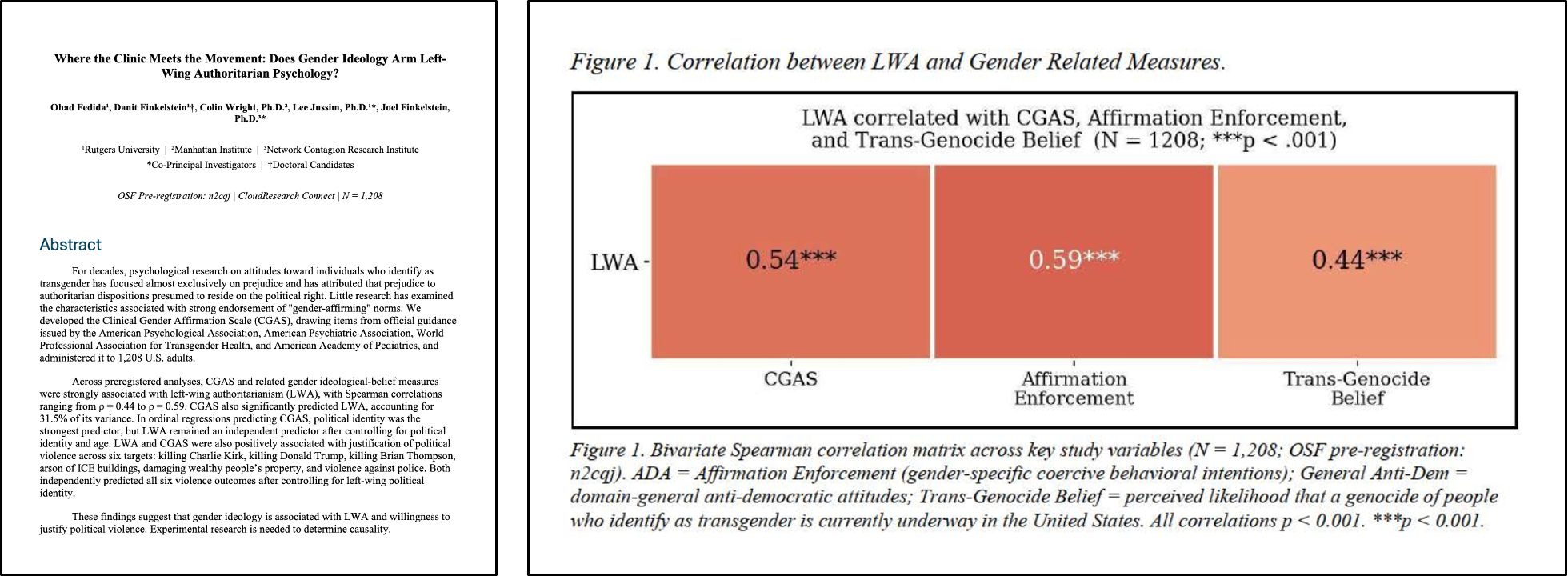
On September 30, NPR published “What’s behind HHS claims that gender-affirming care ‘may’ radicalize.” Its main subject is an August 2026 HHS survey linking “gender ideology” to left-wing authoritarianism.
NPR’s article reads as an attempt to defame the research, rather than report on it. The survey examined a question worth asking: Where the Clinic Meets the Movement: Does Gender Ideology Arm Left-Wing Authoritarian Psychology? It examines links between, and attitudes behind, coercive control coming from the left.
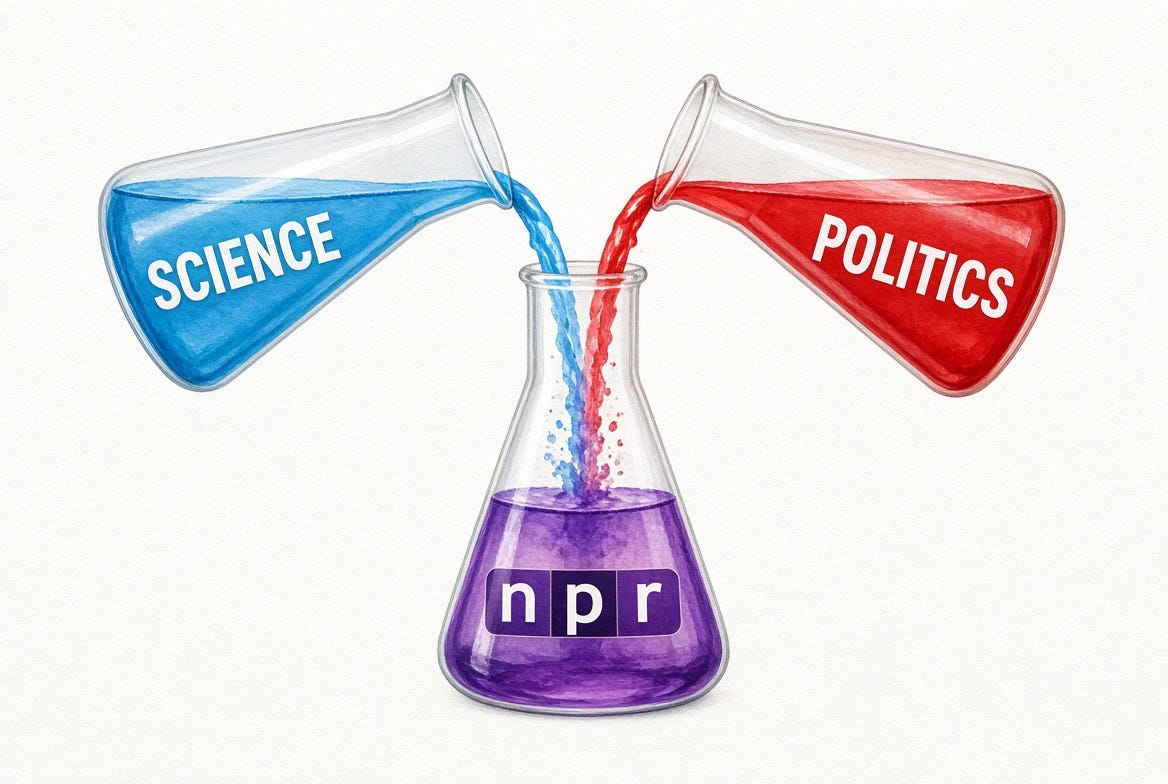
NPR’s charge is that politics is shaping government science. It faults the survey because it was “not peer reviewed” and its data and funding “have also not been made available.” Fair enough. It quotes Adrian Shanker, a former Biden-administration HHS official: “this administration seems to already have the answers for the reports they’re publishing before they start. And they’re partnering with politically-aligned researchers and think tanks to develop reports that meet a political conclusion rather than a scientific one.”
The report’s introduction describes left-wing authoritarianism as “aggression toward perceived oppressors, enthusiasm for top-down censorship and institutional enforcement, and hostility toward conventional social institutions—in short, an authoritarian disposition organized around left rather than right political content.”
Left-wing authoritarianism is a topic NPR would be sensitive about because, through selective reporting, editorializing in content presented as news, and morally elevating progressive attitudes, NPR itself may contribute to these precise authoritarian dynamics. NPR’s attempts to discredit research on this topic appear consistent with its role in the very phenomenon being studied.
It is fair to consider whether a government report is trustworthy when politicians announce the conclusion first, and then gather people committed to that conclusion to write the report. The best way to judge a report is by its content: examine the quality of the logic, analyze the citations, debate the report’s conclusions, and find errors. Sadly, NPR applies skepticism regarding political influence on government reports in only one direction.
Even more upsetting, HHS has placed gender ideology over science under administrations of both parties, with terrible consequences. Internal documents I reviewed for an expert report in Boe v. Marshall show HHS research offices inviting only aligned advocates, turning away detransitioners and parents, and declining a systematic review after being told the evidence in adolescents was missing.
What NPR Says About the 2025 HHS Review
NPR also takes aim at the 2025 HHS review, Treatment for Pediatric Gender Dysphoria: Review of Evidence and Best Practices. It says the review was “originally released in 2025 without peer review or named contributors,” was “mostly authored by well-known advocates against gender-affirming care,” and “included no contributors from major medical groups.”
To borrow a line from NPR’s own story, “originally” is doing important work in that sentence. NPR leaves out that the final report was peer-reviewed and that HHS named its authors on November 19, 2025. I am one of them. I am a member of the American Academy of Child and Adolescent Psychiatry and the American Psychiatric Association (APA), and co-author Kathleen McDeavitt, MD, is also a psychiatrist and APA member. We did not write on behalf of those organizations, but the claim that the authors had no ties to major medical groups is not accurate.
The 2025 review’s core is an umbrella review of systematic reviews. That is the same kind of evidence assessment used by health authorities across Europe that led them to restrict pediatric medical transition (PMT). NPR mentions none of that. It says only that doctors “have worked to debunk the ‘low-quality’ claim.” Its evidence for that is that many clinical recommendations would also be classified as resting on low-quality evidence. That is not a rebuttal. It concedes the point. In effect, it makes a misleading comparison by placing elective and experimental sex-change procedures in the same evidentiary category as treatments for serious medical illness like bone fractures and cancer.
NPR continues to mislead the public.
Meanwhile, NPR states that gender-affirming care is “the accepted medical and mental health standard of care.” It also reports that “major medical associations have repeatedly confirmed” it is the best model.
Those are dubious claims, presented as settled facts. I have already written elsewhere about legal activism and the corruption of open scholarly discourse at American medical associations. Medical organizations fused with an ideological movement, filled their panels and committees with activist physicians, stigmatized those raising concerns, and never debated pediatric medical transition or social transition in their journals. The result is a manufactured appearance of consensus through the suppression of scholarly discourse, as I detail in my initial expert report in Boe v. Marshall (pp. 27–51).
NPR’s sources include a former Biden HHS official, two academics, an anonymous HHS staffer, and an attorney with the Transgender Law Center, a co-author of a deceptive Southern Poverty Law Center report. That SPLC report targets those who resist gender ideology or call for evidence-based medicine by stigmatizing them as “hate groups.” Isn’t that an embodiment of left-wing authoritarianism? Shouldn’t NPR be curious about the SPLC’s role in the very phenomenon studied?
The only person quoted defending the HHS work is one of its own authors. NPR also had to append a clarification correcting its own claim about the evidence on violence.
Now Run NPR’s Test on SAMHSA
In October 2015, SAMHSA issued Ending Conversion Therapy: Supporting and Affirming LGBTQ Youth. Apply Shanker’s test to it.
The politics came first. On April 8, 2015, White House adviser Valerie Jarrett wrote that “the overwhelming scientific evidence demonstrates that conversion therapy, especially when it is practiced on young people, is neither medically nor ethically appropriate and can cause substantial harm,” and that “this Administration supports efforts to ban the use of conversion therapy for minors.” By SAMHSA’s own account, “in early April 2015,” SAMHSA and the American Psychological Association “agreed to collaborate” on the report (p. 9). On April 14, Representative Jackie Speier, flanked by the Human Rights Campaign and the National Center for Transgender Equality, called the practice “abusive quackery masquerading as medicine.”
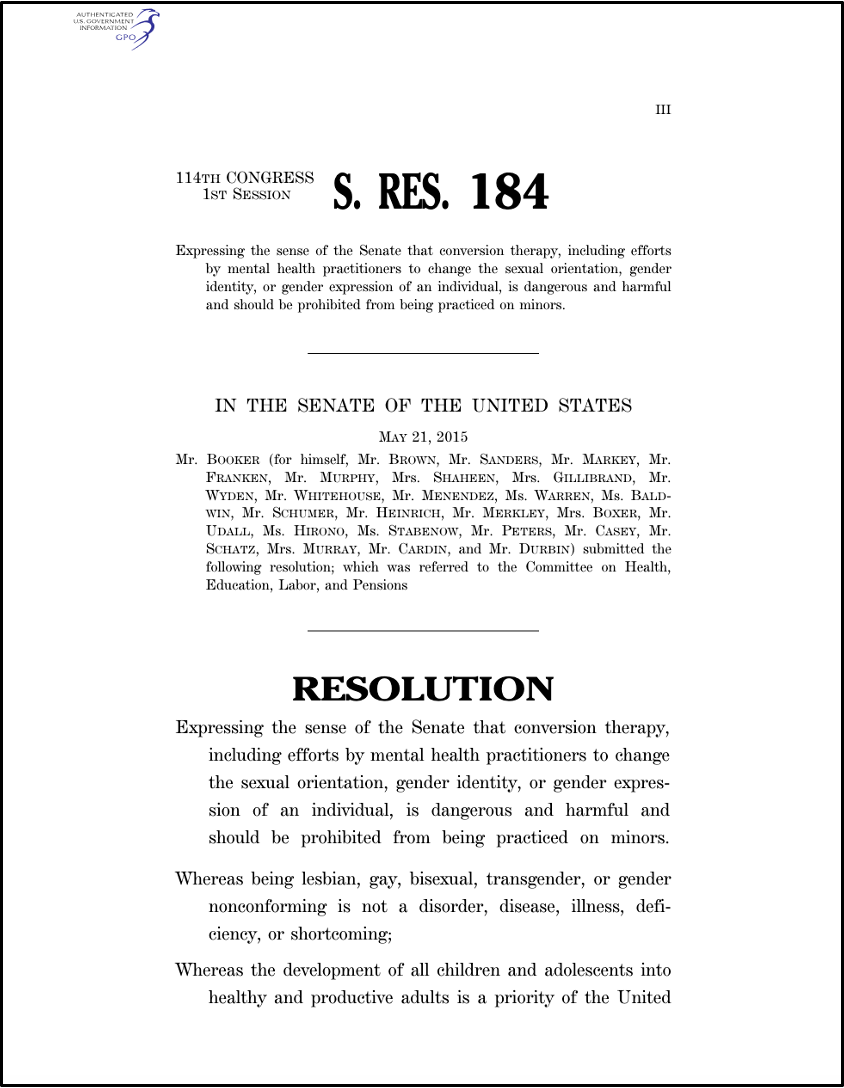
On May 21, Senator Cory Booker introduced S. Res. 184, which defined conversion therapy to include efforts to change “gender identity, or gender expression” and declared it “dangerous and harmful.” Two days earlier, on May 19, Representative Ted Lieu had introduced the Therapeutic Fraud Prevention Act, which would classify commercial conversion therapy aimed at sexual orientation or gender identity as fraud. His partner organizations included the American Academy of Pediatrics, the Human Rights Campaign, the National Center for Lesbian Rights, and the Southern Poverty Law Center. The expert panel did not meet until July 7–8.
The panel was assembled around existing positions. By 2015, the American Psychological Association was already organizationally committed to this ideological project and drew up its list of needed expertise from “existing professional guidelines and resolutions”. They invited “experts” who then nominated others (p. 9). Thirteen people sat on the panel: ten psychologists, two social workers, and one psychiatrist. They included Scott Leibowitz, Laura Edwards-Leeper, and Marco Hidalgo, practitioners of the pediatric gender pathway the report would call appropriate, and Caitlin Ryan, whose Family Acceptance Project supplied the family model the report adopted. The panel also included Mark Yarhouse and Sheri Berenbaum, so it was not uniform. Consensus required only 80 percent agreement, and unanimity was reached in “nearly all instances” (p. 9).
We do not know whether these two members pushed back against the gender identity-related provisions, but even if they did, they would have been outvoted. Observers from LGBTQ human-rights organizations attended. Shanker was concerned about reports influenced by ideologically aligned groups; what about this SAMHSA report?
Critically, this report changed the definition of “conversion therapy.” Conversion therapy previously meant attempts to change sexual orientation. It now morphed into meaning that psychotherapy that helps people come to peace with their body is conversion therapy. There was no review of the evidence on “conversion therapy” for gender identity, but it was claimed to be a harmful process. Psychotherapy for gender identity as conversion therapy is the Trojan horse that underpins much of the changes in clinical practice and across society for the next decade. (See concept creep)
The report also did not soberly review the scant evidence on puberty blockers, hormones, or surgery. Even so, it declared that “social transition and medical intervention are therapeutic approaches that are appropriate for some gender minority youth” (p. 3).
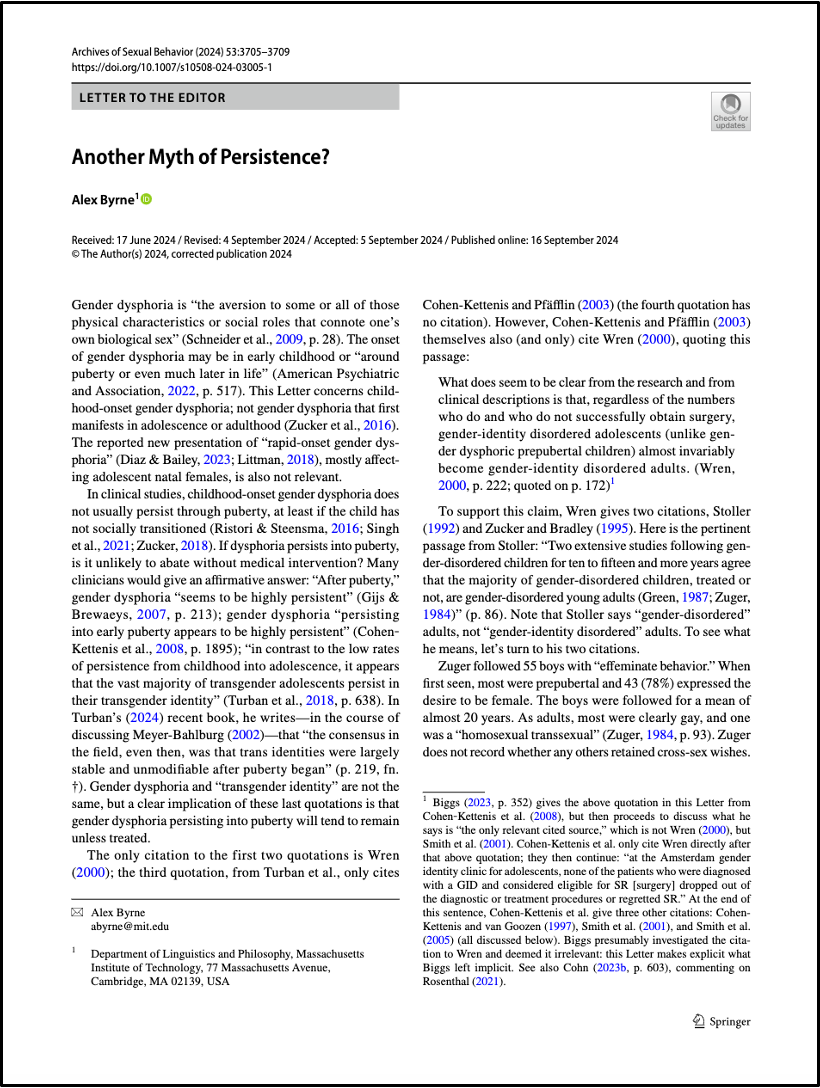
The report’s key premise was persistence: gender dysphoria that worsens at puberty “is unlikely to remit,” and “long-term identification as transgender is likely” (p. 2). It cited professional guidelines and task-force reports to support this. It did not cite long-term outcome studies, because the few that do exist do not support this claim. The theory that gender dysphoria in adolescents leads to long-term transgender identification must hold for both conversion-therapy bans and pediatric medical transition to make sense. It has not held up. See Byrne, “Another Myth of Persistence?”, published in Archives of Sexual Behavior in 2024.
Then the politics came back.
On October 15, Jarrett held a press call on the finished report and said the administration had supported “making it illegal for young people.” In February 2016, Booker, Patty Murray, Speier, and Ted Lieu asked the Federal Trade Commission to treat the practice as fraud. Helping young people accept their sexed bodies was now being framed as fraud, based on this SAMHSA report.
The Same Pattern Inside HHS
HHS did not stop at a 2015 consensus report. Discovery in Boe v. Marshall shows that its research offices kept choosing their audience and declining the review, under the first Trump administration and then under the Biden administration (Kaliebe Supp. Report, ¶¶ 113–161).
On October 22, 2019, the NIH Sexual and Gender Minority Research Office held a listening session and included the Human Rights Campaign, the Trevor Project, Fenway Health, the UCSF transgender center, the National Center for Lesbian Rights, GLSEN, the Center for American Progress, and similar groups. A week earlier, the Kelsey Coalition—parents of gender-nonconforming children who were harmed by medical transition—and a detransitioner who said he represented a community of more than 2,000 asked to be heard. The office replied that invitations were closed, and that the session would not include a detransitioner. The November 2020 session still did not include them. In May 2021, after Gender Health Query asked again to discuss children “undergoing experimental medical treatments that sterilize them,” the office changed the format to a written request for information (Supp. Report ¶¶ 115–152).
HHS also failed to acknowledge a lack of evidence supporting social transition or pediatric medical transition. The American Academy of Family Physicians had asked the Agency for Healthcare Research and Quality (AHRQ) to review the evidence on puberty blockers, hormones, and surgery in adolescents. On September 1, 2020, Karen Robinson, who led the Johns Hopkins review for WPATH’s Standards of Care 8, told Christine Chang, an associate director at AHRQ, that her team “found little to no evidence about children and adolescents,” and that WPATH was “trying to restrict our ability to publish.” In January 2021, AHRQ declined to conduct the review, pointing to an existing review protocol, which was Robinson’s own (Supp. Report ¶¶ 155–158).
In the spring of 2022, Admiral Rachel Levine, then HHS Assistant Secretary for Health, told NPR that “there is no argument among medical professionals” about the value of gender-affirming care. NPR did not question the dubious claim. When NPR revisited that quote in January 2025, it noted that prominent physicians, including Hilary Cass, had since called for caution. WPATH leaders knew better then. Privately, they called Dr. Levine “our best cheerleader” and agreed not to contradict Dr. Levine’s false pronouncements. Other internal documents acknowledge that “a global consensus on ‘puberty blockers’ does not exist” (Supp. Report ¶ 110).
In 2020, HHS was told that WPATH’s own evidence team found little or no evidence supporting PMT in adolescents. Through the end of the Biden administration, HHS continued to promote both pediatric medical transition and social transition, downplaying risks and overstating potential benefits.
NPR, to this day, parrots this misinformation. Who is being political?
One Standard
The SAMHSA conversion therapy report was commissioned after a political pledge, written by clinicians whose model it endorsed, and quietly inserted a Trojan horse that justified social transition and pediatric medical transition. In doing so, it endorsed coercively remaking society by prioritizing gender identity over biological sex, an ideological endeavor.
Activist groups, professional medical organizations, and the federal government fused. A well-meaning effort to push back against homophobia and to help gender-nonconforming young people became the vehicle to empower a divisive ideology that has harmed children, damaged trust in medicine and psychiatry, and spread strife well beyond the clinic.
Now that the public has pushed back and many states have enacted legislative restrictions, these same organizations cry that politics should stay out of clinical care. The medical organizations should have considered the effects of politics on medicine in 2015, and over the next decade, as they politicized this issue, creating a false appearance of consensus by stacking tender panels/committees, suppressing debate, denouncing those urging caution, calling it consensus and claiming those opposed are politically motivated.
One of the signers, the American Academy of Family Physicians, is the same organization that asked HHS in 2020 for a systematic review of puberty blockers, hormones, and surgery in adolescents. AHRQ declined, and HHS did not complete such a review until 2025. Yet the AAFP now invokes “evidence-based standards of patient care” to push back against what they claim is political interference.
By comparison, the recent HHS report NPR criticizes makes tempered claims about left-wing authoritarianism. It’s fine to debate the merits of that report; it is also fine to debate whether NPR has been a tool of left-wing authoritarianism:
Did NPR stigmatize and attempt to marginalize those who would not go along with gender ideology?
Did NPR promote left-wing authoritarianism in government policies, the courts, schools, and universities?
Did NPR harm children by its lack of honesty about the known risks and benefits of PMT?
Does NPR believe that free speech and open exchange of ideas on gender is tolerable in our society?
“In the end the Party would announce that two and two made five, and you would have to believe it.” ~ George Orwell, Nineteen Eighty-Four
RLS Readers: Save 50% on SEGM’s 2026 Conference
The Society for Evidence-Based Gender Medicine (SEGM) is bringing leading researchers, clinicians, patients, parents, and legal experts to Washington, DC, November 5–7, for its 2026 conference, “Rethinking Youth Gender Medicine: Charting a Path Forward.”
Over three days, speakers will examine what the evidence on youth gender medicine actually shows, where important uncertainties remain, and what ethical and responsible care should look like going forward.
SEGM has generously extended a special 50% discount to Reality’s Last Stand readers on both in-person and livestream tickets! Use promo code RLS-SAVE50% when registering.
This special rate may not last forever, so register soon if you plan to attend.

If you enjoyed this free article, please consider upgrading to a paid subscription or making a recurring or one-time donation below to show your support. Reality’s Last Stand is a reader-supported publication, and your help is greatly appreciated.
If you enjoyed this article, you may also like…


NPR and the politicization of science: that’s some heavy Venn diagram overlap.